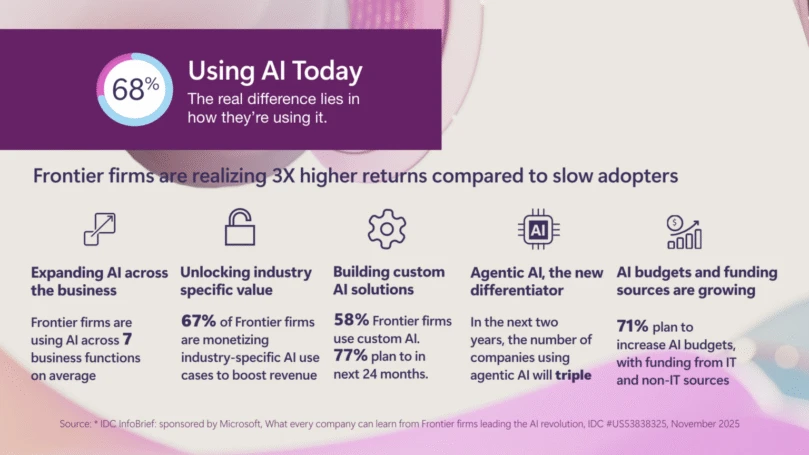
AI is now one of the main catalysts of workplace transformation, rapidly reshaping industries as its momentum accelerates. According to the IDC Business Opportunity of AI Study, with an average ROI of $3.70 for every $1 spent and top leaders in the adoption cycle seeing returns as high as $10.30X1, the business case for AI is only getting stronger.
Increasingly, Frontier Firms—those at the leading edge of innovation and productivity—are demonstrating how AI can unlock new levels of competitive advantage. However, realizing this potential goes beyond simply deploying tools and solutions; it requires a continuous, enterprise-wide strategy that aligns skill-building with broader business priorities. As these organizations continue to transform, new skills and capabilities will inevitably become essential.
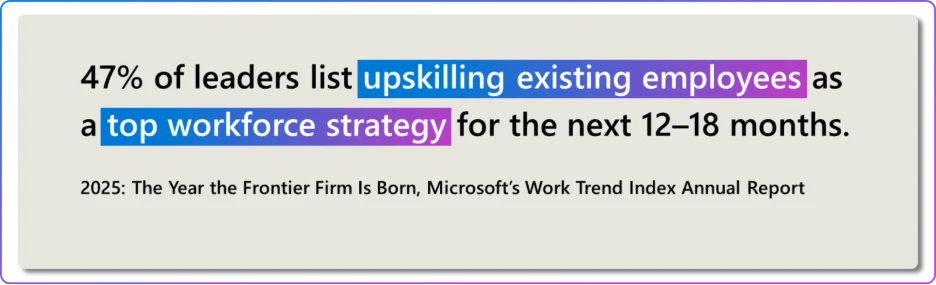
For Frontier Firms, AI skilling is a continuous investment, as well as an integral job requirement. In our conversations with customers, many have indicated they expect their employees from all disciplines to spend 10–20% of their work week on learning and integrating AI into their daily work to deliver the most impact.
At Microsoft, we’ve seen firsthand how creating a culture of continuous AI learning empowers employees, and we shared our insights in our previous blog, “Accelerate employee AI skilling: Insights from Microsoft.” Now, we’re shifting the spotlight to our Frontier Firm customers—drawing key takeaways from the skill-building strategies they’re using to turn ambition into adoption with an AI-ready workforce that drives innovation.
1. When leadership champions AI learning, the whole organization moves faster
Executive alignment plays a pivotal role in shaping how AI adoption takes hold. When leadership drives the learning agenda and anchors it in business strategy, it sets the stage for cultural change. One of the most effective ways to do this is through cross-functional collaboration that connects governance, priorities, and impact. We’ve seen this play out at organizations where leaders are shaping AI strategy through unified, cross-functional action.
Customer highlight: Bupa APAC is driving smarter healthcare solutions with an AI-ready workforce and Microsoft Copilot
With AI reshaping healthcare, Bupa APAC saw an opportunity to make customer experiences more seamless, proactive, and personalized—from automating claims processing to developing preventative care plans tailored for individual needs. Bupa created a Center of Enablement that aligned risk, legal, technology, and business teams to develop a unified approach to responsible AI use. This early collaboration ensured alignment between AI ambition and the needs of different functions, laying the foundation for a tailored, role-based skilling strategy supporting the business priorities. It developed an AI skilling strategy and created a structured environment for AI experimentation, using Microsoft 365 Copilot, GitHub Copilot, and other AI-powered tools to automate tasks, refine workflows, and improve efficiency. Bupa upskilled its workforce with Microsoft 365 Copilot and GitHub Copilot, generating more than 410,000 lines of AI-assisted code, initiating more than 30,000 Copilot chats, and accelerating more than100 AI use cases to improve care.
AI is a critical part of our transformation, but technology alone isn’t enough. Our focus has been on building the right skills and governance to make AI effective across the organization.
—Akhil Mittal, Cloud Platform and DevOps Manager, Bupa APAC
The Bupa APAC example reinforces how a top-down AI strategy that embraces a culture of learning creates clarity and a shared purpose across teams—equipping employees to not only understand but also act on AI goals. For leaders thinking through their own approach, explore Creating an AI Learning Culture: Five considerations to empower teams with AI skills that can guide you and inspire a skills-first mindset.
Creating an AI learning culture

2. Tailored learning builds confidence and drives adoption
No matter how you encourage workforce experimentation and AI learning, one principle remains essential: generic training rarely leads to real behavior change. A tailored approach targeted to individual skill levels and job requirements is essential. Employees are far more likely to adopt AI when they understand how it applies to their day-to-day work. This clarity doesn’t just drive individual confidence, it empowers employees to solve problems faster, service customers better, and contribute to outcomes that matter to the business. Leading organizations offer a compelling example of how connecting learning to everyday responsibilities can power transformation at scale.
Customer highlight: Commonwealth Bank invests in AI skills and Microsoft Copilot to drive innovation
As customer expectations rise, Commonwealth Bank of Australia (CommBank) seeks to harness AI to develop smarter, more secure, and highly customized banking experiences at scale. Recognizing that AI’s full potential depends on workforce readiness, CommBank launched a structured skilling initiative to equip employees with the knowledge and tools to apply AI effectively across the organization. CommBank embedded AI skilling across all levels of the organization through three structured learning paths:
- Leading with AI equips executives and senior leaders with the skills to guide AI adoption strategically, facilitating responsible implementation and alignment with business priorities.
- Working with AI provides employees across departments with practical training to use AI-powered tools like Microsoft 365 Copilot to improve productivity and assist decision-making.
- Building with AI develops technical expertise among engineers, data scientists, and developers—offering specialized learning with tools like GitHub Copilot and Microsoft Power BI to create AI-powered solutions.
AI skilling has equipped employees to adopt AI effectively, with 84% of 10,000 Copilot users reporting they wouldn’t go back to working without it and approximately 30% of GitHub Copilot code suggestions adopted—driving efficiency and smarter decision-making.
With Microsoft 365 Copilot, early adopters reported saving 16% of their time by reducing repetitive tasks, allowing them to focus on more meaningful work and bring their best selves to what they do.
—Dan Jermyn, Chief Decision Scientist, CommBank
As the CommBank story shows, when AI learning is tailored to specific skillsets and the day-to-day realities of work, it becomes a catalyst for impact. From the frontlines to leadership, employees gain the confidence to use AI in ways that enhance productivity and customer value. For organizations looking to jumpstart team training and close skills gaps with tailored learning, we recommend the Microsoft Learn for Organizations.
3. Generating organizational momentum is possible through peer-led learning communities
Pairing learning programs with peer-driven communities helps amplify early wins, reinforces skills, scales momentum, and transforms individual learning into collective progress. These communities thrive when employees have space to share real use cases, ask questions, and learn alongside trusted peers. It’s a model that brings learning to life, and one that is gaining traction with organizations around the globe.
Customer highlight: AI and the human advantage: Adecco Group’s AI skilling strategy fuels productivity with Microsoft Copilot
Recognizing AI’s evolution and its impact on work prompted Adecco to provide AI skills to employees and job seekers. To stay competitive, it aimed to embed AI into operations while ensuring its workforce had the expertise to use it effectively.
The company embedded AI across operations to automate tasks and improve decision-making. Through an internal AI operations team, training, microlearning, and Copilot, Adecco is equipping its employees with skills to apply AI effectively in daily work and client interactions.
To support internal enablement, The Adecco Group created the AI Influencer Community, where employees engage with AI experts, share use cases, and explore best practices. In parallel, the company collaborated with Microsoft and worked closely with its Akkodis Tech Academy (a Microsoft Training Services Partner) on AI upskilling programs. These efforts have been deployed in 12 countries, training more than 12,000 employees in AI fundamentals, data analytics, and other critical digital skills, helping teams work more efficiently, support evolving client needs, and contribute to solution development.
Skilling is really important for us because people are at the heart of our organization. We have a responsibility to ensure our people have the skills to engage with AI, use new tools, and embrace new ways of thinking.
—Caroline Basyn, Chief Digital and Information Officer, The Adecco Group
What stands out from Addeco’s experience is that scaling AI fluency didn’t hinge on formal programs alone—it grew from within. By allowing employees to learn from each other and explore AI together, you can create a more sustainable, community-powered model for adoption. This is a reminder that the most powerful adoption strategies empower connection and shared curiosity.
Bringing it all together to build an AI-ready workforce
When considering these examples, a pattern emerges. Organizations leading in AI fluency aren’t simply adopting tools, they’re building the conditions for their people to thrive with them. While every organization requires its own unique approach, learning from current successes and adapting for your specific goals and workforce is key to achieving results.
To help you advance your organization’s AI skilling efforts, we’ve created the AI Skills Strategy: The Starter Guide, a reflection tool to plan strategic conversations around AI skill-building. This guide is designed for the earliest stages of AI skilling strategy development before a formal plan is in place. It helps you clarify your skilling purpose, identify key stakeholders for all learning initiatives, and begin uncovering where skilling efforts can deliver the most value. By working through these high-level questions, you and your team can align shared goals and lay the groundwork for a tailored, adoptable AI skilling approach that can help you accelerate your organization’s AI growth and reach your business goals.
1 IDC InfoBrief, Sponsored by Microsoft, Business Opportunity of AI, IDC #US52019124, November 2024