
SSRF impact in cloud environments: Beyond network reachability
Server-Side request forgery (SSRF) represents a significant vulnerability class in cloud-hosted services because it directly intersects application behavior with cloud network and identity systems. In the most common case, SSRF is an application-layer vulnerability in which a service accepts user-controlled input and uses it to initiate outbound requests from its own execution context. Although SSRF-like behaviors can also arise in lower-level platform or networking components, cloud environments frequently amplify the impact of these vulnerabilities through their reliance on internal network and identity systems.
As Microsoft’s cloud services expanded in scale and architectural complexity, SSRF began to emerge as a recurring and high-impact vulnerability class across multiple product verticals. Through coordinated vulnerability disclosures and internal investigations, MSRC observed a consistent pattern: SSRF issues were not isolated implementation mistakes, but symptoms of a broader challenge inherent to cloud environments. Cloud services routinely make outbound requests as part of normal operation, operate with broad network egress, and rely on internal HTTP-based control planes and identity services that are only reachable from within the environment. Where SSRF risk is present, these characteristics can amplify impact, allowing a single flaw to cross application, network, and identity trust boundaries.
While SSRF remains an important vulnerability class for cloud service providers to address, modern cloud environments incorporate multiple layers of protection across applications, networks, and identity systems to help reduce both the likelihood and impact of these vulnerabilities. Microsoft continues to invest in these controls across its services, and the guidance in this blog post reflects lessons learned from vulnerability reports, service investigations, and engineering practices.
In response, Microsoft developed secure-by-default anti-SSRF code libraries, informed by MSRC research and real-world reports. The goal was to codify proven SSRF defenses into a durable, reusable control that engineering teams can adopt to apply protections more consistently, reduce common implementation mistakes, and help limit the impact of future vulnerabilities. Open-source versions of the libraries are available on GitHub with trusted package artifacts across platforms published to popular package registries.
This blog establishes a clear, cloud specific view of SSRF. We define what SSRF is, explain why its impact can be amplified in cloud-hosted services, and outline how MSRC assesses its severity when identity, privilege, and internal reachability are at stake. We then present mitigation guidance grounded in real-world vulnerability reports and service investigations, including lessons that led to the development of the anti-SSRF libraries. That work reflects a shift from isolated fixes toward consistent, durable controls designed to reduce SSRF risk at scale across cloud services.
What is Server-Side Request Forgery (SSRF)?
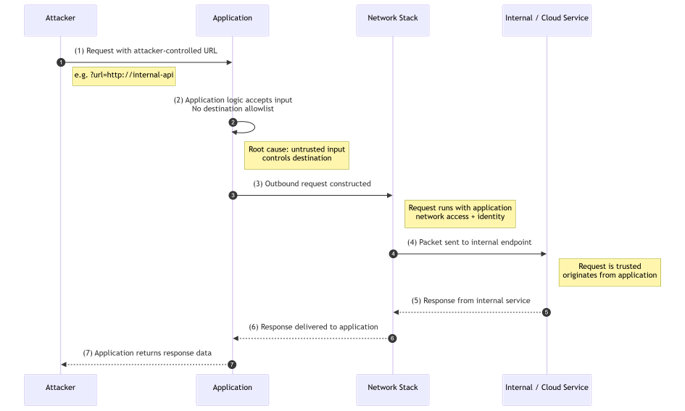
SSRF is a vulnerability in which a flaw in a server is abused to make outbound network requests based on attacker-influenced input. Instead of the attacker directly accessing a target resource, the application is tricked into issuing the request on the attacker’s behalf. The request originates from the server’s execution context and inherits its network access, identity, and trust relationships.
SSRF typically appears in features that fetch remote resources, such as URL previews, webhooks, file imports, or service-to-service calls. When input, determining the destination of those requests, is not strictly constrained, an attacker can redirect the request to unintended targets. These targets often include internal services, local interfaces, or infrastructure endpoints that are not accessible externally.
The security impact of an SSRF bug depends on both the request itself and what the server can reach. In cloud environments, this frequently includes access to internal control plane or identity-related endpoints, allowing SSRF to escalate from a request, forgery issue into credential exposure or privilege misuse.
At its core, SSRF exploits misplaced trust: internal systems trust requests originating from an application, and the application trusts user input to determine where those requests go.
Common root causes of SSRF
1. Untrusted input determines request destination
SSRF occurs when user‑supplied data is used to influence where a server sends outbound requests, without enforcing strict destination constraints.
2. Outbound requests execute with application privilege
The request runs inside the application’s execution context, inheriting its network reachability, identity, and trust relationships.
3. Implicit trust in internal reachability
Internal services often trust requests originating from within the service’s trust boundary, treating them as safe because they originate from a known, trusted application.
4. Lack of centralized destination validation
Ad‑hoc or inconsistent URL validation allows bypasses through redirects, alternate encodings, or unexpected protocols.
5. Feature‑driven request behavior
SSRF is commonly introduced through legitimate functionality, such as URL fetching, webhooks, or service‑to‑service calls, where outbound requests are required by design.
6. Absence of defense‑in‑depth controls
When application‑layer validation is not reinforced by network and identity‑level restrictions, a single flaw can cross multiple trust boundaries.
Why SSRF has elevated impact on cloud services
SSRF has a disproportionate impact on cloud services because cloud platforms, by design, expose sensitive control and identity mechanisms over internal, HTTP based endpoints.
Cloud workloads routinely rely on the instance metadata service (IMDS) to obtain configuration details, network information, and short-lived identity credentials at runtime. These endpoints are unauthenticated at the protocol level and are reachable only from within the execution environment, under the assumption that network locality implies trust.
Where an SSRF vulnerability is present, that assumption breaks down: attacker-controlled input abuses the application to issue requests to metadata endpoints, allowing access to identity tokens and other security critical information that was never intended to be exposed externally.
Unlike traditional environments, where internal services are often protected by explicit authentication and static credentials, cloud services emphasize dynamic identity and broad egress to enable scale and automation. As a result, a single SSRF flaw can escalate beyond internal data access into credential exposure and privilege misuse, significantly increasing blast radius.
This tendency to tighly couple outbound request behavior, identity issuance, and implicit trust in internal reachability is what makes SSRF particularly severe in cloud hosted services.
How MSRC assesses SSRF severity
SSRF findings are evaluated by determining what data or resources become accessible through the forged request and whether that access crosses security or tenant boundaries. An SSRF vulnerability is generally assessed as Critical when it enables access to highly confidential data, including sensitive internal service information or data belonging to another customer or tenant. SSRF vulnerabilities that expose only confidential service-internal data, without cross-tenant impact, are typically assessed as an Important severity instance. Findings that only allow access to non‑sensitive internal information or access ports that should not be open, may be assessed as a Moderate severity instance, while blind SSRF that can only perform port scanning is rated as a Low severity instance.
In addition to data classification, MSRC also considers exploitability factors, such as whether authentication is required and how easily the behavior can be triggered, when determining final severity. This impact‑driven approach ensures SSRF issues are assessed consistently across online services, based on real security risk rather than the presence of SSRF alone.
| Data Classification | Severity | Description |
|---|---|---|
| Highly Confidential |
Critical
|
Cross‑tenant information disclosure or elevation of privilege after reaching internal servers
|
| Confidential |
Important
|
SSRF vulnerability sending requests to sensitive internal endpoints that leak sensitive information or performs a sensitive action
|
| General |
Moderate
|
Blind SSRF reaching ports that should not be open
|
| Public |
Low
|
Blind SSRF that is only used for port scanning
|
SSRF mitigation guidance
Client‑side guidance (Request construction and validation)
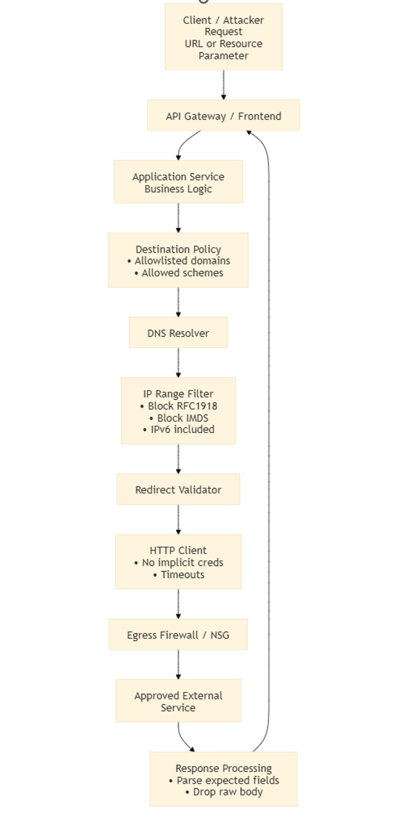
1. Validate all user‑influenced URL components
Any variable used to construct a URL must be treated as untrusted input if it can be influenced by a user. This includes full URLs, hostnames, subdomains, resource names, and workspace identifiers.
2. Apply validation consistently to all endpoints
These controls apply equally to customer‑facing and internal endpoints. Internal‑only usage does not reduce SSRF risk and must not be treated as a trust boundary.
3. Perform DNS resolution before sending requests
User‑tainted URLs must be resolved to IP addresses prior to request execution to ensure they do not map to internal, loopback, link‑local, or otherwise sensitive address ranges. This validation must include IPv6 equivalents, not just IPv4.
4. Defend against DNS TOCTOU conditions
DNS resolution and request execution must be tightly coupled to avoid time-of-check/time-of-use issues, to avoid the risk where a hostname resolves to a safe address during validation but changes before the request is sent.
5. Re‑validate destinations after redirects
Any HTTP redirect must trigger a full re‑validation of the new destination. Redirect chains are a common SSRF bypass when validation is only applied to the initial URL.
6. Restrict outbound network traffic
Outgoing requests should be filtered to limit reachable destinations and prevent access to sensitive internal services. Network‑level controls provide critical defense‑in‑depth when application‑level validation fails.
7. Demonstrate compliance through testing
Services must verify adherence to these requirements using the prescribed compliance tests and validation scenarios, ensuring defenses are effective in practice and not just in design.
8. Follow additional best practices
Supplemental hardening guidance should be applied where relevant to further reduce SSRF risk, such as:
a) Allowlist destinations explicitly
The most effective way to prevent SSRF is to restrict outbound requests to a known, minimal set of approved domains or addresses. If the application does not need to reach a destination, it should not be allowed to do so.
b) Never return raw upstream responses
Applications must not forward raw response bodies from outbound requests directly to clients. Any data returned should be intentionally processed, sanitized, and limited to what the application explicitly expects to expose.
c) Enforce strict URL scheme restrictions
Only allow the URL schemes required for normal operation. If the application only uses HTTPS, all other schemes, —such as http://, ftp://, or file://, —should be rejected to prevent unintended access paths.
Microsoft’s open-source AntiSSRF libraries may be integrated into client-side workflows to benefit from its secure-by-default implementations of the above described mitigations
Server‑side guidance (Service hardening)
1. Prevent anonymous/unauthenticated access
Enforce authentication on all server‑side endpoints to prevent unauthenticated request execution paths that can amplify SSRF impact.
2. Implement outbound network filtering
Servers should restrict egress to trusted destinations, limiting the blast radius if an SSRF vulnerability is introduced.
3. Enforce encryption in transit
All outbound and inbound communication must use TLS to prevent interception or manipulation of SSRF‑triggered requests.
4. Apply additional best practices
Defense‑in‑depth measures should be layered on top of these baseline controls to account for service‑specific risk.
Conclusion
SSRF is a systemic risk that emerges wherever services initiate outbound network requests based on user‑influenced input, particularly in cloud environments where network reachability, identity, and implicit trust intersect.
The impact of an SSRF instance depends on what the forged request can access and the inherited permissions.. For example, an SSRF that can only reach a harmless internal status page may have limited impact, while one that can reach a cloud metadata endpoint and use the service’s identity could expose sensitive tokens or enable privileged actions. Effective prevention requires treating outbound requests as security-critical operations and enforcing layered controls by design: strict destination allowlists, scheme and DNS validation, redirect revalidation, identity scoping, egress filtering, and safe response handling.
No single control is sufficient on its own, but together these measures break the SSRF attack chain before it can cross trust boundaries. For customers, SSRF serves as an example of why secure cloud services rely on multiple layers of defense rather than any single security control. Application validation, identity protections, network restrictions, and service hardening all play an important role in reducing both the likelihood and impact of these vulnerabilities. Microsoft continues to evolve these defenses across its cloud services while sharing guidance that helps improve security practices across the broader industry.
By applying these mitigations consistently across both customer‑facing and internal endpoints, services can materially reduce the likelihood of SSRF exploitation and prevent low‑effort bugs from escalating into high‑impact cloud security incidents.