In the news | Ahmedabad Mirror
Microsoft’s AI Tech Helps Blind Kids To Make Friends, Build Confidence
Tech giant Microsoft has developed a novel Artificial Intelligence-based technology that helps blind children and young people better understand their immediate social environment, interact with peers and gain confidence more easily.

Microsoft has demonstrated the underlying physics required to create a new kind of qubit
| Dr. Chetan Nayak
Quantum computing promises to help us solve some of humanity’s greatest challenges. Yet as an industry, we are still in the early days of discovering what’s possible. Today’s quantum computers are enabling researchers to do interesting work. However, these researchers…
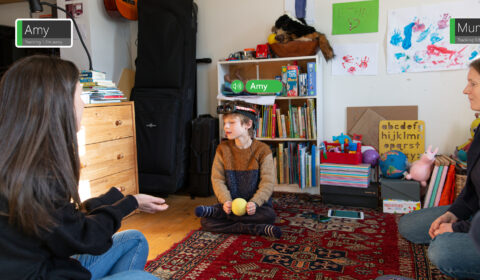
PeopleLens: Using AI to support social interaction between children who are blind and their peers
| Cecily Morrison, Katherine Jones, Martin Grayson, and Ed Cutrell
For children born blind, social interaction can be particularly challenging. A child may have difficulty aiming their voice at the person they’re talking to and put their head on their desk instead. Linguistically advanced young people may struggle with maintaining…
In the news | TechCrunch
Microsoft’s PeopleLens project helps blind kids learn social cues in conversation
Among the challenges of growing up with a visual impairment is learning and participating in the social and conversational body language used by sighted people. PeopleLens is a research project at Microsoft that helps the user stay aware of the…
In the news | WinBuzzer
Microsoft PeopleLens AI Helps Blind Learners and Peers Interact
Microsoft Research has published a blog discussing a new project known as PeopleLens. This is a new artificial intelligence (AI) model that helps young people who are blind and those around them communicate more efficiently.
In the news | The Register
Microsoft, OpenAI method could make training large neural networks cheaper
Cost of tuning hyperparameters using μTransfer was 7% of what it would be to pre-train GPT-3. Companies scaling up their neural network models could cut expensive training costs by employing a technique developed by researchers at Microsoft and OpenAI.
In the news | Wall Street Journal
Forget 5G. Let’s Talk About 6G.
Computer scientists and engineers say the next generation will make cloud computing and the mobile internet globally ubiquitous. As wireless carriers jostle to see who can win the race to deliver 5G services to customers, planning is already well under…
In the news | TechRadar
Microsoft, OpenAI may have solved a fundamental AI bottleneck
Microsoft and Open AI have developed a new method for optimizing massive AI models that are too expensive to train multiple times, such as GPT-3. A blog post published by Microsoft Research describes a technique called µ-Parametrization (or µP), which…
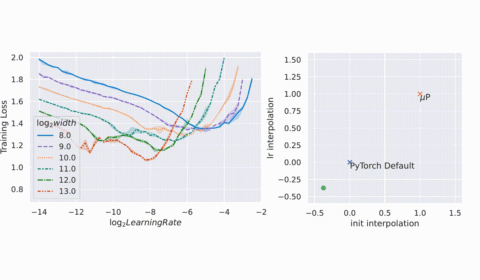
µTransfer: A technique for hyperparameter tuning of enormous neural networks
| Edward Hu, Greg Yang, and Jianfeng Gao
Great scientific achievements cannot be made by trial and error alone. Every launch in the space program is underpinned by centuries of fundamental research in aerodynamics, propulsion, and celestial bodies. In the same way, when it comes to building large-scale…