Research Focus: Week of September 11, 2023
In this issue: Efficient polyglot analytics on semantic data aids query performance; generative retrieval for conversational question answering improves dialogue-based interfaces; a new tool uses ML to address capacity degradation in lithium-ion batteries.
Abstracts: September 13, 2023
| Gretchen Huizinga, Ava Amini, and Kevin Kaichuang Yang
The new #MSRPodcast series “Abstracts” is your source for cutting-edge research in brief. In the first episode, join researchers Ava Amini and Kevin K. Yang to learn about their new paper on using evolutionary-scale protein data to improve protein design.

FP2: Fully In-Place Functional Programming provides memory reuse for pure functional programs
| Anton Lorenzen, Daan Leijen, and Wouter Swierstra
This research paper was presented at the 28th ACM SIGPLAN International Conference on Functional Programming (opens in new tab) (ICFP), a premier forum for discussing design, implementations, principles, and uses of functional programming. Functional programming languages offer a host of…
In the news | Microsoft Stories
AI may hold a key to the preservation of the Amazon rainforest
An animal skitters through the heavy underbrush of the Colombian forest in the dark of night. Hidden deep in the brush is a camera trap that quickly snaps a picture. An AI tool called MegaDetector identifies and classifies the results,…
In the news | LinkedIn Article
Using AI to protect the Amazon
The Amazon rainforest in South America is one of the world’s largest and most dense, but it is disappearing at an alarming rate. Estimates from researchers indicate that approximately 18% of the Amazon rainforest has been completely lost, while an…

大模型时代,如何评估人工智能与人类智能?
编者按:大模型时代的到来,使得人工智能成为了真正影响人类社会的重要技术之一,如何打造“负责任的人工智能”的问题正变得愈发迫切和关键。一直以来,微软始终致力于依照以人为本的伦理原则推进人工智能的发展,微软亚洲研究院也将“社会责任人工智能(Societal AI)”作为一个重要的研究方向。 2023年,微软亚洲研究院特别组织了“社会责任人工智能(Societal AI)”系列研讨会,为计算机领域的科研...
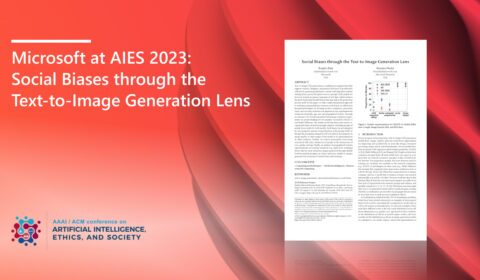
Understanding social biases through the text-to-image generation lens
| Ranjita Naik and Besmira Nushi
Gender, race, and age disparities in AI-generated images persist. This AIES 2023 study on text-to-image models shows that even basic prompts can lead to underrepresentation, calling for responsible bias mitigation strategies.

Intern Insights: Dr. Josh Benaloh with Anunay Kulshrestha and Karan Newatia
| Josh Benaloh, Anunay Kulshrestha, and Karan Newatia
Every year, interns help advance research at Microsoft. In “Intern Insights,” PhD students Anunay Kulshrestha and Karan Newatia talk with cryptographer Josh Benaloh about working on the verifiable election technology ElectionGuard.
In the news | TIME
Microsoft on the TIME100 AI list
This morning, TIME released its first "TIME100 Artificial Intelligence" list online, which includes Kevin Scott, Jaime Teevan, Kate Crawford, and Kalika Bali.