Awards | USENIX OSDI
Daniel Berger receives OSDI 2023 Best Paper Award
Daniel Berger's paper, Enso: A Streaming Interface for NIC-Application Communication, was selected as a best paper by the OSDI'23 organizers for its quality and potential impact. Enso was also awarded for its open source artifacts.
作者:科学智能中心 编者按:近年来,深度学习技术在分子微观结构预测中取得了巨大的进展。然而,分子的宏观属性和功能往往取决于分子结构在平衡态下的分布,仅了解分子的微观结构还远远不够。在传统的统计力学中,分子动力学模拟或增强采样等是获得平衡分布中采样的常用方法,但这些方法昂贵又耗时。 针对这个长期且艰巨的挑战,微软研究院发布了可用于预测分子结构平衡分布的深度学习框架 Distributional Gr...
Research Focus: Week of July 3, 2023
In this issue: A new study looks at engineers’ views on hybrid work; prompt engineering adds context and specificity to generative AI models; Overwatch learns code edit patterns to aid developers; a Qlib update addresses financial market challenges.
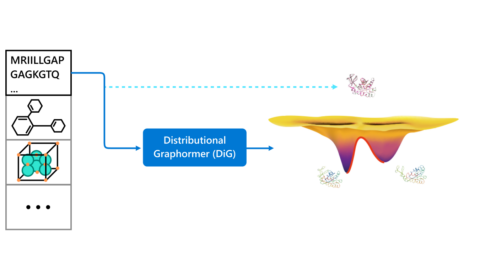
Distributional Graphormer: Toward equilibrium distribution prediction for molecular systems
| Shuxin Zheng, Chang Liu, Yu Shi, Ziheng Lu, Fusong Ju, Jianwei Zhu, Hongxia Hao, Peiran Jin, Frank Noé, Haiguang Liu, and Tie-Yan Liu
Distributional Graphormer, Microsoft’s new deep learning framework for predicting the equilibrium distribution of molecular structures, can generate realistic and diverse molecular structures with high efficiency and low cost.
In the news | Yahoo! News
Breast cancer detection, language learning, sustainability: Can AI help humanity?
While some believe AI could steal jobs or even destroy humanity, others think the technology could improve quality of life for people across the planet.

Qlib全新升级:强化学习能否重塑金融决策模式?
编者按:2020年,微软亚洲研究院开源了金融 AI 通用技术平台 Qlib。Qlib 以金融 AI 研究者和金融行业 IT 从业者为用户,针对金融场景研发了一个适应人工智能算法的高性能基础设施和数据、模型管理平台。一经开源,Qlib 便掀起了一阵热潮,相关开源项目在 GitHub 上已收获了11.4k颗星。作为一个通用技术平台,Qlib 不仅大大降低了行业从业者使用 AI 算法的技术门槛,还为金融...
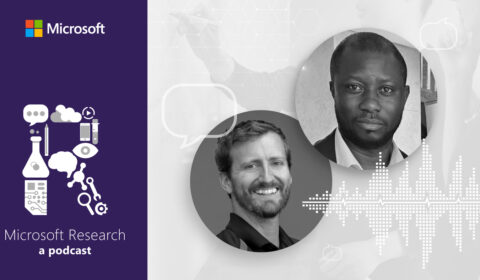
Collaborators: Holoportation™ communication technology with Spencer Fowers and Kwame Darko
| Gretchen Huizinga, Spencer Fowers, and Dr. Kwame Darko
A global team of medical providers is leveraging Holoportation, a Microsoft 3D capture and communication technology, to widen access to specialized care. Computer engineer Spencer Fowers and plastic surgeon Kwame Darko discuss the collaboration.

ACL 2023|大模型时代,自然语言领域还有什么学术增长点?
国际计算语言学年会(Annual Meeting of the Association for Computational Linguistics,简称 ACL)是自然语言处理(NLP)领域的顶级国际会议,ACL 2023 将于2023年7月9-14日在加拿大多伦多举行。随着人工智能技术的快速发展,确保相关技术能被人们信赖是一个需要攻坚的问题。微软亚洲研究院也在不断推进负责任的人工智能的探索发现与...
In the news | DeepLearning.AI
A conversation with Microsoft’s AI for Good Lab Director: Juan Lavista Ferres
AI is emerging as a powerful tool to aid in addressing some of the world’s most complex challenges. Our new specialization, AI for Good, aims to expand the community of people who are equipped to combine human and machine intelligence…