In the news | WinBuzzer
Microsoft and NVIDIA Bring Confidential Computing to GPUs on Azure
Cloud data is becoming a default way for millions of organizations – with multi-nationals or SMBs – to store information. AI is increasingly driving cloud storage solutions, but as always, the specter of cybersecurity threats looms large. Confidential computing by…
In the news | Analytics India
Interview with the team behind Microsoft’s µTransfer
Recently, researchers – Edward Hu, Greg Yang, Jianfeng Gao from Microsoft, introduced µ-Parametrization, which offers maximal feature learning even in infinite-width limit.
Awards | IEEE VR 2022
Mar Gonzalez-Franco receives 2022 IEEE VGTC Significant New Researcher award
Mar Gonzalez-Franco received the 2022 IEEE VGTC (opens in new tab) Significant New Researcher award in recognition of her research and leadership contributions in the field of Virtual Reality and spatial computing, in particular for her work on Avatars and…
In the news | Neowin
Microsoft is working with Nvidia to build confidential GPUs in the cloud
Many organizations, both big and small, utilize the cloud for their data-related needs in storage and AI solutions. In order to secure the privacy and security of sensitive data, it is essential to use confidential computing. For those unaware, this…
In the news | The Register
Microsoft to upgrade language translator with new class of AI model
Microsoft is replacing at least some of its natural-language processing systems with a more efficient class of AI model. These transformer-based architectures have been named "Z-code Mixture of Experts." Only parts of these models are activated when they're run since…
In the news | Official Microsoft Blog
Closing the cybersecurity skills gap – Microsoft expands efforts to 23 countries
Cybersecurity continues to be a significant threat for governments, businesses and individuals around the world. From supply chain disruptions to ransomware attacks, cybercriminals have become increasingly sophisticated and the threat landscape more diverse. These cybersecurity challenges are compounded by a…
语音识别的快速纠错模型FastCorrect系列来了!
作者:冷燚冲、谭旭 编者按:语音识别支持着许多生活中的常见服务,比如手机端的语音转文字功能、视频网站的字幕自动生成等等。但语音识别模型往往并不完美,需要纠错模型来纠正语音识别中的错误。目前,大部分纠错模型采用了基于注意力机制的自回归模型结构,虽然能够提升语音识别的准确率,但是延迟较高,这也成为了纠错模型在实际应用中的瓶颈。一个直接的做法是利用非自回归模型来提升速度,但是简单利用当前的非自回归模型不...

Powering the next generation of trustworthy AI in a confidential cloud using NVIDIA GPUs
| Kapil Vaswani, Antoine Delignat-Lavaud, Stavros Volos, Cédric Fournet, and Manuel Costa
Cloud computing is powering a new age of data and AI by democratizing access to scalable compute, storage, and networking infrastructure and services. Thanks to the cloud, organizations can now collect data at an unprecedented scale and use it to…
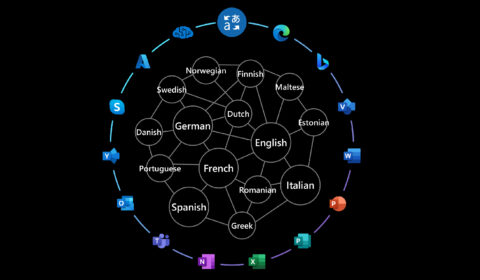
Microsoft Translator enhanced with Z-code Mixture of Experts models
| Hany Hassan Awadalla, Krishna Doss Mohan, and Vishal Chowdhary
Translator, a Microsoft Azure Cognitive Service, is adopting Z-code Mixture of Experts models, a breakthrough AI technology that significantly improves the quality of production translation models. As a component of Microsoft’s larger XYZ-code initiative to combine AI models for text,…