Password Monitor: Safeguarding passwords in Microsoft Edge
| Kristin Lauter, Sreekanth Kannepalli, Kim Laine, and Radames Cruz Moreno
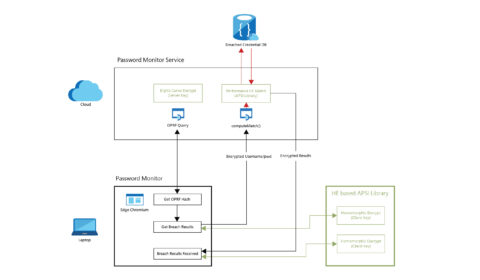
One of the biggest pillars for Microsoft Edge is trust. Today, to further bolster that trust while keeping our customers safe, we introduce a new feature called Password Monitor. The feature notifies users if any of their saved passwords have…
Awards | ACM SIGPLAN
POPL’s Most Influential Paper Award 2021 presented to Sumit Gulwani
Sumit Gulwani received POPL’s Most Influential Paper Award 2021 (opens in new tab) for his paper Automating String Processing in Spreadsheets Using Input-Output Examples. This is the second consecutive year in a row that Sumit has been honored with this award. It…
Awards | IEEE
3 Microsoft researchers elevated to IEEE Fellow for 2021
Steve Hodges, Ivan Tashev and Tom Zimmermann were elevated to the level of IEEE Fellow for 2021. The accomplishments that are being honored are a result of important contributions that led to the advancement or application of engineering, science and…

In the news | The Radical AI Podcast Open Menu
Ability and Accessibility in AI with Meredith Ringel Morris
What should you know about Ability and Accessibility in AI and responsible technology development? In this episode we interview Meredith Ringel Morris, a computer scientist conducting research in the areas of human-computer interaction (HCI), computer-supported cooperative work (CSCW), social computing, and…

Three mysteries in deep learning: Ensemble, knowledge distillation, and self-distillation
| Zeyuan Allen-Zhu and Yuanzhi Li
Under now-standard techniques, such as over-parameterization, batch-normalization, and adding residual links, “modern age” neural network training—at least for image classification tasks and many others—is usually quite stable. Using standard neural network architectures and training algorithms (typically SGD with momentum), the…
In the news | Microsoft Asia News Center
Microsoft Research Asia partners with universities in Asia to build OpenNetLab, empowering AI-assisted networking research
Microsoft Research Asia announced the establishment of OpenNetLab (opens in new tab), an open networking community and platform in collaboration with multiple universities in Asia, including academia from China, Korea and Singapore.
More and more people are relying on instructional videos, such as cooking videos, to teach themselves skills with “how to” instructions. An important research question is then, in place of watching the entire video, can we provide a type of…
In the news | MSPoweruser
Microsoft’s new vision-language (VL) system significantly surpasses human performance
Vision-language (VL) systems allow searching the relevant images for a text query (or vice versa) and describing the content of an image using natural language. In general, a VL system uses an image encoding module and a vision-language fusion module.…
In the news | GOV.UK Department of Health and Social Care
AI at the forefront of efforts to treat coronavirus patients
Patients with COVID-19 are set to benefit from faster treatment, improved outcomes and shorter hospital stays thanks to the use of the latest artificial intelligence. 1) AI imaging database will improve diagnosis of patients presenting with COVID-19 symptoms 2) Increased…