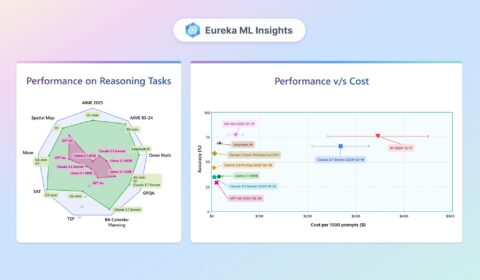
Understanding and measuring the potential of inference-time scaling for reasoning. The new Eureka study tests nine state-of-the-art models on eight diverse reasoning tasks.
In the news | Microsoft on the Issues
Investing in Washington state changemakers: Meet the 20 awardees of the AI for Good Lab’s open call
This month, Microsoft is celebrating our 50th anniversary. To help commemorate fifty years of creating technology that empowers people to achieve more, our AI for Good Lab launched an open call to support innovative AI-based projects here in Washington State.
In the news | LinkedIn Article
Saving Sight with AI: A New Hope for Premature Babies
Retinopathy of Prematurity (ROP) is an entirely preventable disease that has become one of the leading causes of childhood blindness worldwide (Blencowe et al., 2013). Remarkably, this is a condition that didn't even exist just a few decades ago, yet…
In the news | Seattle Magazine
Laura Hoffman: Microsoft AI for Good
Want to understand AI? When we think about the future of technology, it’s easy to picture flashy gadgets or complex code. But today’s guest reminds us that behind every innovation, there are people — thoughtful, passionate people — who are…
In the news | MobiHealthNews
Q&A: Microsoft’s breakthrough AI tool makes it easier to study how proteins are built
Microsoft’s AI for Good Lab has created Seq2Symm, an open-source AI tool that helps scientists determine the 3D shapes of certain proteins, including those found in viruses. Seq2Symm uses AI to predict a protein's 3D shape and structure from a…

CHI上新 | 探索人机协作的新范式
编者按:欢迎阅读“科研上新”栏目!“科研上新”汇聚了微软亚洲研究院最新的创新成果与科研动态。在这里,你可以快速浏览研究院的亮点资讯,保持对前沿领域的敏锐嗅觉,同时也能找到先进实用的开源工具。 CHI 是人机交互领域最具影响力的国际顶级会议之一,今年的 CHI 大会于4月26日至5月1日在日本横滨举办。本期“科研上新”将为大家带来微软亚洲研究院入选 CHI 2025 的三篇精选论文,聚焦生成式 AI...
In the news | TechRepublic
20+ Machine Learning Methods in Groundbreaking Periodic Table From MIT, Google, Microsoft
Developed by researchers from MIT, Microsoft, and Google, I-Con not only provides a new lens for understanding ML but also encourages creative thinking by merging traditional techniques. This groundbreaking approach is poised to propel the field forward, opening up new…

ICLR上新 | 多模态与决策智能的前沿探索
编者按:欢迎阅读“科研上新”栏目!“科研上新”汇聚了微软亚洲研究院最新的创新成果与科研动态。在这里,你可以快速浏览研究院的亮点资讯,保持对前沿领域的敏锐嗅觉,同时也能找到先进实用的开源工具。 4月24日至4月28日,全球最负盛名的深度学习盛会之一 ICLR 大会在新加坡举办。我们通过两期“科研上新”为大家带来多篇微软亚洲研究院入选 ICLR 2025 的精选论文解读。在第一期的内容中我们分享了包括...

Research Focus: Week of April 21, 2025
In this issue: our CHI 2025 & ICLR 2025 contributions, plus research on causal reasoning & LLMs; countering LLM jailbreak attacks; and how people use AI vs. AI-alone. Also, SVP of Microsoft Health Jim Weinstein talks rural healthcare innovation.