
Research Focus: Week of October 7, 2024
Simplifying secure decision tree training; Improving accuracy of audio content detection; A novel neurosymbolic system for converting text to tables; New video series: AI for Business Transformation; TEE security protections for container workloads.

ECCV上新 | 精选计算机视觉领域6篇前沿论文
编者按:欢迎阅读“科研上新”栏目!“科研上新”汇聚了微软亚洲研究院最新的创新成果与科研动态。在这里,你可以快速浏览研究院的亮点资讯,保持对前沿领域的敏锐嗅觉,同时也能找到先进实用的开源工具。 2024年的ECCV(European Conference on Computer Vision)于10月4日在意大利米兰落下帷幕。作为计算机视觉领域的重要国际会议之一,微软亚洲研究院有多篇论文入选。本期的...
By Yadong Lu, Senior Researcher; Jianwei Yang, Principal Researcher; Yelong Shen, Principal Research Manager; Ahmed Awadallah, Partner Research Manager Recent advancements in large vision-language models (VLMs), such as GPT-4V and GPT-4o, have demonstrated considerable promise in driving intelligent agent systems…
Awards | American Physical Society
Frank Noé, American Physical Society Fellow
The AI for Science partner research manager received this distinction for the development of machine learning methods for advancing the physical sciences, in particular for the many-body sampling problem and the electronic structure problem.
In the news | Fred Hutch Press Release
Cancer centers launch Cancer AI Alliance to unlock discoveries, transform care using cancer data and applied AI
Dana-Farber Cancer Institute, Fred Hutch Cancer Center, Memorial Sloan Kettering Cancer Center, and The Sidney Kimmel Comprehensive Cancer Center and Whiting School of Engineering at Johns Hopkins – have joined forces and secured funding from AI technology leaders AWS, Deloitte,…

Data Formulator: Exploring how AI can help analysts create rich data visualizations
| Chenglong Wang, Steven Drucker, Dan Marshall, Jeevana Priya Inala, Kori Inkpen, and Jianfeng Gao
Data Formulator investigates combining UI interactions with natural language input. Powered by AI, it can help users create or adapt visualizations and supports continuous refinement through an iterative process. Now available on GitHub.
In the news | Planet
Project Centinela
Planet’s biodiversity site monitoring program delivers an unprecedented array of high-resolution, high-frequency satellite imagery, analytics, and Planetary Variables into the hands of those who are maintaining a lifeline for biodiversity and the communities that depend on that variety of life.
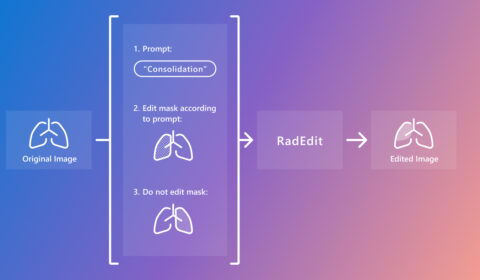
Stress-testing biomedical vision models with RadEdit: A synthetic data approach for robust model deployment
| Max Ilse, Daniel Coelho de Castro, and Javier Alvarez-Valle
RadEdit stress-tests biomedical vision models by simulating dataset shifts through precise image editing. It uses diffusion models to create realistic, synthetic datasets, helping to identify model weaknesses and evaluate robustness.
Abstracts: September 30, 2024
| Amber Tingle, Daniela Massiceti, and Martin Grayson
The personalizable object recognizer Find My Things was recently recognized for accessible design. Researcher Daniela Massiceti and software development engineer Martin Grayson talk about the research project’s origins and the tech advances making it possible.