In the news | Microsoft On the Issues
Sustainability: A year of progress and a decade of action
One year ago, Microsoft CEO Satya Nadella, President Brad Smith and CFO Amy Hood announced Microsoft’s bold commitment to be carbon negative by 2030 (opens in new tab) and to remove our historic emissions by 2050. This was the beginning of Microsoft…
In the news | Official Microsoft Blog
One year later: The path to carbon negative – a progress report on our climate ‘moonshot’
A year ago, we launched the biggest commitment in Microsoft’s history to focus on the climate crisis. As Satya Nadella, Amy Hood, and I announced last January (opens in new tab), Microsoft committed to become carbon negative as a company by 2030 – meaning that by…
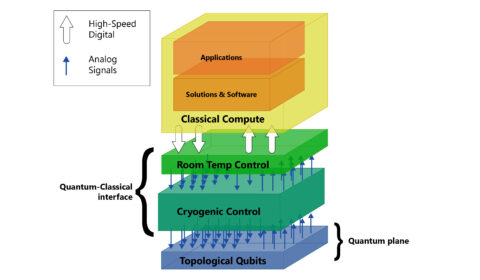
Full stack ahead: Pioneering quantum hardware allows for controlling up to thousands of qubits at cryogenic temperatures
| Dr. Chetan Nayak
Quantum computing offers the promise of solutions to previously unsolvable problems, but in order to deliver on this promise, it will be necessary to preserve and manipulate information that is contained in the most delicate of resources: highly entangled quantum…
In the news | Microsoft Industry Blogs
Improving the pace of vaccine distribution through technology
The COVID-19 pandemic has negatively impacted our health, economy, and psychosocial well-being. Public health mitigation measures such as wearing masks, social distancing, avoiding large gatherings, and washing hands have demonstrated benefit in curbing the spread of infection, but have been…
In the news | The Next Web
This AI chess engine aims to help human players rather than defeat them
Maia's algorithms find mistakes that players should work on. Artificial intelligence has become so good at chess that its only competition now comes from other computer programs. Indeed, a human hasn’t defeated a machine in a chess tournament in 15…
Introduction Neural Architecture Search (NAS) is an exciting field which facilitates the automatic design of deep networks. It has achieved state-of-the-art performance on a variety of tasks, surpassing manually designed counterparts [e.g., 1–3]. Recently, one-shot NAS methods became popular due…
Editor’s note: AI programming is one of the great expectations that people have for artificial intelligence. Although current AI programming technology has benefitted many ordinary users who do not know how to program, it still has a long way to…
“The world runs on software” —— Our modern life relies on diverse software systems, which provide services including search, shopping, chatting, recommendation, and so on. As user requirements and scenarios increase, these systems continuously grow in scale and complexity over…

While heuristic evaluations are less expensive, they’re typically not as exciting to run as usability studies or interviews, and they don’t produce convincing videos for stakeholders. So, how can we raise the stakes for heuristic evaluations and when should we?