MIT announced danah boyd is the recipient of the 2022-23 Morison Prize in Science, Technology, and Society (STS). The Morison Prize recognizes an outstanding individual who combines humanistic values with effectiveness in practical affairs, particularly in science and technology. danah…
In the news | Microsoft FLAML on GitHub
Surpassing 1 Million Downloads – A Retrospective and a Look into the Future
This week, FLAML has reached a significant milestone: 1 million downloads. Originating as an intern research project within Microsoft Research, FLAML has grown into an open-source library used widely across the industry and supported by an active community. As we…

Using generative AI to imitate human behavior
| Tim Pearce, Tabish Rashid, Anssi Kanervisto, Dave Bignell, Mingfei Sun, Raluca Stevenson, Sergio Valcarcel Macua, Shanzheng Tan, Ida Momennejad, Katja Hofmann, and Sam Devlin
Diffusion models have been used to generate photorealistic images and short videos, compose music, and synthesize speech. In a new paper, Microsoft Researchers explore how they can be used to imitate human behavior in interactive environments.
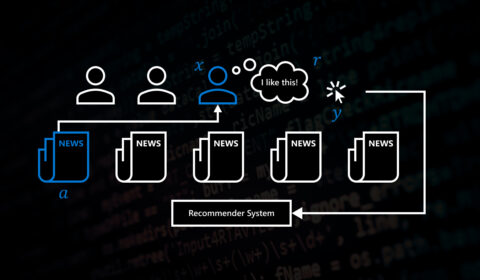
Inferring rewards through interaction
| Jessica Maghakian, Akanksha Saran, Cheng Tan, and Paul Mineiro
In reinforcement learning, handcrafting reward functions is difficult and can yield algorithms that don’t generalize well. IGL-P, an interaction-grounded learning strategy, learns personalized rewards for different people in recommender system scenarios.
In the news | The Times of Israel
Microsoft partners with Start-Up Nation Central to tap Israeli agrifood tech
US tech giant Microsoft has partnered with Start-Up Nation Central to help Israeli agrifood tech startups augment their AI-powered models for sustainable farming solutions and get exposure to global markets. Microsoft and Start-Up Nation Central are working together to identify…
Awards | Institute of Mathematical Statistics (IMS)
Lester Mackey named IMS Fellow
Lester Mackey, Principal Researcher, Microsoft Research, has been named Fellow of the Institute of Mathematical Statistics (IMS). Dr. Mackey received the award for deep theoretical work in statistical machine learning with impactful applications.

Collaborators: Gov4git with Petar Maymounkov and Kasia Sitkiewicz
| Gretchen Huizinga, Petar Maymounkov, and Kasia Sitkiewicz
Collaboration is key to bringing ideas from lab to life. In the first episode of the #MSRPodcast series “Collaborators,” learn how GitHub’s Kasia Sitkiewicz and Protocol Labs’ Petar Maymounkov are teaming up to make open-source collaborative work better.
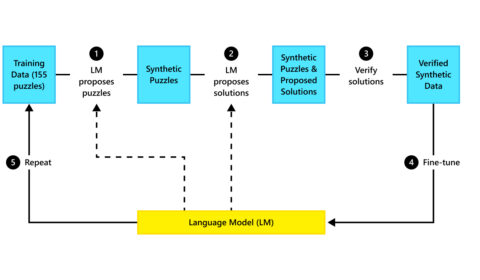
AI self-play for algorithm design
| Adam Tauman Kalai and Patrick Haluptzok
Self-play has helped AI systems succeed in games like chess and Go. Can the same method help improve AI programming abilities? Using easy-to-check, hard-to-solve programming problems, researchers show AI can create, solve, and train on its own puzzles.
Awards | International World Wide Web Conference
John Langford, Rob Schapire and co-authors receive the 2023 Seoul Test of Time Award
The International World Wide Web Conference Committee (IW3C2) announced today that the 2023 Seoul Test of Time Award will be presented to the authors of the paper “A Contextual-Bandit Approach to Personalized News Article Recommendation;” Wei Chu, (Ant Group), Lihong…