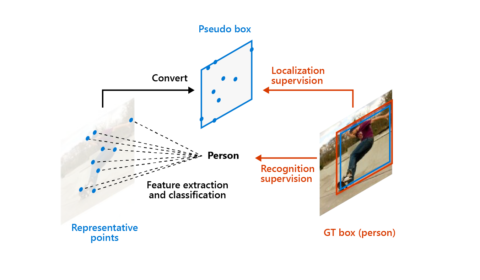
Getting a better visual: RepPoints detect objects with greater accuracy through flexible and adaptive object modeling
| Han Hu and Steve Lin
Visual understanding tasks are typically centered on objects, such as human pose tracking in Microsoft Kinect and obstacle avoidance in autonomous driving. In the deep learning era, these tasks follow a paradigm where bounding boxes are localized in an image,…
In the news | Engadget
Microsoft’s latest VR experiment is a literal walk in the park
The VR system can adapt to changes to the route made by the walker, 'making it possible to transform a walk to the grocery store or to a bus stop, say, into a walk through Times Square in VR.'
In the news | Architect Magazine
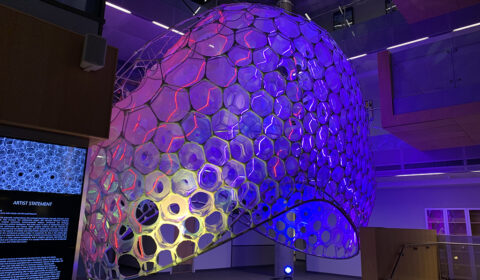
Jenny Sabin Studio’s “Ada” Embeds AI in Architecture at Microsoft
To get a sense of the mood in Microsoft’s Research Building 99, just take a look at "Ada." Named for the polymath and programming visionary Ada Lovelace, the two-story tall architectural pavilion suspended in the atrium, at the tech company's campus…
In the news | Architect
Jenny Sabin Studio’s Ada Embeds AI in Architecture at Microsoft
Named for the polymath Ada Lovelace, the two-story pavilion at the tech company's headquarters is driven by human sentiment data.
In the news | Architect
Jenny Sabin Studio’s “Ada” Embeds AI in Architecture at Microsoft
To get a sense of the mood in Microsoft’s Research Building 99, just take a look at “Ada.” Named for the polymath and programming visionary Ada Lovelace, the two-story tall architectural pavilion suspended in the atrium, at the tech company’s…

A new era of spatial computing brings fresh challenges—and solutions—to VR
Virtual reality (VR) has continually pushed the boundaries of how we perceive, from its early days of Ivan Sutherland’s Sword of Damocles to today. With the technology emerging from its early stages of bulky equipment tethered to one place out of necessity, researchers now are working with increased possibilities derived from hardware and new input sensors. The result is a unique set…
Awards | National Academy of Medicine
Peter Lee elected to National Academy of Medicine
Peter Lee, Corporate Vice President, Microsoft Healthcare, was elected by his peers in the National Academy of Medicine for distinguished contributions to medicine and health—advancing state-of-the-art artificial intelligence for precision medicine, including genomics, immunomics, and medical imaging, and in cloud technology for…
In the news | Microsoft Azure Blog
Azure API for FHIR® moves to general availability
Today, Microsoft becomes the first cloud with a fully managed, first-party service to ingest, persist, and manage healthcare data in the native FHIR format. The Azure API for FHIR® is releasing today in generally availability to all Azure customers.