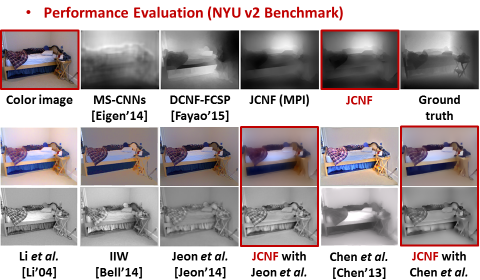
By Miran Lee, Senior Principal Research Program Manager, Microsoft Research Asia Four researchers. Two institutions. One successful computer vision breakthrough. That’s the power of collaboration. The project, “Unified Depth Prediction and Intrinsic Image Decomposition from a Single Image via Joint…
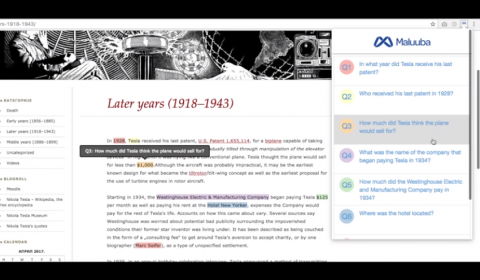
Advancing machine comprehension with question generation
Microsoft Research Montreal lab's vision is to create machines that can comprehend, reason and communicate with humans. We see a future where humans interact with machines just as they would with another human. We could ask a question in natural…
In the news | Microsoft Transform
“My God, it’s better”: Emma can write again thanks to a prototype watch, raising hope for Parkinson’s disease
Haiyan Zhang, a Microsoft researcher, to spend months studying Parkinson's disease while building and testing prototypes that could, she hoped, temporarily short-circuit the hand tremors, allowing Lawton to write her own name again.
In the news | Beta News
Build 2017: Microsoft’s ‘Project Emma’ is a wearable for Parkinson’s disease sufferers
Today at Build 2017, Microsoft unveiled many cool new technologies, one particular announcement touched the hearts of many. Called 'Emma,' it is a wrist wearable that can help people suffering with Parkinson's disease.
In the news | USA Today
Microsoft shows off watch that quiets Parkinson’s tremors
The watch works through a combination of sensors and AI (artificial intelligence) techniques to potentially detect and monitor symptoms like tremors, stiffness and instability, among others, according to Microsoft.
In the news | TechRadar
From Kinect to InnerEye
No one single technology exists in a vacuum. Microsoft’s Kinect may have suffered an ignoble slide into obscurity following its troubled pairing with the Xbox One. But its underlying principles, technology and the research that went into developing it now…

Where cryptography and quantum computing intersect
By Kristin Lauter, Principal Researcher, Microsoft Research Last week I spent time at the American Institute of Mathematics in San Jose, working with a group of 20 or so mathematicians and computer scientists on questions related to quantum arithmetic, at…

CHI Part 2: Creating technologies that enhance lives in the areas of health and eye tracking
By Justin Cranshaw, Researcher, Microsoft Research With its focus on the relationships between people and computation, the field of human-computer interaction (HCI) excels at creating technologies that marry human skills with computational functionality, to enable outcomes neither humans nor computers…
Awards | OnMSFT.com
Microsoft’s Project Catapult wins GeekWire’s ‘Innovation of the Year’ award
Project Catapult, a longtime research initiative on field programmable gate arrays (FPGA), received the 'Innovation of the year' award during the ceremony held at the Museum of Pop Culture.