Awards | ICCV 2021
“Swin Transformer: Hierarchical Vision Transformer Using Shifted Windows” receives ICCV 2021 Best Paper Award (Marr Prize)
Swin Transformer: Hierarchical Vision Transformer Using Shifted Windows, received ICCV 2021 Best Paper Award (Marr Prize). The Microsoft Research co-authors include Yue Cao, Baining Guo, Han Hu, Steve Lin.

Microsoft Translator: Now translating 100 languages and counting!
| Krishna Doss Mohan and Jann Skotdal
Today, we’re excited to announce that Microsoft Translator has added 12 new languages and dialects to the growing repertoire of Microsoft Azure Cognitive Services Translator, bringing us to a total of 103 languages! The new languages, which are natively spoken…
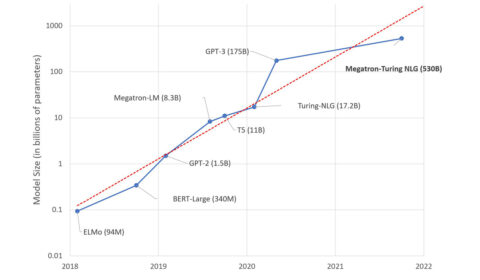
Using DeepSpeed and Megatron to Train Megatron-Turing NLG 530B, the World’s Largest and Most Powerful Generative Language Model
| Ali Alvi and Paresh Kharya
We are excited to introduce the DeepSpeed- and Megatron-powered Megatron-Turing Natural Language Generation model (MT-NLG), the largest and the most powerful monolithic transformer language model trained to date, with 530 billion parameters. It is the result of a research collaboration…
In the news | VentureBeat
Microsoft taps AI techniques to bring Translator to 100 languages
Today, Microsoft announced that Microsoft Translator, its AI-powered text translation service, now supports more than 100 different languages and dialects. With the addition of 12 new languages including Georgian, Macedonian, Tibetan, and Uyghur, Microsoft claims that Translator can now make…
Awards | X-Rings: A Hand-mounted 360 Degree Shape Display for Grasping in Virtual Reality
Best Paper: Honorable Mention Paper, UIST 2021
In the news | Microsoft AI Blog
Azure AI empowers organizations to serve users in more than 100 languages
Microsoft announced today that 12 new languages and dialects have been added to Translator. These additions mean that the service can now translate between more than 100 languages and dialects, making information in text and documents accessible to 5.66 billion…
In the news | MSPoweruser
Microsoft Research shows off AirConstellations for the Ultimate Flexible Workstation
Microsoft Research has shown off a new technology which makes it easier to manage and spread your workspace intelligently over a variety of devices.
In the news | IEEE Spectrum
Microsoft Predicts Weather for Individual Farms: DeepMC uses machine learning and AI to localize weather data
Imagine you're a farmer in the northern United States. It's early spring, and nighttime temperatures are just starting to rise above freezing. You need to fertilize your newly-planted crops, but you also know that at freezing temperatures, the fertilizer will…

How our research findings helped inform our UX directions to use the intelligent model in shaping how to smartly light up the automatic calculation capabilities to assist users to achieve their tasks efficiently without relying on a calculator.