In the news | New York Times
Here’s What the Rise of Clean Energy Looks Like From Space
A constellation of satellites orbiting 250 miles above Earth's surface shows how solar and wind have taken off in recent years.
In the news | LinkedIn Article
Global Renewables Watch: A New Era of Energy Insights
In 2022, we set out to help answer a question we heard time and time again: how much renewable energy does the world have? Joining with The Nature Conservancy and Planet , Microsoft’s AI for Good Lab announced the launch…

Claimify: Extracting high-quality claims from language model outputs
| Dasha Metropolitansky
Claimify, created by Microsoft Research, is a novel LLM-based claim-extraction method that outperforms prior solutions to produce more accurate, comprehensive, and substantiated claims from LLM outputs.

Metasurface: Unlocking the future of wireless sensing and communication
| Lili Qiu and Hao Pan
Metasurfaces explore engineered 2D materials that manipulate electromagnetic and mechanical waves, offering advances in wireless tech. They can power indoor GPS, extend 5G/6G coverage, and enable wireless sensing and imaging.
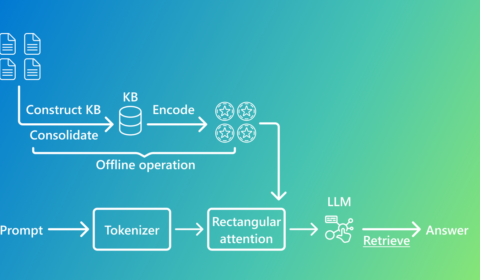
Introducing KBLaM: Bringing plug-and-play external knowledge to LLMs
| Taketomo Isazawa, Xi Wang, Liana Mikaelyan, Mathew Salvaris, and James Hensman
Introducing KBLaM, an approach that encodes and stores structured knowledge within an LLM itself. By integrating knowledge without retraining, it offers a scalable alternative to traditional methods.
In the news | Microsoft Unlocked
Peter is Here: AI for Cultural Heritage
Students are buzzing with excitement because their lesson is a little different today. They’re about to embark on an extraordinary quest within Minecraft Education. As Vatican Conservators in the Peter is Here: AI for Cultural Heritage game, their task is to…
In the news | LinkedIn News
Damage Assessment: Cave City Arkansas
We would like to extend our deepest sympathies to everyone affected by the extreme weather events in the Southeastern United States. Our lab has conducted building damage assessments for areas in Arkansas affected by the recent tornadoes. In collaboration with Planet…
In the news | Tech Community
Image Search Series Part 2: AI Methods for the Automation of 3D Image Retrieval in Radiology
In the news | Tech Community
Image Search Series Part 2: AI Methods for the Automation of 3D Image Retrieval in Radiology