Everyone uses AI. But reaching the Frontier takes more than that.
On the Frontier is a new series of unscripted conversations with the leaders putting AI to work inside some of the world’s most recognizable companies—Lumen, Levi’s, Mastercard, EY, and DuPont. Each episode is an honest conversation about what’s actually changing: how work gets done, how decisions get made, and what it takes to move when the ground keeps shifting underneath you.
Most AI talk lives at the extremes—it’ll replace everyone, or it’s all hype. Neither helps the person who actually has to decide. These leaders aren’t forecasting from a stage; they’re living in the messy reality and making real calls without a playbook. This series asks the practical questions to tease out what’s really working, and what challenges lie ahead.
On the Frontier draws on research from Microsoft and the Frontier Firm AI Initiative. Launched with the Harvard Business School AI Institute, the Initiative conducts applied research to understand organizations building AI into the core of how they operate. Its cohort of global organizations—including the companies featured in this series—takes part in large-scale experiments in real AI patterns of work that we use to produce evidence-based blueprints and executive workshops for leaders putting these ideas into practice. The conversations you’ll watch here show the human side of that same inquiry, through the eyes of the leaders building Frontier Firms in real time.
HOST

Matthew Duncan leads Microsoft’s Future of Work & AI initiative, where his team produces the Work Trend Index, the company’s flagship research on how work is actually changing, and WorkLab. He has spent his career studying where work is headed. One conviction shapes every conversation in this series: that AI isn’t a tool you bolt onto the old way of working, but a fundamental shift in how work gets done.
CORRESPONDENT

Sherrell Dorsey is an award-winning technology journalist, author, and the host of TED Tech. She has built her career reporting at the intersection of technology, innovation, and the people it affects. In each episode she finds the pattern behind the story, connecting one company’s experience to everyone’s future.
Explore the episodes
1. Lumen’s people-first playbook
Lumen didn’t start their AI transformation with technology. They started with trust.
Every leader has an AI strategy. Ana White thinks most of them are starting in the wrong place. As Chief People & AI Enablement Officer at Lumen, she’s leading AI transformation across her company on the conviction that the technology isn’t where this begins—the people are. She talks about leading through fear, building trust, and what has to come first if any of it is going to work.
KEY TAKEAWAYS
AI transformation is 70% people, 30% tools. The technology is the smaller half of the job; the harder work is helping your people through it.
Do it with them, not to them. Transformation that's imposed on people fails; the leaders who bring people through it are the ones who succeed.
Lead from the pause. The space between stimulus and response is where good decisions get made—slowing down is a discipline, not a delay.
FEATURED SPEAKER
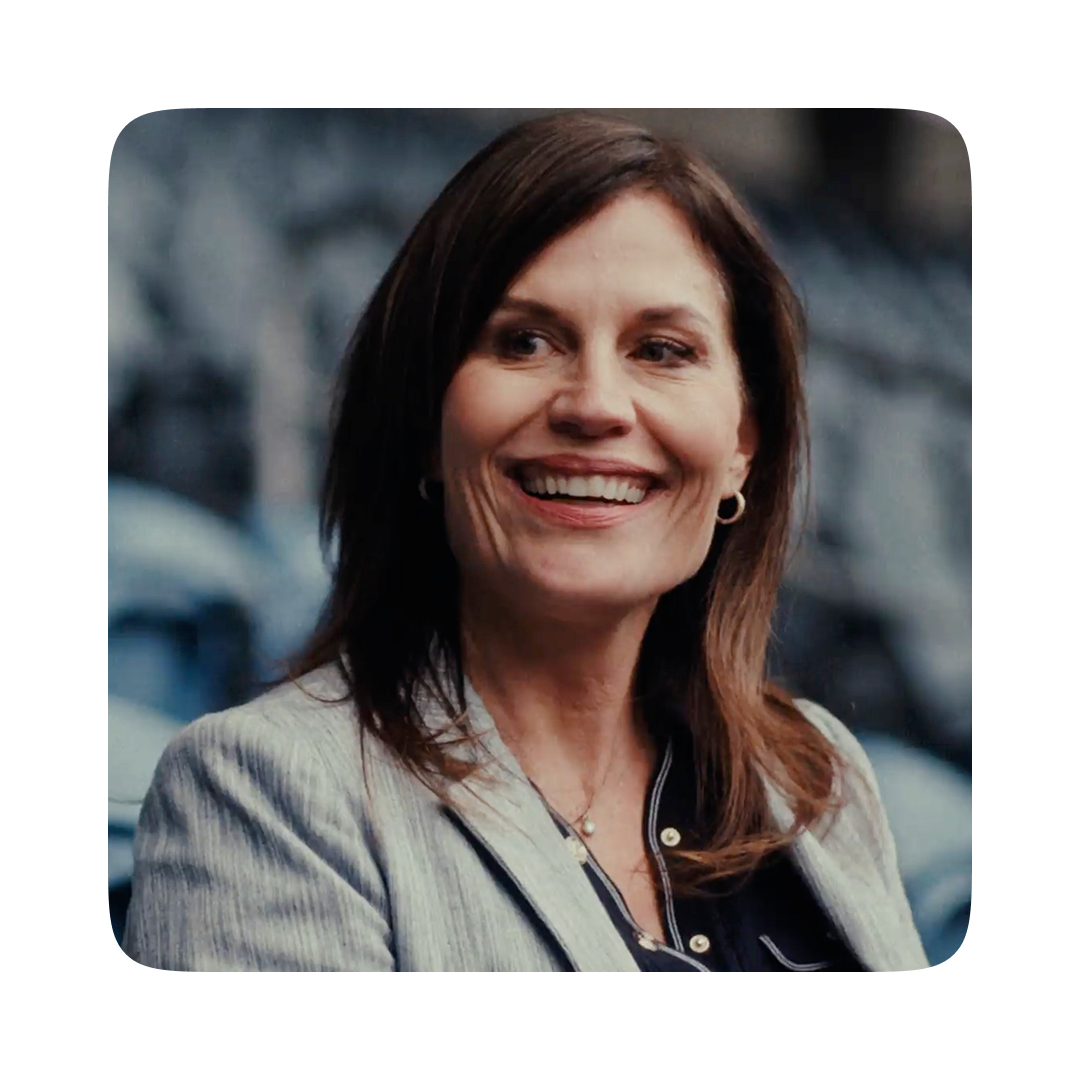
Ana White, Chief People & AI Enablement Officer | Lumen Technologies
Ana has spent her career on the people side of big technological shifts, at Microsoft, at F5, and now at Luman, which is exactly why she refuses to treat AI as a technology problem. What drives her is a conviction that transformation lives or dies on whether people feel safe enough to be curious in the middle of it. She talks openly about leading with vulnerability instead of certainty, and about why the most important thing a leader can do right now is lean into their own growth mindset and curiosity. For Ana, this isn’t abstract. It’s 21,000 people, and the belief that none of it works if you don’t start with them.
Coming soon...
2. Inside Levi’s ‘Slow AI’
How do you put AI to work without losing what made you worth something in the first place?
AI can do almost anything now—so the real question at Levi’s isn’t what it can do, but where it doesn’t belong. Jason Gowans, Chief Digital and Technology Officer at Levi Strauss & Co., talks about using AI at global scale without losing the taste, heritage, and point of view that made the brand worth something in the first place. The hard part is knowing where to draw the line.
FEATURED SPEAKER

Jason Gowans, Chief Digital & Technology Officer | Levi Strauss & Co.
Jason runs digital and technology for a brand built on something AI can’t manufacture: taste, heritage, and a point of view earned over 170 years. That tension is what makes him interesting on this topic. He’s genuinely excited about what AI unlocks, like faster experimentation, employee-built agents, and busywork offloaded, and he’s equally clear about what he won’t hand over. What matters to him is using the technology to free people up for the judgment and creativity only they can bring, while protecting the thing that makes Levi’s worth caring about.
3. Mastercard’s plan for agentic commerce
What happens when it’s not one company changing, but an entire industry—all at once?
Soon your AI agent won’t just help you shop—it’ll buy on your behalf. Sherri Haymond, EVP and Global Head of Digital Commercialization at Mastercard, is helping build the rules for a world where machines transact for us, while an entire industry rewires itself in real time. A conversation about agentic commerce, the trust it depends on, and what it takes to move a whole ecosystem at once.
FEATURED SPEAKER

Sherri Haymond, Executive Vice President, Global Head of Digital Commercialization | Mastercard
Sherri has spent her career building the partnerships that let entire payment ecosystems move together. She helped get a fractured industry onto shared standards once before, with tokenization and mobile payments, and she’s doing it again with agentic commerce. What animates her is the coordination problem itself. She describes the industry as a giant chessboard of independent players, and she clearly relishes the puzzle of getting them all moving in rhythm. Her real subject, underneath the technology, is trust: the thing that’s hard to build, easy to lose, and non-negotiable when a machine is the one spending your money.
4. EY on becoming the agent boss
Everyone’s about to become a boss—to AI.
EY built tax-expert AI agents grounded in 20 million documents—more than any professional could ever hold in their head. So what happens to the value of expertise itself? Mark Luquire, Managing Director and Global Microsoft Alliance Co-Innovation Leader at EY, thinks it’s about to mean something very different—and that we’re entering an “agent boss” era where everyone, early in their careers, will have to manage AI. A conversation about the future of knowledge work, and what it means for anyone whose value is what they know.
FEATURED SPEAKER

Mark Luquire, Managing Director, Global Microsoft Alliance Co-Innovation Leader | EY
Mark sits where AI meets the business of expertise, helping some of the world’s largest organizations rethink how knowledge work gets done when an agent can hold 20 million documents in its head. What makes him compelling is that he’s lived the shift personally. He describes the moment AI stopped being a curiosity and became a genuine thought partner, and he’s honest about how disorienting that is for anyone whose value has always been what they know. For Mark, AI is a way to expand what people are capable of, and he’s clear-eyed that getting there means letting go of some hard-won professional identity.
5. DuPont on AI where you can’t break things
What do you do when the systems you’re changing were never built to move fast?
Move fast and break things doesn’t work when breaking things isn’t an option. Alice Hildick Hilson, Senior Director of Digital Innovation and Enterprise Technology at DuPont, leads AI inside a company more than 200 years old — where the work is physical, the timelines stretch across years, and there’s no luxury of getting it wrong in a highly regulated environment. A conversation about transforming a legacy company one plant and one process at a time, and what it really costs to move when the ground keeps shifting underneath you.
FEATURED SPEAKER

Alice Hilson, Senior Director of Digital Innovation and Enterprise Technology | DuPont
Alice is a scientist by training, a geologist who moved through energy and technology innovation before landing at a 200-year-old materials company—where, as the company’s most senior AI and data leader, she makes the calls. She leads like someone comfortable with uncertainty but unwilling to be reckless with it. She’s a surfer, and she talks about transformation the way she talks about the water: You learn to read the difference between patience and boldness, and you start in the small waves before you paddle out to the big ones. What matters to her is doing this honestly inside a place where the stakes are unforgiving and the margin for error is thin: moving anyway, one plant and one process at a time, without pretending it’s easy.
Explore Frontier Firm resources:
Practical guidance for transforming your organization with AI.