
The most-shared AI commentary right now starts from an observation that’s hard to argue with: the gap between what today’s models can do and what enterprises are deploying is enormous, and it’s sparking frustration. Ethan Mollick captured that feeling most pointedly in a recent piece for The Economist, arguing that enterprises are domesticating AI before it gets the chance to do its best work—that IT governance, risk-averse process, and the impulse to fit the technology into existing structures are the primary bottleneck. Erik Brynjolfsson at Stanford has spent 30 years documenting why this happens. His J-curve framework—the dip-before-the-payoff pattern that technology adoption tends to follow—is the intellectual architecture behind the claim that organizational lag, not model quality, determines whether a technology compounds or stalls.
They’re both right. The diagnosis is serious and grounded. What I’d add is a different read on what’s creating the gap in the first place.
Here’s the part I’d push on. The friction Mollick argues enterprises should dismantle—bureaucratic gatekeeping, the impulse to overindex on pilots and experimentation—is not the same as the infrastructure that allows AI to scale. Identity. Permissions. A connection to the data your business actually runs on. A record of what AI agents did and why. Integration with the tools where work already happens. That layer isn’t where AI goes to die. It’s what allows AI to disappear into the work, which is a necessary condition for scale.
How technology diffuses
Geoffrey Moore documented the pattern in Crossing the Chasm: the behaviors that define early adopters—a willingness to go through unnatural acts for technology that isn’t yet seamless—are exactly what makes them unrepresentative of everyone else. Pragmatists don’t cross the chasm because the technology gets more capable. They cross it when the technology meets them inside the work they’re already doing.
The web didn’t transform commerce through exotic browser experiments. It transformed commerce when it became the invisible layer beneath what Amazon built—when ordering toothpaste required no understanding of the underlying technology at all. That invisibility was earned. Amazon rebuilt logistics, fulfillment, and pricing infrastructure from the ground up before the technology could disappear into the purchase. The invisibility was the outcome of the redesign, not an alternative to it. Mobile followed the same arc. It won not when it was new and experimental, but when the interface disappeared into the task itself.
In each case, the technology became consequential when most people stopped thinking about it. Deliberate structural work happened before the experience became effortless. The leading indicator of enterprise technology maturity has never been interface novelty. It’s how undetectable the technology is beneath the day-to-day work. AI is not exempt from this pattern.
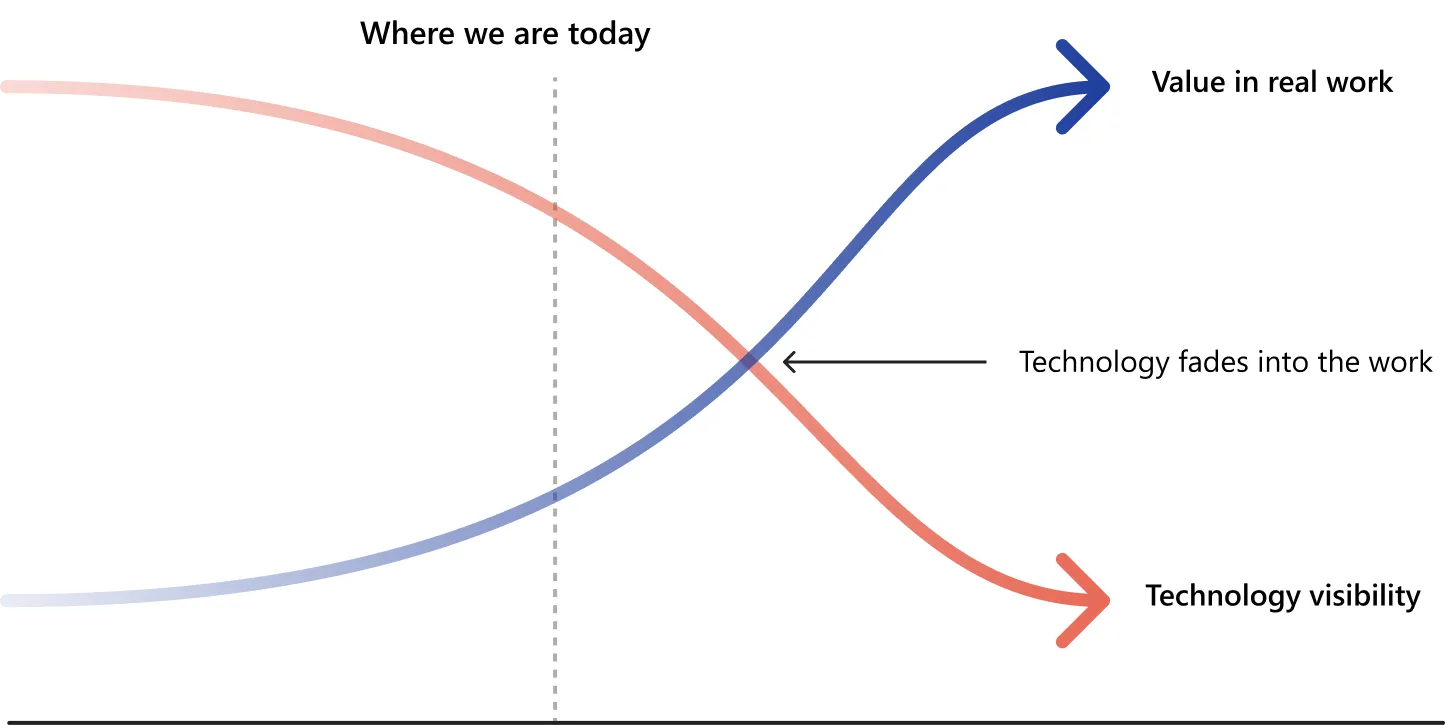
The same shape, every time
The web, mobile, and now AI all follow the curve: loud and visible at the start, load-bearing and invisible by the end. Value rises as the interface disappears.
The layer that carries the weight
Vision from the top and experimentation across the business both matter. But neither pays off without what sits beneath them: the layer that knows who’s asking, what they’re allowed to see, the data the business runs on, and the tools where work already happens.
The problem that layer solves is re-learning. Today’s AI approaches every task like a new hire on day one. In every prompt or spec, you have to explain where the data lives, how to format the output, what standards apply. What organizations are now learning to build are skills: structured sets of directions that encode how a specific piece of work runs. A skill is different from a prompt the way a process manual is different from an email. A prompt asks the AI to figure it out. A skill tells AI how this organization has decided to do it. Building those skills at scale—deciding what they should encode, maintaining them as workflows evolve, distributing them so teams aren’t each starting from scratch—is the formalization work that separates an operating model from a well-funded pilot.
Most organizations are closer to this than they realize. Underlying capability has been accumulating in enterprise software for years—in features that went unused, workflows too complex to adopt, data sitting unstructured in systems designed for human navigation. Generative AI makes those capabilities accessible at scale, but only when the infrastructure is in place to enable it.
The operating model problem leaders are stuck on
Leaders largely understand that AI integration requires redesigning work. The harder problem is knowing how. The processes that need to change are the same ones the organization depends on today, and nobody gets a pause from running the business to rebuild it.
There’s a moment in scaling AI where you can feel the ceiling. The speedometer says the car can go faster, but the engine is already maxed out. What unlocks the next gear isn’t incremental improvement. It’s stepping back from how the work is currently structured and asking whether the structure should exist at all.
That requires deliberate intervention. At Microsoft, product development teams went through Camp AIR—a three-week immersive program that gave participants protected time, internal coaches, and a shared set of AI tools. As one leader put it, for those three weeks their priority wasn’t delivering the feature they were working on—it was figuring out how to work differently with AI. Time was carved out. Workflows were mapped end to end. New practices needed to be built before the old ones could reassert themselves.
Leaders who don’t create that structure will eventually face a version of it imposed by competitive pressure—with less time and fewer options. There is no finished map, and the pace of AI development has made any blueprint provisional. What’s available instead is a domain running visibly ahead—software development—where the new patterns of work are already documented. It isn’t a template. It’s a relay. Someone ahead on the same road, sending signals back about what the terrain looks like. What those signals show isn’t AI overwhelming people. It’s people redesigning the work so the technology becomes the part nobody notices.
What it all means for leaders
The J-curve resolves—it always has. Mollick and Brynjolfsson are right about that. What determines whether an organization leads or follows is whether it’s building the wiring while everyone else is still arguing about the switch.
The practical question isn’t how much AI capability is accessible inside your organization. It’s whether the infrastructure beneath your AI investments is load-bearing or just providing cover for more pilots. The first step is smaller than it sounds. Pick one recurring workflow that matters—a report, a review cycle, a handoff between functions—and ask three questions:
Where does the work stall today?
Where do humans intervene just to move things along?
What would it take for an agent to handle that without being retaught every time?
The answers are the foundation for creating the skill. Building one well, distributing it, and watching how it performs under real conditions is what treating infrastructure as an operating model decision looks like in practice. Once you’ve seen it work in one place, the pattern becomes visible everywhere. And then, if the work has been done right, it stops being visible at all. The AI that nobody mentions in the meeting, the report that arrives without anyone pulling it, the summary that was just there—that’s what AI working looks like.
For more insights on AI and the future of work, subscribe to this newsletter.