Ryan Roslansky and I are colleagues at Microsoft—he leads LinkedIn as CEO and also oversees the team of engineers responsible for Microsoft 365 and Copilot as EVP. That puts him at the intersection of three things I think about constantly: how work is changing, what tools are accelerating that change, and how people can find their footing in a quickly shifting landscape.
I’ve been talking a lot recently about what humans will do in this next era, and Ryan is about to publish a book on exactly that. Open to Work: How to Get Ahead in the Age of AI, co-authored with LinkedIn’s Chief Economic Opportunity Officer Aneesh Raman, makes the case that as AI absorbs more of the efficiency work—the “more, better, faster” that has defined most jobs for decades—people finally have the space to do what they’ve always been best at, but rarely had time for.
What makes that argument land is where it comes from. Ryan has visibility across more than a billion professionals—how skills are shifting, how roles are evolving, how hiring is changing—in the middle of one of the most consequential transitions in the history of work.
I asked him a few questions to mark the launch.
In the book, you frame skills as the new currency. What makes a skill compounding versus perishable in the age of AI—and how should people choose where to invest their learning time to stay valuable and relevant in this dynamic landscape?
Most of us define our work by our titles. I’m a consultant. I’m a teacher. I’m a CEO. But it’s the wrong framing.
Everybody’s job is a set of skills and tasks. Your job, my job, every job. And if you break down your job into a set of tasks and the skills needed to do those tasks, you can start to understand which set of tasks and skills AI can most likely automate and which it can’t.
Every job is now three kinds of tasks
AI is changing work by absorbing routine effort, reshaping collaboration, and sharpening the importance of human judgment.
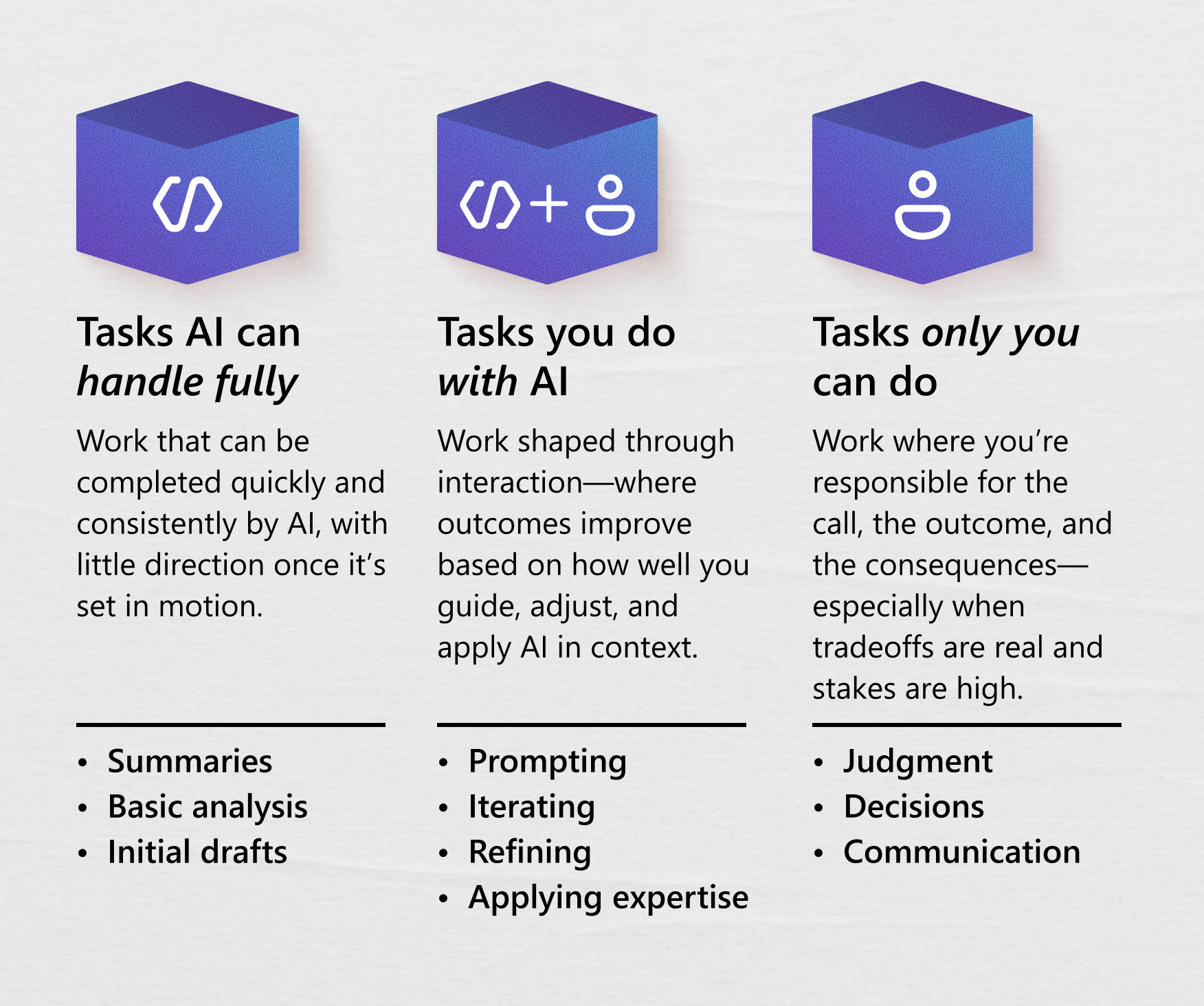
The first bucket of tasks are those that AI can handle fully—tasks that are about quick summarization, analysis, or the first draft of content.
As AI takes on more and more of those tasks, there’s the second bucket, the tasks you are going to do with AI. This is the most important bucket for everyone right now because this is where you start reshaping your role before the market does it for you. And it’s where you need to be intentional about building skill depth. Learn how to use the tools, get fluid in those tools, and then develop your uniquely human capabilities on top of that, the skills that aren’t easily reduced down to automatable tasks. This bucket is where skills compound and you start delivering new things in new ways.
And that all opens up more time and focus on the tasks in the third bucket—the one filled with tasks only you can do because it’s about judgment or decision making or communication. These skills aren’t going to disappear. And in many cases, they’re becoming even more central to what your job is.
I keep coming back to this idea that the old org chart is gone—linear ladders, predictable structures, long tenure. If that chart no longer works, what replaces it? How do leaders organize their teams now?
A lot of how work is structured today was designed for the industrial age, when the focus was efficiency and scale. Org charts emerged to bring order to that system and create predictability. But today companies need to operate more like massive startups— adapting quickly and moving people toward new opportunities and challenges. In that environment, traditional org charts can become a constraint.
Microsoft came up with a different way to think about this: the work chart. It’s pretty simple. Organize your organization around the work that needs to be done.
We’ve started experimenting with that framework at LinkedIn. Historically, a product idea has had to move through separate functions across engineering, product, and design, and then separate layers within all those functions before it makes it into the hands of actual members. The complexity and time that takes doesn’t put us in the right position to succeed. But now, AI tools have made it possible for individuals to do work across those functions and silos. So we created a new role called a builder and recruited for it in a very untraditional, but straightforward way: send us an example of something you’ve built with AI. We didn’t focus on credentials like schools or previous companies—just whether you could use these tools to build something.
Six months in, we have a group of remarkable builders, many right out of college, who are already teaching us how to think differently, build differently, and organize around the work differently.
We both talk a lot about agency at work, but we’re also watching entire job categories change almost overnight. How do you reconcile encouraging people to take ownership of their careers with the reality that AI and other forces are reshaping what work looks like?
People tend to talk about labor market shifts like the one we’re all experiencing as though a new technology comes along, everyone adopts it, and then productivity explodes. What they often don’t talk about is the messy middle, where people are trying to figure out how to adapt to that new technology, when there’s uncertainty and there’s fear and there’s job loss, and roles are being displaced or replaced or remade. Everyone’s trying to figure out, what will the next five years of my career look like?
In the face of all this change, what people need right now isn’t certainty. It’s agency. The feeling that they still have some control over what comes next.
The first step to building that agency is by shifting from a fixed mindset about what work has been to an open mindset—hence the title Open to Work. It’s all about making this your mindset moving forward. Open to change. Open to trying new things, learning new things, failing and growing in new ways. When I look at the people who are most resilient, most adaptive, most entrepreneurial, most open to leaning into moments like this, they aren’t the ones with the best credentials. They’re the ones who are open to whatever is in front of them.
You’ve got the best vantage point in the world on how careers are actually evolving—1.3 billion members, real-time data on job transitions, skills, and hiring. What’s the most surprising pattern you’re seeing right now?
Whether or not you’re changing your job, your job is changing on you. The skill sets for jobs globally have changed by about 25% since 2015, and you can expect your job to change by as much as 70% by 2030.
But what’s fascinating isn’t just how work is changing, but also how who does what work is changing. People who once felt boxed into certain jobs or career paths are now able to use AI tools to have agency in their professional lives to go and build what they want to build in the world. We’ve seen a surge in members adding “Founder” to their LinkedIn profiles, growing 60% year-over-year and tripling since 2022.
And even as the broader labor market remains sluggish, there’s another important signal: since 2023, we’ve seen a net increase of 1.3 million new AI-related roles—from data annotators to forward deployed engineers integrating AI into workflows, to data center jobs. In other words, despite the headlines, AI is creating more jobs than it’s replacing.
You’re not just writing about the future of work—you’re helping build it, especially with your role leading the team behind Microsoft 365 Copilot. What’s something you’ve learned from building Copilot that changed how you think about the future of human-AI collaboration?
Our goal is to make Microsoft Office a canvas for AI and human collaboration at scale. It’s not just about helping you to write an email, it’s putting a strategist or thought partner in your pocket while you’re writing that email. It’s not just about creating a PowerPoint presentation, it’s about giving you a professional designer at the push of a button to make that presentation look fantastic.
But as powerful as these tools are, the reality is that many people are still figuring out how to incorporate them into their day-to-day work. As they try to understand where AI can create the most value, there’s often starts and stops and a fair amount of uncertainty about the best way to move forward.
So for people getting started with AI tools, I recommend starting with the things AI is uniquely good at: searching across large datasets, summarizing documents, and quickly recalling information.
From there, look for tasks that are simply done faster with AI versus doing them manually. Early wins help build momentum.
Then ask AI to iterate with you. Like a thought partner. And don’t expect a perfect one-shot answer. Be specific about the output you want, and refine as you go. Like any new tool, it takes a little time to get into the groove.
And one practical point people often overlook: AI becomes far more powerful when it’s connected to the information you use to do your job. Giving it access to the right documents and context is what really unlocks its potential.
What excites me most is the agency these tools create. For decades, work has been constrained by time, process, and how many people it took to bring something to life. AI and tools like Copilot are starting to compress that distance, handling more of the “more, faster” work so people can focus on what only they can do.
Final thoughts
After conversations like this one, I keep coming back to the fact that the people navigating this moment best aren’t waiting for certainty. They’re forging ahead. Ryan is absolutely correct about what matters most now: this moment is still open. The choices people make in the next few years—about skills, mindset, how they use this technology—will shape the future in ways we can’t fully predict.
Open to Work is where he and Aneesh lay out what those choices look like in practice. If this conversation raised questions about your own career trajectory—and I imagine it did—checking out their book is a good next step.