
For most of my career, the defining promise of technology was information at your fingertips. The personal computer made knowledge accessible, the internet made it searchable, and mobile put it in your pocket. That shift reshaped commerce by making it easier for consumers to discover, compare, and transact.
It also created a new problem. As access to information expands, decision-making becomes the bottleneck. Anyone who has turned to Dr. Google for a diagnosis knows the feeling: you don’t leave with clarity—you leave with a long list of possibilities and very little guidance on which possibilities matter.
AI shifts the paradigm from information at your fingertips to expertise at your fingertips—guidance, interpretation, and context that helps you decide what to do next.
This won’t be limited to healthcare or shopping. It will show up in finance, travel, education, customer support, enterprise procurement—anywhere there’s a decision point between consumers and producers.
The consumer-producer system is about to change
At the highest level, commerce is an exchange between entities that produce and entities that consume. Sometimes that’s an individual buying a product. Other times it’s a business purchasing services or a patient seeking care. The “what” varies, but the structure stays the same: something is needed, something is offered, and someone has to decide and take action.
Historically, the bridge between the two sides has been information. Search engines, marketplaces, comparison tools, and recommendation feeds helped buyers see their options. But they are information intermediaries. They surface choices; they don’t carry the reasoning burden—that task is left to the human.
In an agent-mediated economy, that bridge becomes expertise, with agents on each side. A consumer-side agent represents intent, context, and constraints. A provider-side agent represents offerings, policies, capacity, and performance. Those agents coordinate to narrow the set of viable options and help the consumer make the final call.
Healthcare makes the difference obvious. Today, searching symptoms online floods you with information, not expertise. Soon, a consumer health agent will ask follow-up questions, pull in relevant medical history (with your permission), and reason through the pattern the way a clinician would. A provider-side agent will match that context against comparable cases, available pathways, and constraints like coverage and timing.
Humans still decide, but agents handle the intake and reasoning that determines where the patient goes next—instead of going to their primary care doctor with a vague complaint, the patient arrives with a clearer hypothesis and a suggested route to the right level of care.
Why expertise, not personalization, is the breakthrough
It’s tempting to describe this shift as personalization, because agents will understand your preferences, your history, and your constraints in a way that feels tailored.
But personalization is an outcome. The breakthrough is scalable expertise. These systems can interpret context, ask clarifying questions, and apply domain knowledge to guide decisions. That’s the difference between a system that helps you browse and a system that helps you choose.
It also changes the work on the producer side. When expertise moves to the interaction layer, producers need to start designing for agent interpretation. That means making what you offer easy for agents to understand, verify, and trust.
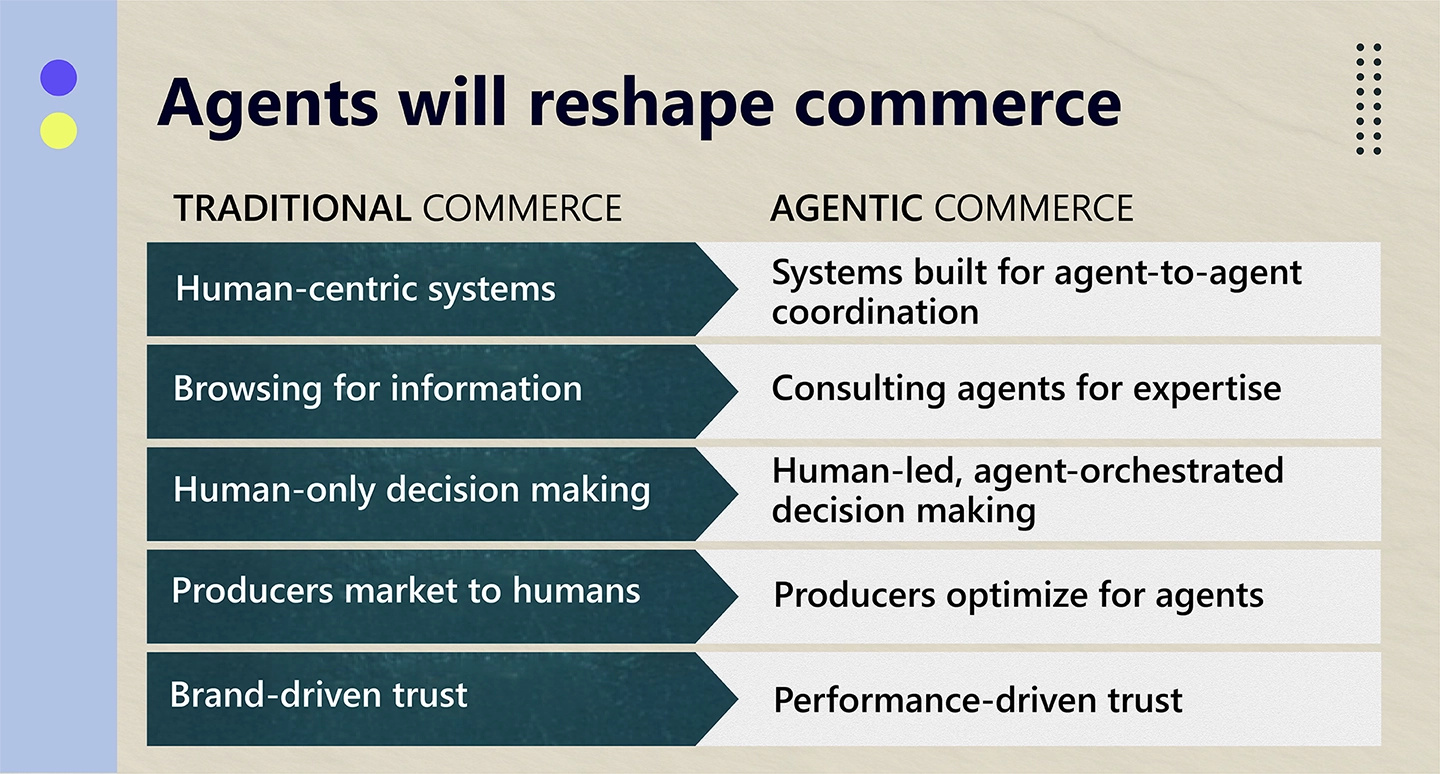
Once agents are doing the sorting, comparison, and first-pass reasoning, the center of gravity shifts.
Buyers spend less time navigating options and more time approving outcomes. Producers spend less time optimizing for attention and more time optimizing for reliable execution. And the systems underneath commerce evolve from being designed for human browsing to being designed for agent coordination.
A new tension: the principal-agent gap
In the information era, the principal and the agent were the same entity: the consumer. You searched, interpreted, and chose. There was no distance between intent and action. In the agentic era, that changes. The principal, whether that’s a person shopping or a leader making business decisions, sets the goal and constraints. Then an AI agent handles the evaluation loop—narrowing options, weighing tradeoffs, and recommending a course of action.
That shift creates speed and clarity but also introduces a new gap. Once an agent is doing the first-stage decision work, the risk moves from “did it find the right options?” to “did it choose the right tradeoffs?” How do you know it understood what mattered most—and how do you correct the agent when it optimizes for the wrong outcome?
We don’t have to resolve that tension immediately. But it will shape trust, market behavior, and how producers design offerings in a world where the buyer is increasingly represented by an agent.
What it all means for business leaders
If expertise becomes the new interface, the goal is straightforward for producers: be a business that agents can understand, trust, and recommend.
That starts with making your offerings legible—clean data, clear policies, and machine-readable structure. It also requires tightening the connection between what you promise and what you deliver, because agents will evaluate that gap faster than humans can.
On the flip side, when your business is the consumer, ensure that your purchasing agent has access to as much context as possible about what “good” looks like for the parameters that matter—price, speed, reliability, outcomes—so it can do the comparison work and your team can focus on reviewing the tradeoffs.
The firms that pull ahead won’t treat this like a marketing or purchasing shift. They’ll treat it like an operating shift: designing for agent evaluation, then using agents to move through decisions faster, with better judgment at the center.
For more insights on AI and the future of work, subscribe to this newsletter.