
Most leaders don’t have a strategy problem—they have an outcomes problem. Their decisions make sense, their teams are busy, the dashboards look fine. And yet performance doesn’t always move the way it should.
That’s because outcomes rarely hinge on a single decision or team. They’re shaped by patterns that cut across roles, functions, and time. Most of those patterns aren’t visible while the work is happening. By the time they show up in metrics, the opportunity to shape them has already passed.
What’s changing now is that AI can surface patterns no individual or team can track on their own, making it possible to understand how everyday decisions actually produce results. That shift has consequences for how expertise works inside organizations—and how leaders take responsibility for outcomes.
Human expertise doesn’t scale to organizational impact
Expertise within an organization is, at its core, pattern recognition. It develops through experience, lives inside individuals, and often resists documentation. That reality has shaped how organizations hire for and structure work. Over time, it produces familiar constraints: quality depends on who happens to be involved, and expertise remains scarce.
This creates a fragile system. When expertise lives inside individuals, execution depends on availability, continuity, and proximity. Organizations compensate with approval chains and institutional memory stored in long-tenured employees. But the underlying constraint holds: the patterns that drive real organizational impact are too large to fit inside any one person’s head—and can’t be exploited simply by adding more people.
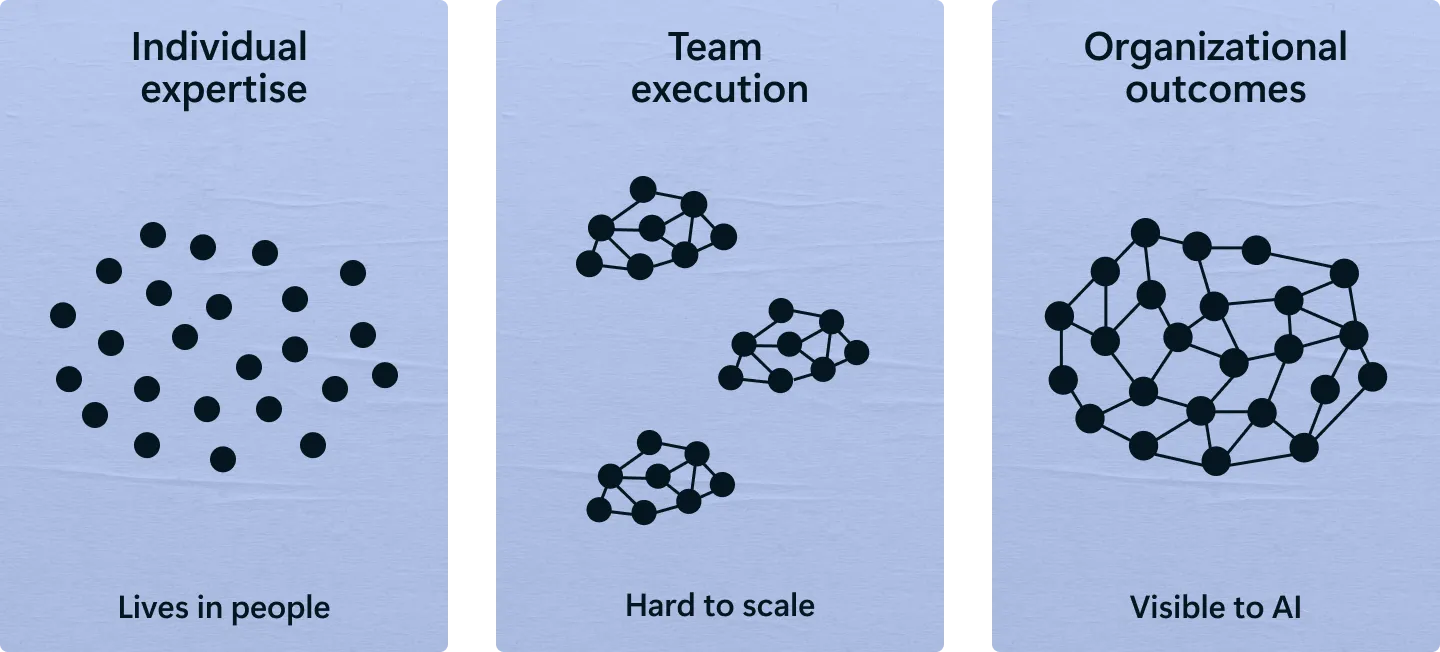
The result is a structural disconnect: improvements at the individual level don’t reliably translate into organizational performance. People move faster on their own tasks, but the system those tasks sit inside hasn’t changed. Siloes persist, and leaders struggle to build bridges between them. That’s because the patterns that produce results don’t reside in individual tasks. They emerge across them.
AI shifts that constraint. By operating across time, teams, and data simultaneously, it can surface patterns that no individual or function can reliably see on their own. That capability makes an organization’s pattern system visible—and, for the first time, operable.
What humans know—and what organizations need to see
Expertise recognizes patterns in context. AI reveals how those patterns combine to drive outcomes.
When prediction becomes a design capability
Patterns matter because they make outcomes predictable—not perfectly, but directionally enough to act. Organizations have always tried to do this through plans and forecasts. What’s different now is that predictions can be generated quickly, explored inexpensively, and tested before resources are committed.
I recently met with the team at Simile, a startup that builds AI-driven simulations based on patterns of audience behavior and decision-making. Before a company reprices a product, launches a product or service, or shifts its messaging, Simile can model how specific groups are likely to respond—testing the judgment behind those decisions before committing resources.
Here’s an example: CVS operates more than 9,000 stores. Every one of them has a shelf layout—decisions made by merchandising teams about which products go where. Those decisions were always grounded in experience and data, but the feedback came after the fact. With Simile, CVS merchandisers can now run simulated consumer responses to layout options before committing to any changes—catching sales loss from poor placement before it happens. The judgment behind the decision gets examined before it becomes a cost. That’s a different kind of organization than the one that existed five years ago.
That same logic applies to entrenched patterns inside organizations. Consider auditing. The core pattern is straightforward: structured checks and validation produce a statement that financial records can be trusted. That’s the value. But over time, a great deal accumulated around the core—travel, onsite coordination, document handling, layers of review. Those activities weren’t the source of trust. They were the infrastructure that made the pattern executable under the constraints that existed at the time. The problem is that organizations couldn’t easily tell the difference, so they built teams, workflows, and budgets around the bundled activities as if they were the core. The scaffolding became the structure.
This is exactly the kind of distinction AI can surface—not just in auditing, but across functions and industries. When you can see which activities consistently contribute to the outcome, organizations can redesign work around the patterns that deliver the most impact and pare back those that are just along for the ride.
Where leadership comes in
As more execution moves to AI systems, leadership is less about supervising tasks and more about taking responsibility for the patterns that shape outcomes. It becomes about deliberately choosing which patterns to reinforce and which to unwind, and accepting accountability for the consequences of those choices. That is a different kind of responsibility—one less concerned with managing capacity than with understanding the structures that produce value at scale.
The practical test for leaders is simple but uncomfortable: which patterns in your organization consistently produce outcomes you stand behind, and which merely organize effort without changing results? Until recently, answering that question wasn’t operationally possible. Now it is—and leadership is increasingly defined by how you act on what that answer reveals.
Some patterns are the source of your competitive advantage: the judgment calls, the customer relationships, the decisions only your organization is positioned to make well. Others are just infrastructure—necessary but not differentiating. For years, organizations couldn’t easily tell the difference, so they built teams and budgets around both. When those patterns become clearly visible, the leadership decision is straightforward, if not easy: automate what doesn’t differentiate, and shift resources to what does.
For more insights on AI and the future of work, subscribe to this newsletter.