
Every piece of software your organization runs on—your CRM, your ERP, your project management platform, your productivity suite—was built around a single assumption: that the primary user was a human being. That assumption no longer holds.
Agents are already working inside your software stack—at machine speed, without needing menus or training, handling work in seconds or minutes that used to take humans hours or days. Now the question is what that changes—and for whom.
The user has changed—and that changes everything
For 30 years, every piece of enterprise software was built around a single constraint: the human on the other end. Every feature had to be discoverable. Every workflow had to be learnable. The ceiling on what software could do was limited to what a person could navigate. When agents are doing the work, that ceiling disappears. Software no longer must reflect a choice between powerful and usable.
Evidence of that shift is already here. A finance manager on one of our commercial finance teams recently described sitting down with a messy dataset, a blank workbook, and a single goal: get to the business story faster. They asked Copilot to build a product-level pivot from a raw data pull. When the first pass came back as a full-year view, they typed back in plain English that they needed fiscal quarters—and Copilot navigated back into the source, added a column mapping every row to the correct quarter, and rebuilt the pivot. The manager kept going, asking for a Volume-Rate-Total decomposition, plus a year-over-year contribution bridge. And finally, to stress-test the output, they deliberately broke several formulas and asked Copilot to audit the whole workbook. It walked every tab, flagged every inconsistency with a severity level, and rewrote every broken formula—all while the manager answered emails and took calls on a second screen. Their reflection captures the shift: “While it works quietly in the background, we can shift our focus to insights, decision-making, and meaningful business-partner conversations.” The manager wasn’t navigating Excel. AI was.
That “quietly in the background” part matters. A lot of the most consequential agents won’t show up as a chat window at all. They’ll run headless—triggered by a policy change, a data refresh, a ticket being opened, a shipment being delayed—executing work inside systems at machine speed, then surfacing results only when a person needs to review, approve, or step in.
Our new Copilot Cowork is an agentic system that goes into the enterprise software your organization already runs and executes work on your behalf—the human states the goal, the agent does the work. It also happens to be a product that was itself almost entirely agent-written, by a handful of engineers, in weeks. In both cases, the shift is the same: agents are becoming the primary operators of enterprise software.
Software is being redesigned for agents at three layers
Agents are already working inside your tools. The platforms that pull ahead will be transformed from the data up.
What this means for the software you already own
Most of the conversation about AI and enterprise software focuses on the surface—the interface, the features, the speed. And that’s all important, but even more consequential changes are happening under the hood.
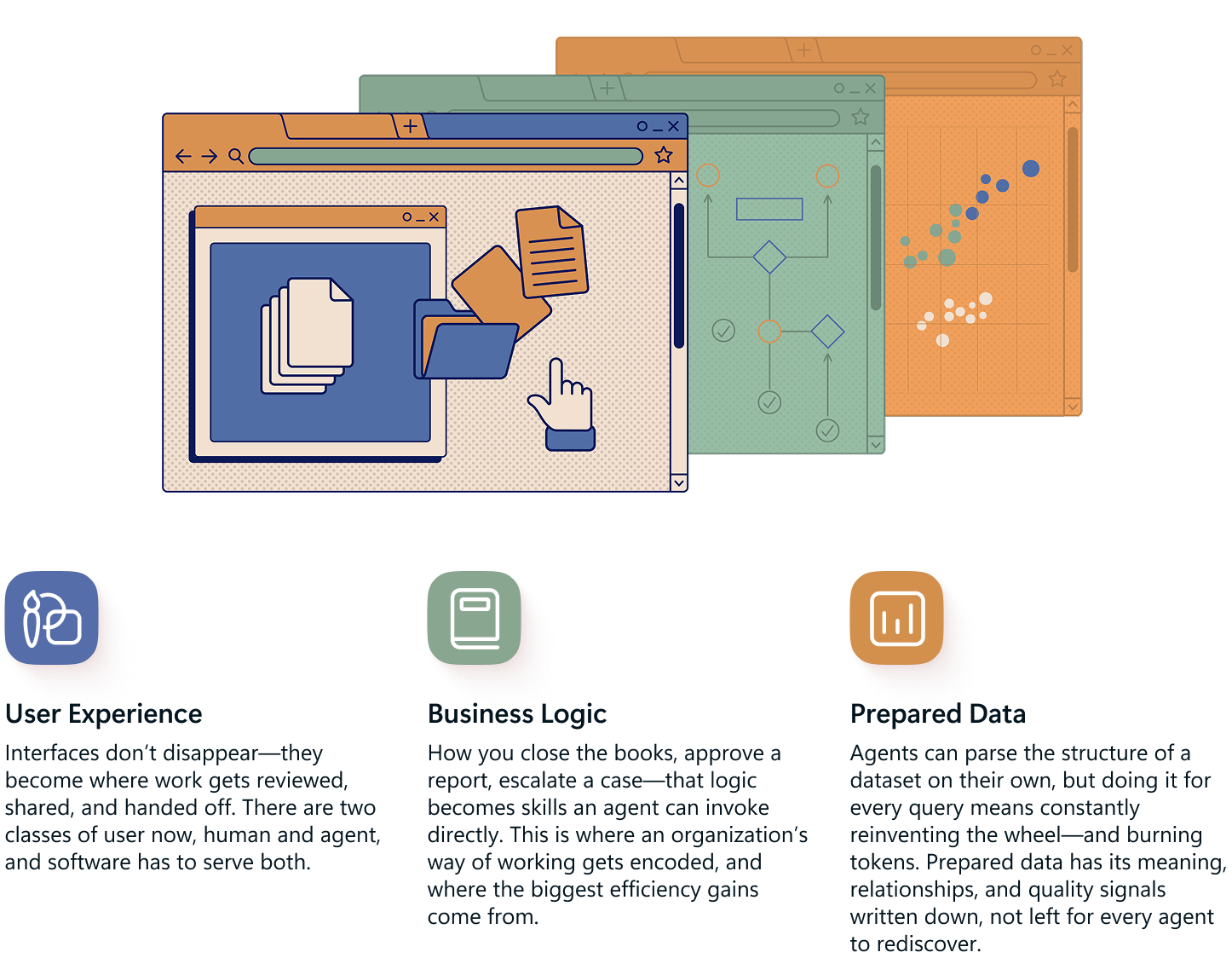
User experience. There is a view gaining traction that interfaces will disappear entirely as agents take over, but technology doesn’t diffuse that way. Adoption happens when you meet users where they are: in the tools they know and the canvases where work lives. Interfaces become the rendezvous point: where work gets reviewed, shared, and handed off. There are two classes of user now—human and agent—and software has to serve both.
Business logic. The layer that encodes how a company operates: how you close the books, how a report gets approved, and whom a case gets escalated to. Right now, that logic is embedded in workflows designed for humans. As agents take on more of that execution, it needs to be embedded in the system as skills that an agent can invoke directly. This is where the biggest efficiency gains will come from.
Prepared data. Every enterprise application stores data as a foundation for its work, but agents benefit from it being optimized for their use. Agents can figure out the structure and meaning of a dataset on their own—but if they have to do that every time someone asks a question, the AI has to reinvent the wheel over and over again. The fix is to prepare the data as it enters the system so agents can get straight to answering the question rather than figuring out what they’re looking at. Think of it as the difference between handing someone a massive pile of papers versus a well-organized brief. Same information, very different starting point.
What this means for your organization
If agents are handling more execution, and the barriers to creating software are lower than ever, a reasonable question emerges: why not just build your own? Because while building your own CRM might now be possible thanks to AI, every hour spent building and maintaining software that an off-the-shelf solution could handle is an hour not spent on the work that defines your competitive edge. The AI era is going to force a reckoning about where organizations spend their time and resources. The companies that pull ahead won’t be the ones that do the most—they’ll be the ones that are most disciplined about what only they can do. The Frontier Firms we’re seeing aren’t insourcing more—they are concentrating more.
This applies to the tools your organization already owns or subscribes to as well. Most organizations pay for software with rich features that few or no employees use. Agents will find and use those features. And eventually they may even start requesting capabilities no human user would have thought of. Software will develop faster than any individual can follow, and that makes the human layer more consequential, not less.
As human work shifts upstream—less hands-on time in the software, more time deciding what it should produce—the organizations that pull ahead will be the ones that deliberately develop their employees’ capacity to set direction, evaluate outcomes, and stay accountable for how the system performs. That’s a talent and culture investment, not a technological one. And the time to start investing is now.
For more insights on AI and the future of work, subscribe to this newsletter.