GridFM
Small foundation models for the electric grid
Technical innovations
The development of GridFM has led to the following technical innovations:
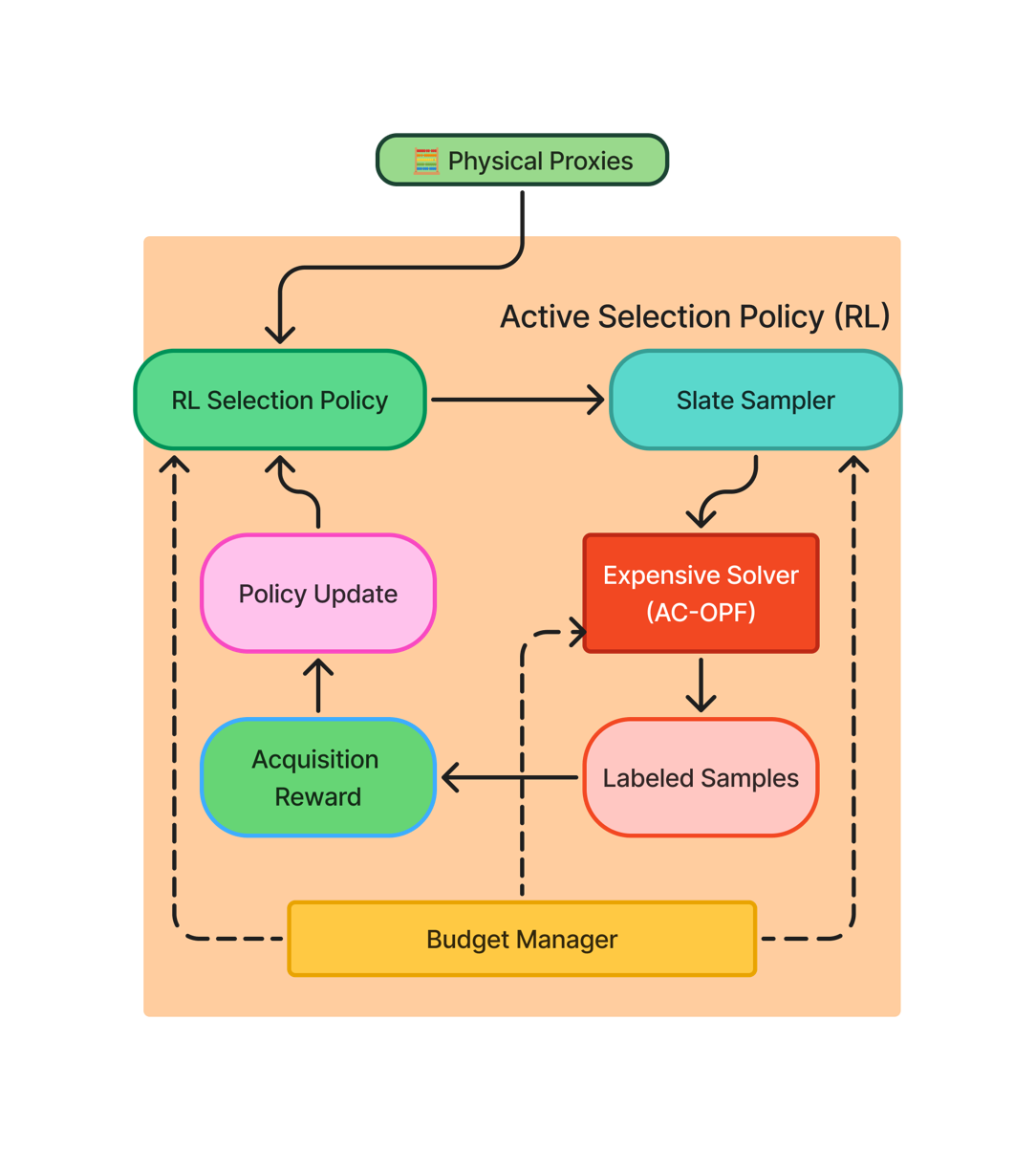
Hybrid SL + RL training
The GridFM team uses a hybrid pipeline that includes:
- Supervised Learning (SL) using classical solver ground truth
- Reinforcement Learning (GRPO) to optimize performance under physics constraints
Physics‑informed loss functions
Experiments incorporate constraints such as:
- Kirchhoff’s Current Law (KCL)
- Thermal limits
- Flow constraints
- Economic objectives
- Feasibility metrics (PQE)
These physics-informed loss functions allow the model to learn physics and how the laws impact optimal power
Integration with established AC-OPF solvers
The output of GridFM is not a guaranteed optimal solution, but it provides a great “warm start” for existing solvers. This means that utility providers can continue to rely on their certified OPF solvers but improve the solving speed by using a GridFM solution as a starting point.
Power grid topology modeling
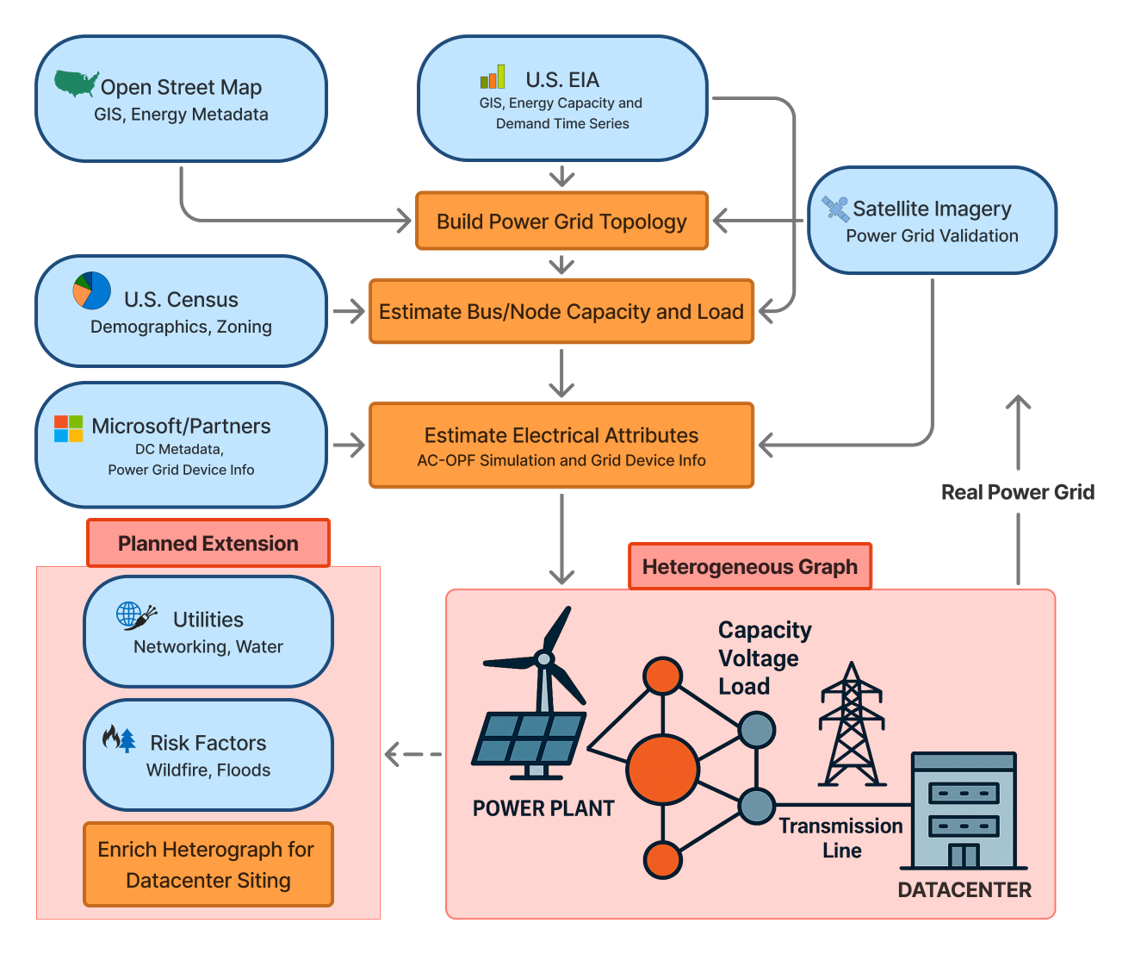
Accurate, up-to-date grid topology is largely unavailable or privately controlled. Our approach to develop accurate data for testing and training GridFM was to fuse multi-modal public and proprietary data in order to reconstruct the grid with as high fidelity as possible.
Utilizing GIS, generation and demand time-series, datacenter metadata, demographics/zoning, and satellite imagery from OpenStreetMap, U.S. EIA, and Microsoft/partners proprietary data we construct a heterograph with busses, lines, transformers, generators, and loads for training and simulation.