This is the Trace Id: a072f1012d8a2d594bad96e1d459c8dc
1/30/2025

Wipfli saves $860,000 a year with just one of many auditing and consulting solutions built using Microsoft Power Platform

Wipfli, a top US consulting and accounting firm, was looking for a new development platform that could automate processes more efficiently and better manage rapidly growing operations.

The company selected Power Platform and reduced the time it took to create a minimum viable product from months to days. These prototypes are then refined by business users working closely with professional developers to create enterprise-grade applications.

Developers at Wipfli have created thousands of apps to automate critical business processes. One auditing solution has saved over $78,000 in manual processing costs while another is on track to save the company $860,000 a year versus a third-party solution.

Wipfli

Wipfli is a top US consulting and accounting firm offering a range of services including audit, tax, advisory, and technology solutions. Serving more than 59,000 clients, the company focuses on emerging and mid-market organizations in financial services, manufacturing, distribution, healthcare, and government. With over 3,200 associates, Wipfli has offices in the US, India, and the Philippines.

Over the last decade, the company has grown tremendously, driven in part by a series of mergers and acquisitions. This brought operational challenges: How to do more with less? How to automate and standardize processes?

“We needed a new development platform that could help us automate processes, faster,” says Kelly Fisher, Practice Partner at Wipfli. The company has been building custom-coded software solutions for over 20 years. But to better meet operational goals, Wipfli has made a shift to Power Platform. “With Power Platform, we’re able to go live with applications much faster than with custom code,” says Fisher.

Zac Charnecki, Partner, Innovation & Transformation at Wipfli, elaborates, “With custom code, a minimum viable product will typically take us around six months. With low code, we can develop a prototype in a few days, if not hours.”

As a citizen developer who builds many of these prototypes himself, Charnecki acknowledges that, while these early builds may not address an entire business problem, they provide an effective starting point. “We consistently find that it’s better to develop a basic, low-code solution on Power Platform right away and work on it incrementally than wait for a custom-coded solution.”

Much of this incremental work on a prototype is done by the business users themselves. “When employees discover that they can refine a prototype in Power Platform which just a small amount of training, that’s when the real magic happens,” says Charnecki. These business users turned citizen developers use their deep understanding of the business to refine the core functionality—and then pro developers at Wipfli will often come in to complete the more complex parts of a project. In total, the company has trained over 300 citizen and professional developers on Power Platform.

“Fusion development—this close collaboration between business users and pro developers—is really the key to our success with Power Platform,” says Fisher. Case in point—an invoice processing application developed for Wipfli’s state and local tax (SALT) group.

With custom code, a minimum viable product will typically take us around six months. With low code, we can develop a prototype in a few days, if not hours.

Zac Charnecki, Partner, Innovation & Transformation, Wipfli

Automating tax auditing with a customized invoice reader

The idea for the SALT invoice processing app came up during a Wipfli leadership conference. Charnecki had been talking with the head of the SALT group about process automation using Power Platform—and this led to a discussion about a particularly labor-intensive auditing process.

To ensure the correct payment of sales tax in specific jurisdictions, Wipfli clients hand over large, digital containers of invoices for auditing. Previously, the SALT team then had to work through each invoice manually to confirm tax rates and required payments. The head of the group asked Charnecki if he could help streamline the process.

“I literally stepped away, designed a working prototype with Power Platform, and demoed it two hours later during a break between meetings,” says Charnecki. The app he created using Power Apps also leverages the pre-built invoice processing model included with AI Builder in Power Automate to look for specific fields relevant to the audit process, and check for tax inconsistencies.

What happened next was even more exciting. During an early internal trial of app, the team processed one of their own vendor invoices through the app and, to their amazement, discovered a tax overpayment. “That really motivated the team to move from prototype to production,” Charnecki says with a smile.

Working with pro developers, the SALT team refined the AI model driving the app, enabling it to account for handwritten text, landscape and vertical formatting, and other data fields. Equally important was the functionality that weeded out potential errors generated by the model. Discrepancies in invoice totals and subtotals trigger a triage report, helping the audit team zero in on errors and remediate more efficiently.

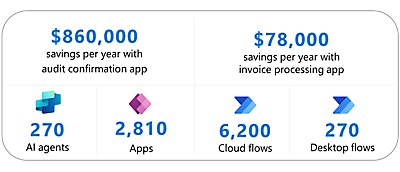
Charnecki estimates the app has already saved the company over $78,000 in manual processing costs—just in its first year of operation. The app has also turned out to be a great tool for soliciting new engagements through auditing spot checks. As Charnecki adds, “We could never duplicate this experience that quickly with custom code. Even with the lowest-cost vendor we have, we would have spent our entire annual budget with that one app alone.”

Infographic showing 270 Microsoft Copilot Studio agents developed at Wipfli plus 2,810 apps, 6,200 cloud flows, and 270 desktop flows.

Replacing off-the-shelf software with a low code solution

The SALT app is just one of thousands of apps that Wipfli has created using the same, winning process—a combination of rapid prototyping and close collaboration between business users and professional developers.

Another example: Wipfli’s audit confirmation app. An audit confirmation is a request for information from a third party to verify a client’s financial record. For example, if a client reports a receivable from a customer, Wipfli will mail a request to that customer asking to confirm the amount.

In this case, there was an off-the-shelf solution already available for digitizing the process, but it was extremely expensive. Wipfli was able to create a low code version at a fraction of the cost. Built using Power Apps, the app leverages the pre-built Adobe Acrobat Sign connector to create, send, and monitor the status of confirmation agreements.

Given the volume of confirmation requests that Wipfli sends out regularly, the company expects this app will save $860,000 a year versus their third-party solution—and that’s with only 80% of confirmations done digitally. Wipfli is confident that, with this app, they’ll be able to digitize the other 20%, generating even more savings. What’s more, the app is being re-tooled for other confirmation scenarios such as benefit plan confirmations to yield even more benefits.

Leveraging the full potential of Power Platform

Along with the use of Power Apps and Power Automate, Wipfli is leveraging other Power Platform products such as Power Pages. This includes the development of a new, more efficient customer portal.

The first phase of the project is focused on Wipfli’s audit and tax business clients to facilitate the communication and exchange of documents. There are already several thousand clients using the site with more phases planned to cover other parts of the business. Once the full rollout is complete, Wipfli anticipates over 100,000 visitors.

“With Power Pages, our cost of maintenance is significantly lower compared to our previously custom coded site,” says Fisher. The team also sees a much easier path forward for adding AI capabilities. This includes plans for development of an agent—a specialized AI assistant built using Microsoft Copilot Studio. The agent will soon support Wipfli clients accessing information on the site.

Meanwhile, Wipfli is also delivering more Power Platform solutions directly to clients. “The lower development and maintenance costs have been particularly beneficial to our mid-market clients who are often managing tight budgets,” says Fisher. That, in turn, has led to even more business opportunities for Wipfli. As she adds, “Our Power Platform practice is making a huge impact at Wipfli both internally and externally for our clients.”

Learn more about Wipfli on LinkedInFacebook, and X.

With Power Pages, our cost of maintenance is significantly lower compared to our previously custom coded site.

Kelly Fisher, Practice Partner, Wipfli

Take the next step

Fuel innovation with Microsoft

Talk to an expert about custom solutions

Let us help you create customized solutions and achieve your unique business goals.

Drive results with proven solutions

Achieve more with the products and solutions that helped our customers reach their goals.

Follow Microsoft