
Business as we know it is changing. Competitive advantage is shifting toward organizations that can harness AI to fundamentally changing the patterns of how work gets done. This enables frontier firms to innovate faster, reduce friction in execution, and dynamically respond to changing conditions in real time.
We are seeing new AI-assisted scenarios across Dynamics 365 apps and Power Platform, from natural language queries to automated decision-making. As a direct result, Microsoft Dataverse, the underlying data platform for Dynamics 365 and Power Platform, is seeing rapid growth in metadata, solution artifacts, and contextual data.
This shift is driving a new class of workloads that require significantly more storage capacity than traditional systems. As a direct result, we received customer feedback that over time the base entitlement for business apps was not sufficient to get started, which was a hinderance to innovation. Starting in December, we are implementing two updates to address customer concerns:
- Increasing baseline Dataverse capacity across business applications (Dynamics 365 and Power Platform). This includes an increase to tenant included capacity (specifics can be found on page 43 of the December Issue of the Dynamics 365 Licensing Guide under “Default subscription capacity included per tenant”). These changes ensure customers have the headroom to scale new scenarios without hitting limits. Whether you’re building Copilot experiences, orchestrating workflows, or enabling agentic apps, Dataverse now provides flexibility and capacity to support your innovation.
- Simplifying the overall storage entitlement across Dataverse and Dynamics 365 ERP applications to make capacity planning easier. This flexibility creates the foundation needed for agentic ERP at scale.
Impact on your Dynamics 365 ERP data storage licensing
For ERP customers using Dynamics 365 Finance and Operations apps, the key update is that default storage capacity is increasing and will now be reported as a shared entitlement across both the ERP operational store and Dataverse. This change gives customers greater flexibility to allocate storage where it’s needed most. Instead of managing separate pools, customers can now apply their storage entitlements seamlessly as ERP workloads grow.
- Before: Operations and Dataverse capacities were capped separately for the same F&O product.
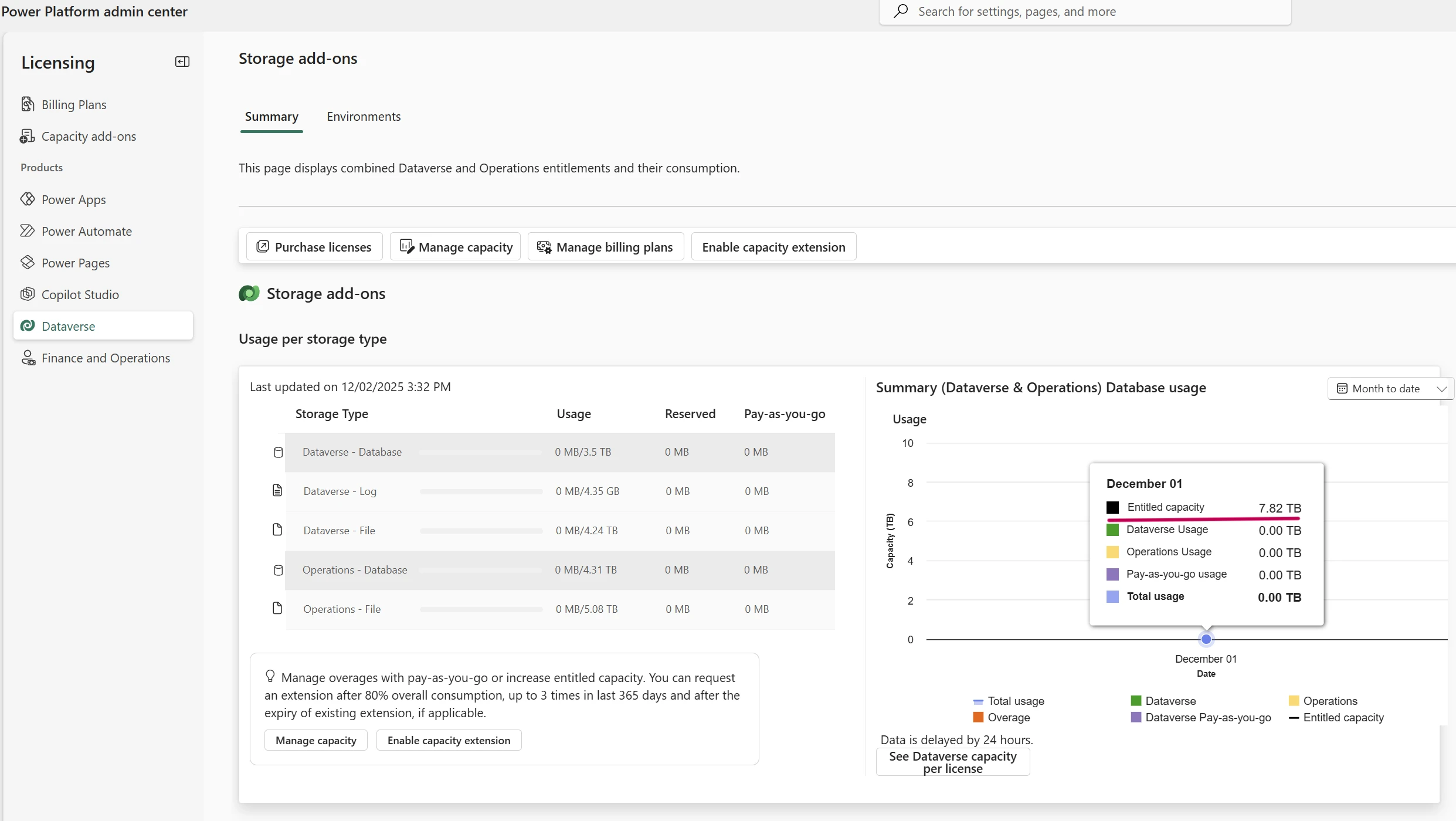
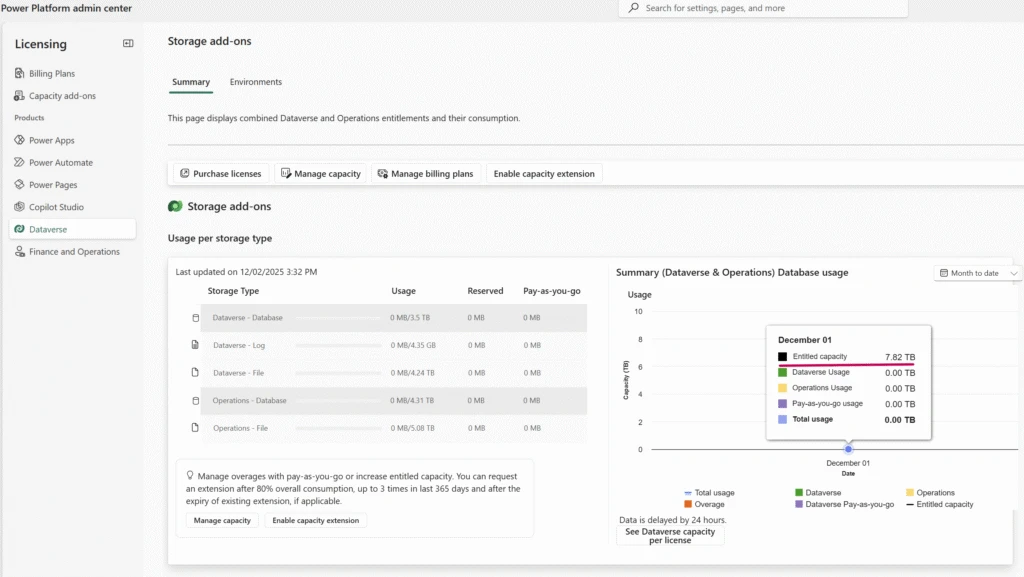
- After: Storage capacity functions as one combined entitlement that can be used for either Dataverse or ERP (see “entitled capacity” in diagram below)
This matters most for Dynamics 365 Finance Premium and Supply Chain Management Premium customers, where the combined entitlement is materially higher than either footprint alone. The increase reflects the way ERP usage is evolving — with more execution context traveling alongside the transaction. In practical terms, this means:
- If AI-assisted approvals generate more annotations or reasoning context, that growth can be absorbed without Dataverse becoming a limiting factor.
- If supplier or operational workflows accumulate larger supporting files, attachments now draw from the full entitlement rather than a smaller segment.
- If orchestration or exception resolution produces more state and process history, it scales as part of ERP rather than hitting a cap early.
Under the previous entitlement model, Dataverse could fill more quickly than the ERP store even if total tenant capacity remained. Under the new model, capacity follows usage — not a system boundary.
Why this accelerates system-of-action ERP
When ERP is purely a system of record, storing the final outcome is enough. But when ERP becomes a system of action, it must also retain how and why an action was taken — not just what was recorded.
The contextual data that enables agentic execution can no longer sit at the edge of the system. It becomes part of the operational story. This update aligns the storage model with that reality, giving organizations the flexibility to modernize without re-engineering their data footprint or rethinking where contextual data is allowed to live.
Capacity now reflects the purpose of ERP in the AI era — not only documenting the state of the business, but helping drive what happens next.
Looking ahead: modernizing storage entitlements
By modernizing storage entitlements now, we are ensuring customers have the runway to support that growth — not after they hit constraints, but ahead of it. This removes friction from ERP transformation and positions organizations to move confidently toward AI-enabled operating models.
The latest Dynamics 365 Licensing Guide reflects the changes and no customer action is required. The updated entitlements will be reflected automatically in Power Platform admin center as the new model takes effect. As these capabilities roll out, customers will gain additional flexibility to grow agentic ERP workloads with confidence, knowing their storage model now matches the future of ERP. To learn more, please review the following resources:
- Review the updated licensing guide: Dynamics 365 Licensing Guide
- Read docs: Dataverse capacity-based storage overview – Power Platform | Microsoft Learn
- Read docs: Finance and operations storage capacity – Power Platform | Microsoft Learn