
As we step into 2026, the era of AI experimentation is officially over.
For three years, enterprises tested, piloted, and explored. They spun up proofs of concept. They evaluated dozens of vendors. They waited to see what would stick. That phase is done.
Now, chief information officers (CIOs) are consolidating. Chief financial officers (CFOs) are demanding measurable returns. Procurement teams are cutting the tools that never made it past pilots. The enterprises that were cautious buyers in 2024 and 2025 are becoming decisive buyers in 2026, but only for solutions that deliver real, quantifiable impact within quarters, not years.
For founders building enterprise products, this shift changes everything. The bar for attention is higher. The tolerance for “potential” without proof is gone. But for startups that can demonstrate outcomes, the opportunity has never been larger. Enterprises are ready to spend, and spend significantly, on the AI solutions that work.
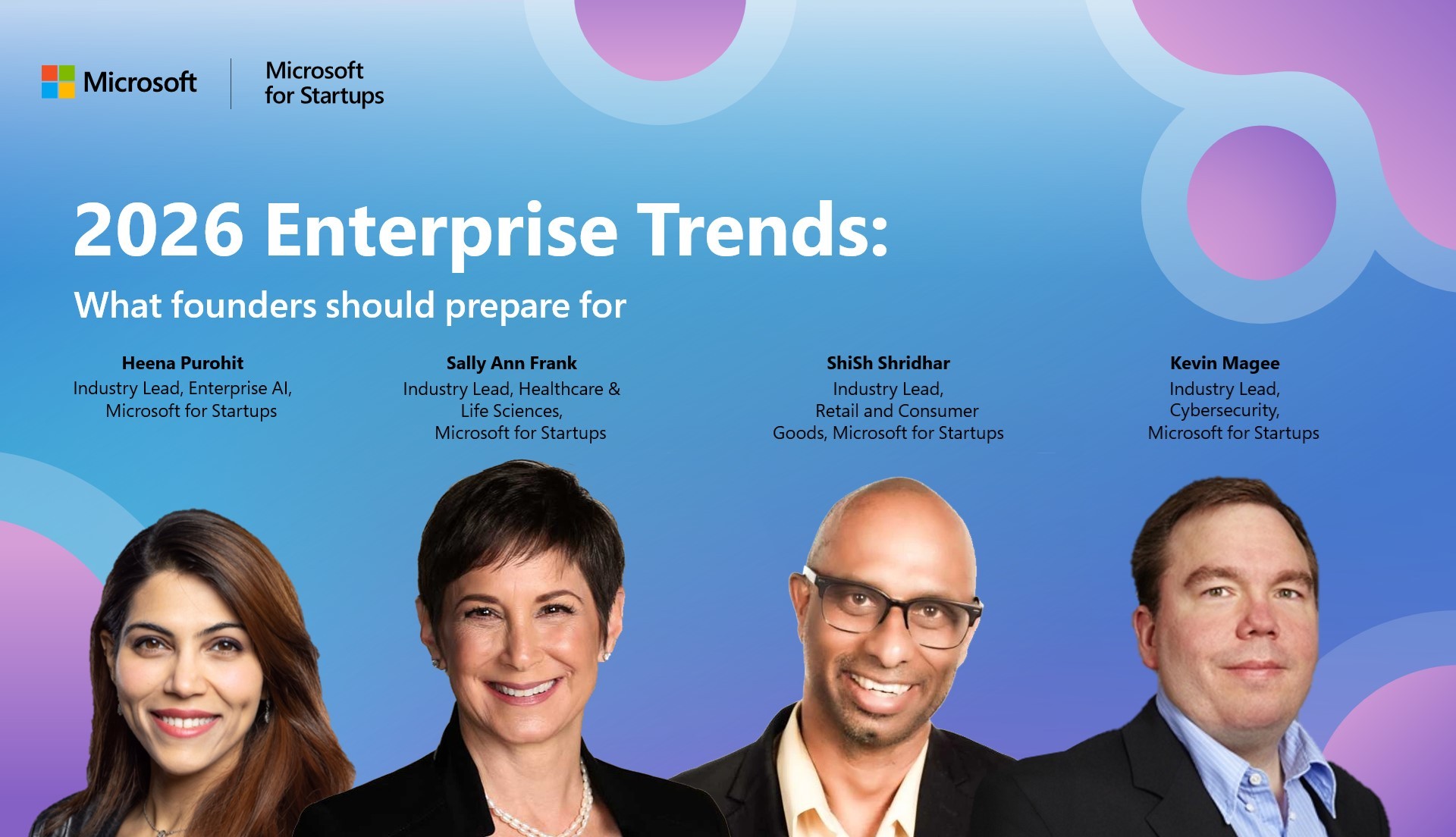
We asked four of our industry experts to share what they are hearing directly from enterprise buyers. These are the people who sit in rooms with CIOs, chief information security officers (CISOs), and transformation leaders every week. They see the patterns before they hit the headlines. Here is the one trend each of them says founders need to understand right now.
Healthcare and life sciences: From AI novelty to AI maturity

Sally Ann Frank, Industry Lead, Healthcare and Life Sciences, Microsoft for Startups
“The conversation has completely shifted. Two years ago, healthcare leaders were excited about AI’s potential. Now they’re overwhelmed. They’re dealing with legacy systems, manual clinical and operational processes, fragmented workflows, and rising expectations created by generative AI. What they’re asking for is very specific: AI tools that are secure, governed, compliant, interoperable, and capable of scaling across complex clinical, research, and commercial environments. The appetite for ‘innovation theater’ is gone. In 2026, healthcare and life sciences will be defined not by AI novelty, but by AI maturity, trustworthiness, and measurable business value.”
The trend: The experimentation phase is over. Healthcare providers, payers, and life sciences organizations are done with prototypes. They want production-grade solutions that integrate into existing workflows, reduce operational burden, and deliver real return on investment (ROI). Pilots still have a place, but only as a stepping stone to full production implementation.
Actionable advice: Anchor your solution to specific, validated pain points that large healthcare and life sciences enterprises actually face: workflow efficiency, revenue leakage, research and development acceleration, patient throughput, care team effectiveness. Build enterprise-grade architecture from day one, including robust data governance, clinical safety guardrails, patient information security, auditability, and integration into Electronic Health Record (EHR), Enterprise Resource Planning (ERP), and Revenue Cycle Management (RCM) ecosystems.
Most importantly, shift from technology-led pitches to outcome-led value propositions backed by disciplined pilots, customer-validated metrics, and transparent total cost of ownership. The startups that win this year will combine deep technical excellence with domain credibility, mature delivery capabilities, and the ability to remove friction from how enterprises adopt and operationalize AI.
Retail and consumer goods: Commerce in an agentic AI world

ShiSh Shridhar, Industry Lead, Retail and Consumer Goods, Microsoft for Startups
“The most important change is not better chat or smarter recommendations. It is delegation. Consumers are beginning to outsource decisions, not just discovery. In retail, that means agents that compare products, manage subscriptions, rebalance inventory, negotiate pricing, trigger replenishment, and transact without human approval each step of the way. This is the moment where the unit of commerce stops being the click and becomes the outcome. Value is created not in the interface, but in how these agents coordinate in real time. This is why Agentic Commerce is not a user interface (UI) shift. It is an operating model shift.”
The trend: Agentic Commerce is quietly crossing the point of no return. What began as experimentation with copilots and conversational interfaces is now evolving into autonomous, goal-driven agents that act on behalf of consumers, employees, and brands. Across the Consumer Electronics Show (CES), National Retail Federation (NRF), and World Economic Forum (WEF), a consistent signal has emerged. Commerce is shifting from interfaces to intent. Agents are no longer assisting the journey. They are executing it.
Actionable advice: Builders and operators should stop asking how humans interact with software and start asking how agents interact with systems. If your product requires manual workflows, static dashboards, or human-in-the-loop decisions for routine actions, it will be bypassed. Design for machine-readable intent, outcome-based APIs, and trust primitives like identity, permissions, and policy enforcement. Agentic Commerce rewards infrastructure over interfaces and coordination over control. Data, content, and execution engines that agents can reason over will matter more than front-end experiences. The next generation of retail winners will not sell to users. They will interoperate with agents.
Further reading:
- Why agentic commerce is rewriting retail
- How AI agents are shifting work from tasks to outcomes
- Signals from CES, NRF, and WEF on agent-led commerce
Cybersecurity: AI is both the problem and the answer

Kevin Magee, Industry Lead, Cybersecurity, Microsoft for Startups
“CISOs have stopped asking only ‘how do we lock down AI?’ and have started asking ‘how do we use AI to fix what has been broken forever?’ Analysts drowning in alerts. Vulnerability backlogs growing faster than anyone can remediate. Compliance programs consuming entire quarters to produce snapshots already obsolete. These problems burn out good people. And the platforms and tools we have invested in for years are now, with AI, reaching the point where they can genuinely solve them at scale.”
The trend: In 2025, AI became one of the largest new attack surfaces enterprise security had ever faced. Last year, every Chief Information Security Officer (CISO) conversation I had centered on AI sprawl. Business units deploying agents faster than security could catalog them. Models trained on proprietary data, autonomous systems with broad access, citizen developers quietly sidestepping every control we had spent years constructing. We have seen this before. We saw it with software as a service (SaaS). We saw it with cloud. Adoption races ahead of governance, and security scrambles to catch up.
In 2026, it is becoming something else: an accelerant capable of making the tools we already rely on orders of magnitude more effective. That is what will define 2026. The startups gaining traction are not positioning as “AI security” vendors. They are solving specific operational pain with AI as the engine. Faster triage. Continuous governance. Real remediation that closes the loop. The budget conversation is moving into the boardroom, and the question is no longer “how much do we spend on defense?” It is “how does security enable the business to move faster?”
Actionable advice: For enterprise leaders, audit where teams spend the most hours on repetitive work and start there. Prioritize solutions that integrate deeply with the security stacks you’ve already invested in, like Microsoft. Present security as a business enabler, not overhead.
For founders, pick one operational motion and own it completely: automate, remediate, or govern. Integrate deeply with the stacks your customers already run, like Microsoft Sentinel and Microsoft Security Copilot. Help your champions tell a story their CFO understands.
Enterprise AI: The year of ROI reckoning

Heena Purohit, Industry Lead, Enterprise AI, Microsoft for Startups
“Enterprises are prioritizing AI investments with measurable P&L impact: revenue acceleration through increased conversion rates, larger deal sizes and reduced cycle time, cost reduction through fewer errors requiring rework and reduced spend, and risk management through lower churn and better contract enforcements. These are examples of initiatives that can drive margin improvement. We’re also seeing organizations replace vanity metrics with next-generation measures. Instead of task completion rates, leaders are now measuring Agent Value Multiple, which captures value generated per agent cost. They’re tracking metrics like Agent Cost Per Completed Task and Context Memory Optimization to manage token consumption.”
The trend: After two years of AI experimentation, boards and CFOs are demanding proof that AI investments hit the profit and loss (P&L), not just the productivity dashboard. The data is stark: 74% of AI leaders report productivity gains from AI in the form of time saved, but only 11% say their organization has seen measurable financial value from AI in 2025.1 Time saved is not money saved, and that gap is forcing a fundamental shift in how enterprises evaluate, measure, and fund AI initiatives.
Actionable advice: Founders must help their customers drive measurable, demonstrable value. This requires changes at multiple levels. On the product side, build key performance indicator (KPI) tracking into your solution and give customers dashboards showing before-and-after deployment impact. Provide benchmarking data to help them set goals. In short, help them create a business case for you. Also explore aligning software pricing to business outcomes, like charging per outcome delivered rather than per user.
On the customer success side, teach your customers how to convert time saved into money saved. That requires deliberate process redesign: doing more with fewer resources as demand increases, repatriating outsourced work, compressing experience curves so juniors perform like seniors, and using newfound capacity to grow revenue rather than absorb slack. Forward-deployed engineers not only support successful implementation; they can also become an additional revenue stream. If you’re not helping customers through this transformation, you’re leaving value on the table and making yourself easy to cut.
The bottom line
Across every industry our team covers, enterprise buyers are sending the same signal: show us the impact or show yourself out.
The startups that will win in 2026 share common traits: they’ve moved beyond pilots to production, they’re measuring outcomes in quarters not years, and they’re building solutions that fit into an increasingly autonomous enterprise landscape. Whether it’s AI agents making decisions, security systems operating at machine speed, or commerce happening without human initiation—the future is arriving faster than most founders expect.
Our industry experts are here to help you navigate this landscape. If you are building in enterprise AI, cybersecurity, retail, or healthcare and want to connect with our team, we would love to hear from you. The buyers are ready. The question is whether your startup is ready for them.
Meet our industry experts
- Tom Davis—Partner, Microsoft for Startups
- Sally Ann Frank—Industry Lead, Healthcare and Life Sciences
- ShiSh Sridhar—Industry Lead, Retail and Consumer Goods
- Kevin Magee—Industry Lead, Cybersecurity
- Heena Purohit—Industry Lead, Enterprise AI
1Gartner Business Quarterly, Q1 2026.