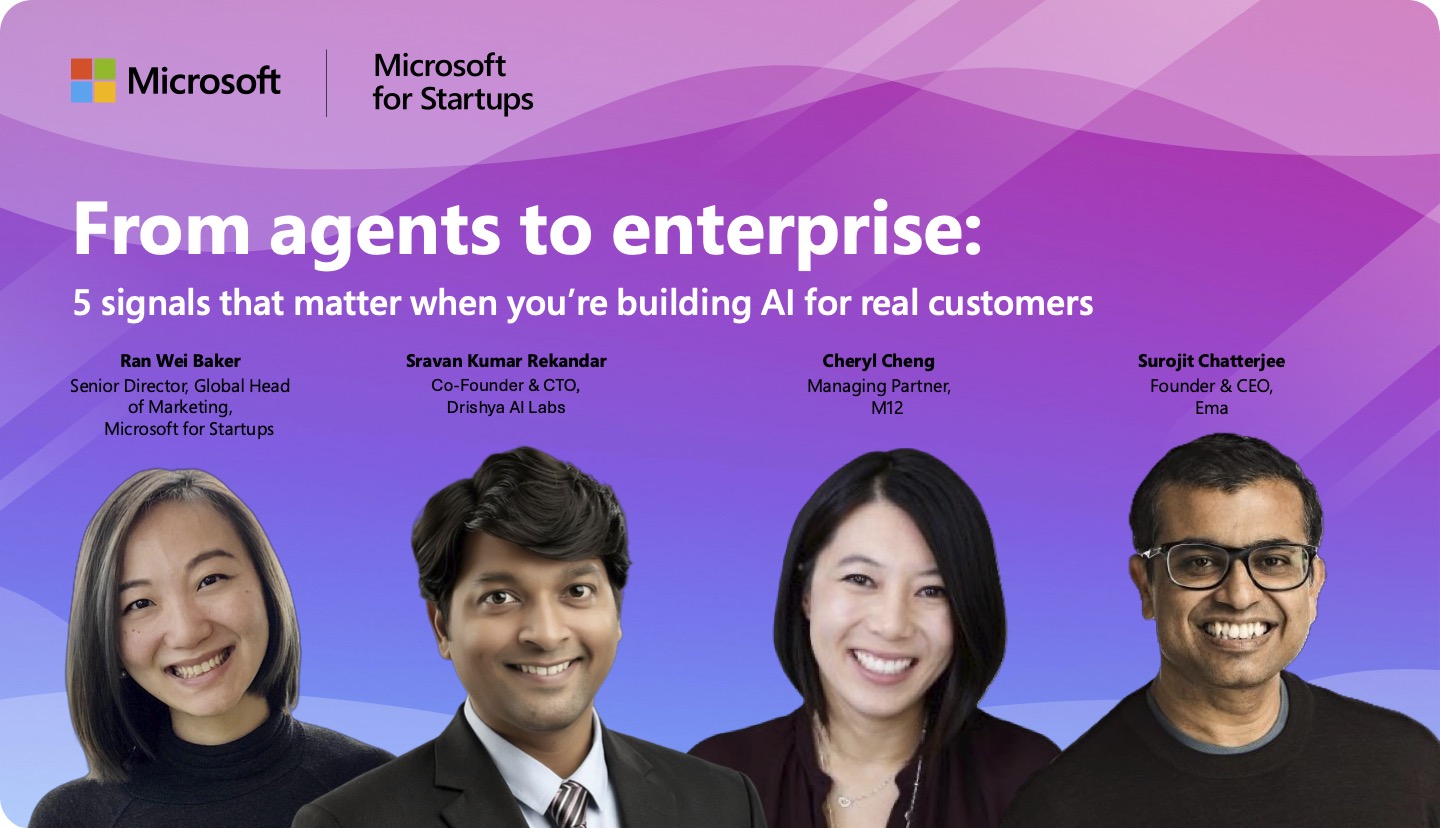

At Microsoft for Startups, we work with founders and ecosystem partners every day to help startups translate early momentum into solutions enterprises can truly adopt securely, reliably, and at scale.
As a part of Asian American and Pacific Islander (AAPI) Heritage Month this May, we’ve been connecting with founders, investors, and ecosystem leaders across our community who are shaping this next wave of AI to better understand what it takes to move from promising demos to enterprise-ready systems.
This perspective draws on insights from across that ecosystem, including:
- Surojit Chatterjee, Founder and CEO of EMA
- Sravan Rekandar, Co-Founder and Chief Technology Officer (CTO) of Drishya AI
- Cheryl Cheng, Managing Partner at M12, Microsoft’s venture fund
What stood out in these conversations wasn’t just what these companies are building, but how consistently the same patterns show up. You see it in how founders operate inside systems, and in how investors see those patterns repeat across portfolios.
The bar for AI has shifted. It’s no longer enough to demonstrate what a model can do. The companies breaking through are the ones that can show how their systems hold up inside real enterprise environments, where reliability, security, and operational fit are tested every day.
Across those conversations, five signals continue to emerge:
1. Enterprise readiness starts with understanding real workflows
In enterprise environments, shifts happen quickly. Early on, you’re showing what the AI can do. But as soon as you engage real teams, the focus moves to where it fits into existing workflows and systems.
AI systems are increasingly doing the work, not just supporting it. Because of that, understanding enterprise workflows, which are often far more complex than small and medium-sized business (SMB) or mid-market environments, becomes critical.
You can see this in how companies are approaching product design:
- At EMA, this shows up in the concept of “AI employees,” designed to operate directly within enterprise workflows and handle multi-step tasks across systems rather than sitting alongside them.
- At Drishya AI, it shows up differently. “We chose to build on computable, contextual models instead of relying purely on prompts.” Over time, those computable models became the foundation for their generative AI agents, grounding prompts in a structured engineering context to ensure accuracy and reliability.
Across both approaches, the pattern is consistent: enterprise readiness isn’t defined by the model. It’s defined by how deeply the system fits into a workflow.
2. The best AI companies build for production from day one
There’s a clear distinction between companies building for possibility and those building for production.
In enterprise environments, systems must be:
- Reliable under real-world conditions
- Explainable and auditable
- Consistent over time
The challenge isn’t just getting AI to work. It’s making it trustworthy.
At Drishya AI, this shows up clearly. As Sravan Rekandar, Co-Founder and CTO of Drishya AI, put it: “The biggest challenge isn’t building AI, it’s making it trustworthy within complex, real-world environments.”
That emphasis on trust extends beyond the application layer. It also depends on the infrastructure that AI systems run on, especially in enterprise and regulated environments where reliability, security, and compliance are expected.
Across the startups we work with, this often shows up in how teams leverage platforms like Azure to:
- Support consistent performance at scale
- Meet enterprise security and compliance requirements
- Enable integration with existing enterprise systems
At the same time, enterprise buyers are raising the bar. They’re no longer evaluating whether AI works. They’re evaluating whether it can be deployed and relied on in production.
That means demonstrating:
- Measurable, near-term ROI
- Clear movement from proof-of-concept to production
That bridge from experimentation to traction is where many companies stall. If you optimize for demos instead of deployment, you will struggle to cross the enterprise gap.
3. Your moat isn’t your model, it’s your workflows and data
One of the most persistent misconceptions in AI is where defensibility comes from.
Model advantage alone doesn’t hold for long. What compounds is:
- Proprietary or hard-to-replicate data
- Deep integration into workflows
- Systems that become part of how work gets done
Across what we hear from both founders and investors, this shift is becoming increasingly clear. As Cheryl Cheng, Partner at M12, notes, “Companies often think they have more of a moat than they do. In the AI world this often means believing that your model is your moat. It isn’t. The moat is in the data and, more importantly, in the workflows.”
You can see this play out across different approaches:
- EMA’s defensibility grows as its systems become embedded into enterprise workflows and part of how work gets executed day to day.
- Drishya’s defensibility grows as its contextual engineering foundation enables scalable, structured intelligence across industrial systems.
From a founder perspective, this shift also shows up in what proves you’re operating beyond experimentation. If your differentiation lives only at the model layer, it won’t hold. Depth in workflows and data is what compounds over time.
4. Enterprise scale depends on systems, not just technology
The move from early traction to enterprise scale is where everything changes.
At this stage, success looks less like better AI and more like systems design:
- Deployment models that work across large organizations
- Integration into existing processes and infrastructure
- Clear paths to adoption and change management
Different companies approach this in different ways:
- EMA focuses on structured deployment within enterprise workflows, ensuring their systems can operate across functions and environments.
- Drishya builds a contextual engineering intelligence platform that has evolved from Piping and Instrumentation Diagram (P&ID) digitization into a broader system spanning Hazard and Operability Study (HAZOP), fabrication packs, simulation automation, data quality, and asset intelligence. This allows them to scale use cases while staying enterprise-ready.
But the underlying principle is the same. AI doesn’t scale in isolation. It scales as part of a broader system.
This is where enterprise expectations become more explicit. It isn’t just about technical performance. It’s about how well a system integrates, operates, and delivers value at scale.
Surojit Chatterjee, Founder and CEO of EMA, highlighted what real scale looks like in practice, in that “foundation now powers real deployments like Sky, the AI Employee we built for Hitachi Digital that lives inside Microsoft Teams and handles more than 100,000 Human Resources (HR) questions a year across their global workforce.”
5. Constraints create clarity, especially early on
In a market where capital and hype can pull teams in many directions, constraints can be a feature, not a bug.
Early-stage focus forces the most important decisions:
- What problem actually matters
- What workflow to prioritize
- What not to build
There’s also a common misconception that scale, whether in funding or valuation, is the primary signal of success. In practice, what matters more is clarity. That clarity is especially critical when selling into enterprise.
Enterprise customers don’t buy broad capability. They buy specific solutions to well-defined problems within a workflow. The faster a startup can articulate that, the faster it can move from experimentation to real traction.
In many cases, capital constraints plays a useful role in enforcing that discipline. Cheryl also shared an insight that “capital constraints in the early days are a good thing because you’re forced to make critical product and strategy decisions that create focus.”
From a go-to-market (GTM) perspective, that focus shows up in a few important ways:
- Clearer positioning, anchored on a specific workflow
- Faster enterprise buy-in, since buyers can map directly to existing processes
- Stronger ROI narrative, making it easier to justify internally
- More disciplined expansion, where a single workflow becomes a wedge into broader adoption
Without that constraint, it’s easy to overbuild for breadth while missing depth where it matters most.
The companies that break into enterprise aren’t the ones that can do everything. They’re the ones that solve one critical workflow exceptionally well.
From AI possibility to AI accountability
Across all five signals, one broader shift is emerging.
We’re moving from an era of AI possibility to an era of AI accountability.
The companies that succeed won’t just be the ones building impressive technology. They’ll be the ones that:
- Integrate into real workflows
- Deliver measurable outcomes
- Earn trust in enterprise environments
And as we continue to highlight AAPI founders and leaders this month, what stands out isn’t just the diversity of backgrounds. It’s the consistency in how many are approaching this moment.
They’re grounded in real systems, focused on real workflows, and ultimately, driven by real impact.
For founders building today, the question is no longer whether they can build something impressive, but whether they can build something enterprises today can actually rely on.
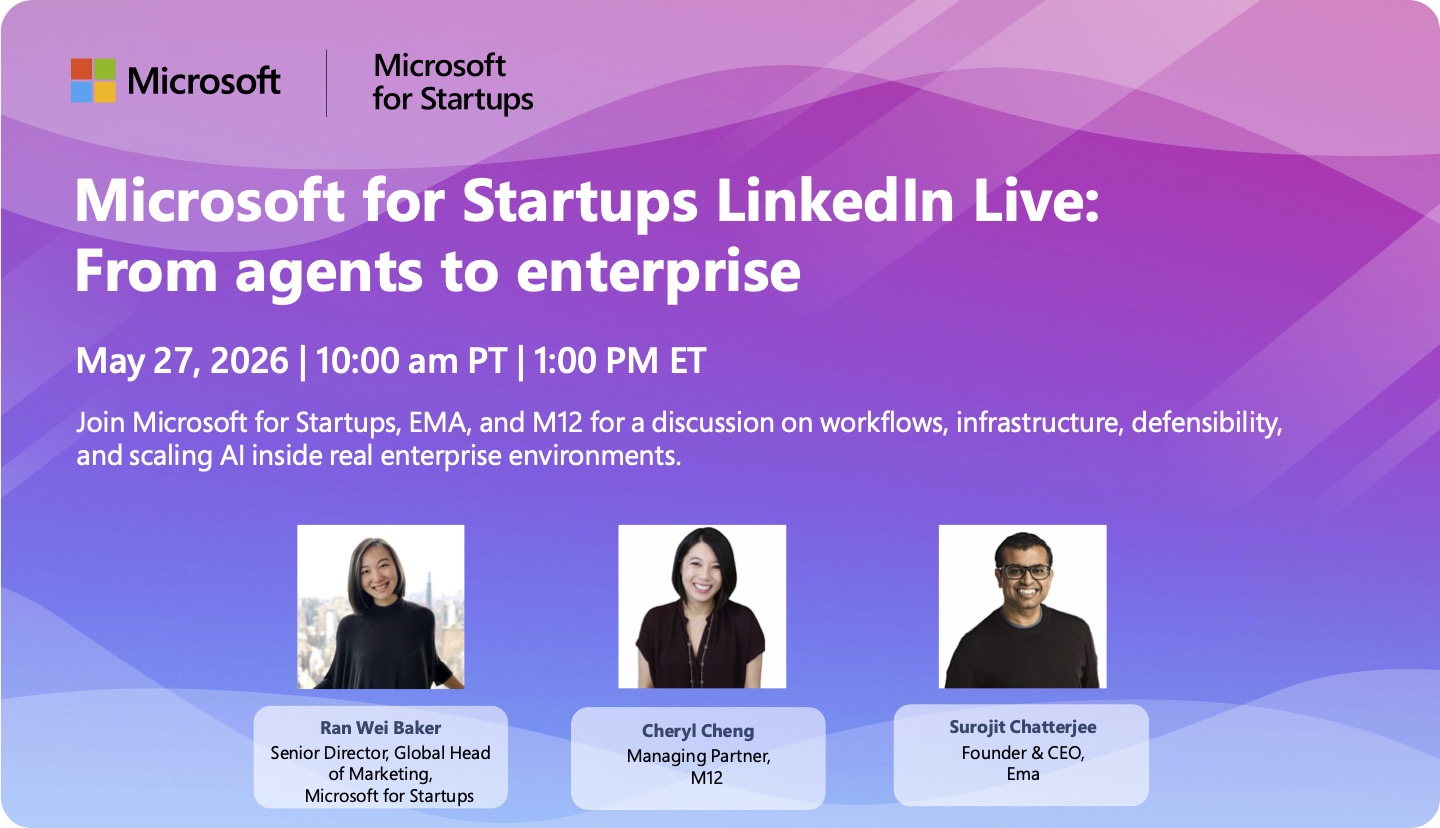
Join the LinkedIn Live conversation
Want to hear more from the leaders featured in this article? Join Ran Wei Baker, Cheryl Cheng, and Surojit Chatterjee on May 27, 2026, for a LinkedIn Live conversation on what it takes to build AI for real enterprise customers.
Register here: LinkedIn Event
Get started with Microsoft for Startups
If you’re building AI and thinking about how to move from early traction to enterprise readiness, you don’t have to do it alone.
At Microsoft for Startups, we partner with founders at every stage to help translate promising ideas into scalable, enterprise-ready solutions, through access to Startup credits across Azure and GitHub, technical guidance, and a global ecosystem of partners and customers.
Apply to Microsoft for Startups to get started.
Access your startup benefits today
Microsoft for Startups helps founders build fast, scale smart, and sell more. Apply today to unlock up to $150,000 in Startup credits to start building immediately.