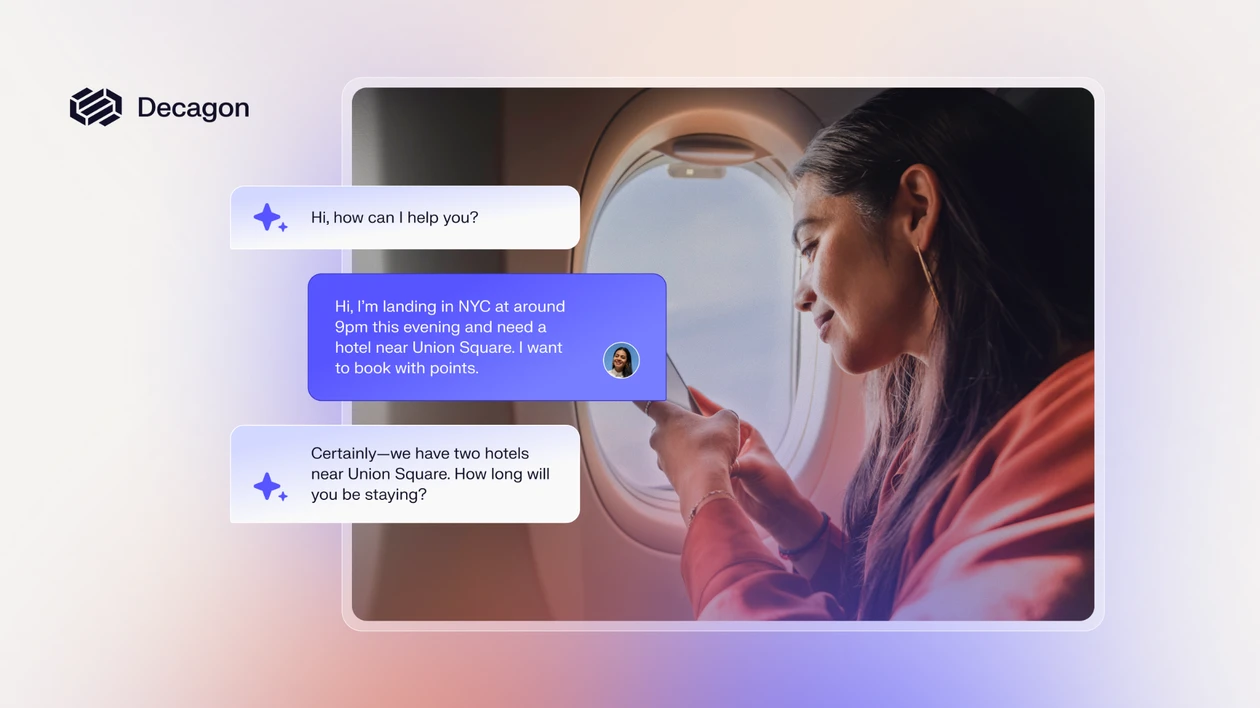

We’re delivering the always-on concierge experience your customers deserve.
—Ashwin Sreenivas, Cofounder and Chief Technology Officer, Decagon
Transforming customer experience
Decagon is quickly transforming the enterprise customer experience from rigid and generic to adaptive and personalized thanks to its unified, AI-native platform that brings agent development, testing, analytics, and deployment into one place.
Founded in 2023 by Ashwin Sreenivas and Jesse Zhang, the fast-growing company set out to put the some of the best artificial intelligence to work for the enterprise in a meaningful way, and quickly found the pain of the chatbot era was the perfect opportunity for not just important disruption, but real and measurable transformation.
Now, many of the world’s most respected enterprise companies rely on Decagon to build, manage, and scale AI agents that are capable of resolving millions of customer inquiries across chat, email, and voice—24 hours a day, 7 days a week.
- Enabled businesses to achieve average deflection rates nearing 70%, with many businesses like Duolingo achieving deflection rates well above 80%.
- Driven customer satisfaction score (CSAT) improvements for leading enterprises, with beloved brands like Oura reporting three times CSAT increases.
- Reduced the cost of support conversations, with popular consumer platforms like ClassPass reporting a 95% decrease in the cost of support conversations.¹
The future is agentic AI
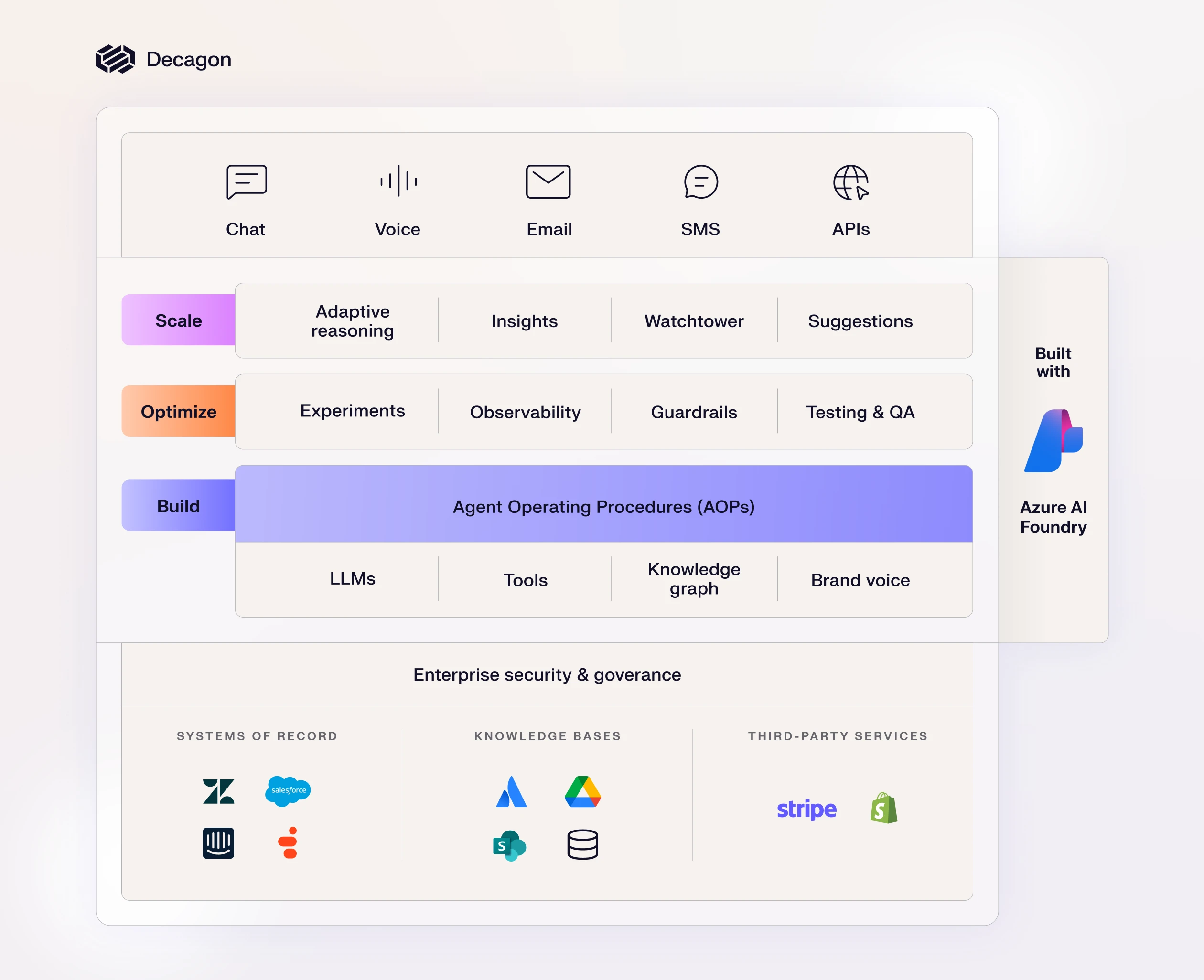
Decagon makes it easy to build a flexible, intelligent, and deeply human customer concierge experience for any enterprise use case. And even within a highly competitive landscape, Decagon goes one step further than the rest with its Agent Operating Procedures (AOPs)—natural language instructions that compile into structured logic for agents to reliably execute workflows. AOPs let teams teach their agents the same way they’d onboard a new teammate, describing what to do, how to do it, and under what conditions to adapt. The result is human-readable, machine-executable reliability.
Decagon’s approach eliminates the friction of traditional coding-heavy software development kits (SDKs) that function as black boxes for business users. Now, customer experience (CX) and product teams can directly design, test, and refine agent behavior without asking for engineering resources or relying on expensive professional services. At the same time, Decagon’s AOPs give technical teams full control over how the agent operates under the hood. They can:
- Write tools that extend AOPs by triggering actions in core systems (customer relationship management, billing, fulfillment, and more.)
- Integrate internal knowledge bases to inform the agent’s reasoning and ticketing systems and contact center as a service (CCaaS) platforms to escalate conversations when needed.
- Manage version control through Git and connect to custom alerting tools like PagerDuty, Slack, or email.
The result is a new model for enterprise AI that is fast, secure, personalized and adaptable.
The Microsoft Azure advantage for fine-tuning Decagon’s concierge AI
Customer experience shouldn’t be a cost center. It should be a growth driver that delivers personalized, concierge-like interactions across every channel.
—Cyrus Asgari, Lead Research Engineer for fine-tuning, Decagon
To deliver all day, every day concierge AI for its customers, Decagon has to ensure its agents can handle any situation or scenario. To do so, Decagon runs a multi-model AI stack designed for agent orchestration at scale. Microsoft Azure plays a central role in this ecosystem by helping host a diverse set of models, and Decagon leverages Azure to host both off-the-shelf and fine-tuned variants, deployed across regions for low-latency, high-availability inference. This architecture enables Decagon to deliver enterprise-grade reliability while retaining the flexibility to orchestrate specialized models within its agent pipeline.
During the fine-tuning process, the Decagon team discovered that models could easily become too narrowly focused on specific patterns in the training data, a problem known as overfitting. To overcome this, Decagon made substantial investments in diversifying their training data, refining their training methods, and developing thorough evaluation strategies. These efforts were crucial in building AI agents that can adapt to real-world customer needs and deliver reliable, high-quality support even when faced with novel or complex inquiries.
Now, Azure AI Foundry helps Decagon deploy fine-tuned models close to users, reducing latency while ensuring data residency and security requirements are met. To deliver reliable, real-time responses across millions of interactions, Decagon relies on Azure’s global scale and enterprise readiness. Its multi-model AI stack runs across multiple regions and includes both proprietary and third-party models orchestrated in real time. Azure’s infrastructure also enables safe, iterative deployment so that each model version can be rolled out, evaluated, and, if needed, rolled back without disrupting live production.
Azure gives us the ability to host diverse models across regions, maintain high availability, and intelligently route traffic. That combination of performance, redundancy, and monitoring is critical for an enterprise-grade product.
—Cyrus Asgari, Lead Research Engineer for fine-tuning, Decagon
Measuring success with precision
Decagon’s evaluation framework uses both offline and online metrics to ensure quality and adaptability. Offline testing includes model accuracy, F1 scores, and human-annotated preference labels. Once live, online evaluation continuously monitors real-world outcomes such as resolution rate, latency, and customer satisfaction.
This comprehensive, data-driven approach is powered by a strong signals loop: customer interactions generate valuable signals that feed back into the system, enabling Decagon to rapidly iterate and optimize its models in response to real-world usage. For enterprises, this means every customer interaction is backed by a system that is constantly learning and improving, allowing Decagon to deliver the seamless, human-like experiences that define its platform.
Empowering enterprises to scale concierge CX with confidence
With Azure, Decagon delivers the reliability and flexibility modern enterprises need to scale customer experience with confidence. Its AI agents go beyond automated rigidity to deliver intelligent, personalized support that feels truly human.
From adaptive reasoning and enterprise-grade security to proactive knowledge management, Decagon’s platform gives organizations full visibility and control over every customer interaction.
Decagon is just one example of the power of partnering with Microsoft for Startups. If you’re building with AI, reimagining customer experience, or tackling another enterprise challenge, we’d love to learn more about what you’re creating.
¹ How ClassPass Got Its Support Bot on Par With Humans, The Information.