
Modern enterprises rely on an increasingly complex software delivery stack, spanning ticketing and planning tools, Git platforms, CI systems, and cloud infrastructure. While each tool is powerful on its own, the workflows connecting them are often fragmented, manual, and difficult to govern at scale.
For startups building automation or AI-driven developer platforms, this fragmentation presents both a challenge and an opportunity. Enterprise teams want autonomy and speed, but only when it is delivered with security, observability, and control.
Overcut was created to meet that need.
Overcut is an agentic workflow platform for the software development lifecycle that allows engineering organizations to define and run autonomous workflows directly inside the tools teams already use, including GitHub, Azure DevOps, and Jira. Rather than optimizing individual developer productivity, Overcut focuses on automating repeatable SDLC processes at the organizational level in a way enterprises can trust.
The key takeaway for founders building in this space is simple: enterprise adoption of agentic automation is not driven by flashy demos. It is driven by controlled autonomy. Security, identity, observability, and governance are what separate pilots from production.
What Overcut automates in real enterprise environments
Overcut supports workflows like ticket triage and root cause analysis, test generation, remediation, migrations, documentation, and release preparation. Each workflow is executed by autonomous agents that understand code, tickets, and surrounding context, operating with guardrails defined by the organization.
From day one, Overcut was built for enterprise environments where security, compliance, and control are non-negotiable. Azure provides the foundation that makes autonomy practical without sacrificing trust. 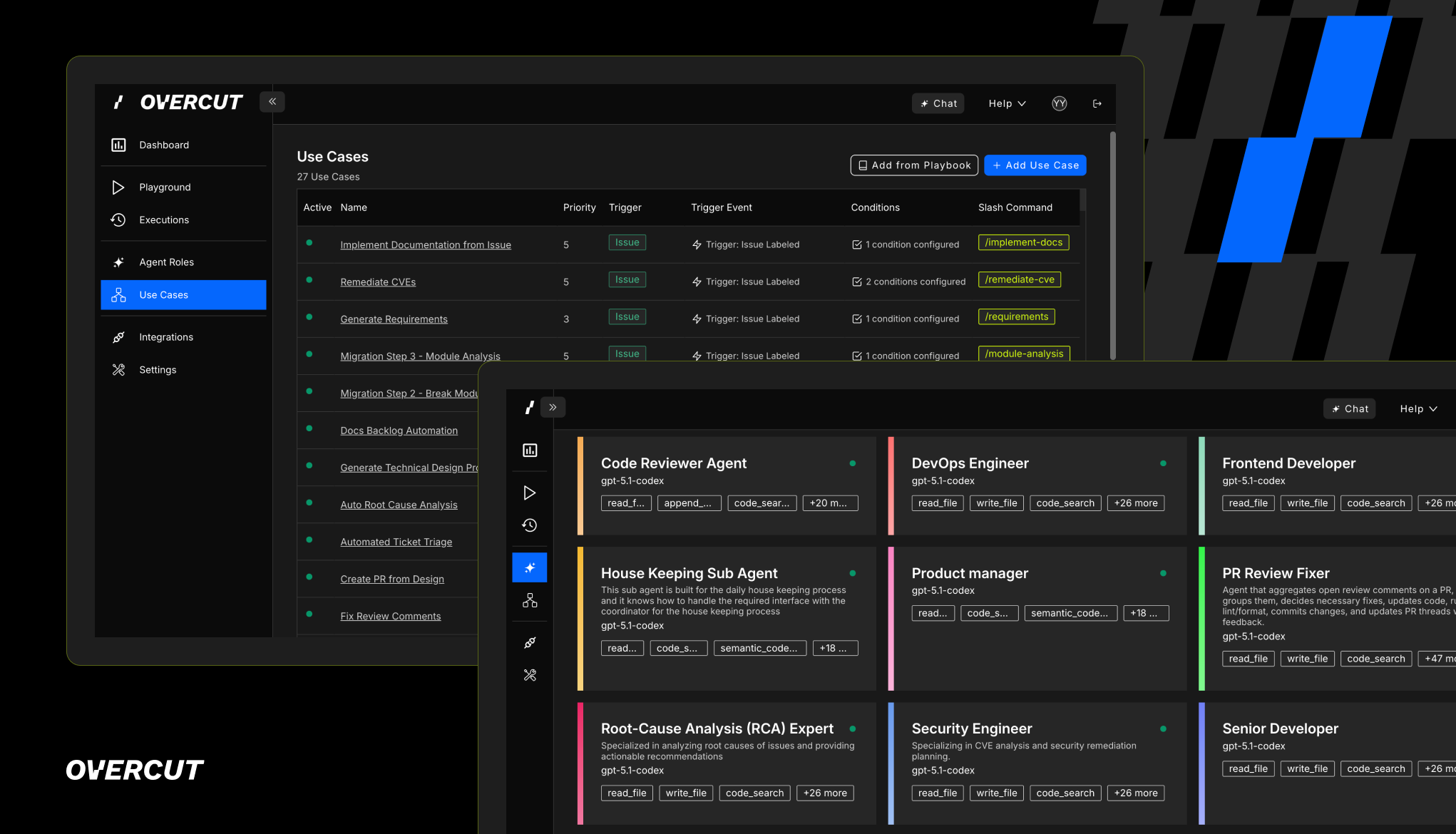
Why Azure was the natural foundation
Overcut serves organizations with distributed engineering teams and mission-critical production systems. These teams require isolation between workloads, identity-driven access control, regional data residency, and predictable scalability.
Azure’s managed services, security model, and global footprint allowed Overcut to meet these requirements while staying focused on building the product. By building natively on Azure, Overcut delivers a platform that can scale from early pilots to high-volume execution with the same operational posture.
A founder’s perspective on building with Azure:
From the beginning, we knew Overcut had to operate inside real enterprise environments, not just demos or developer sandboxes. Azure gave us the building blocks to design agentic workflows that are powerful but still controlled, observable, and secure. We can focus on how agents reason and collaborate, while Azure handles identity, isolation, and scale in a way enterprises already trust.
Yuval Hazaz, Founder and CEO, Overcut
An architecture designed for controlled autonomy
Overcut’s platform is built around a simple principle: autonomous agents must be powerful, but never uncontrolled. Every agent runs in an isolated, observable, and policy-driven environment. Azure enables this architecture across every layer of the system.
Azure Kubernetes Service as the orchestration backbone
Overcut’s execution engine and microservices run on Azure Kubernetes Service (AKS). AKS provides the elasticity and resilience required to orchestrate large volumes of autonomous agent workloads.
With AKS, Overcut can:
- Scale agent execution dynamically based on demand
- Run thousands of isolated agents in parallel
- Use Azure AD Workload Identity instead of static secrets
- Avoid operational overhead associated with VM management
This enables consistent performance during high-volume workflows such as incident response, backlog processing, or large-scale refactoring.
Network isolation with Azure Virtual Network and NAT Gateway
All Overcut components run inside tightly segmented Azure Virtual Networks, with subnets and Network Security Groups enforcing strict traffic boundaries.
A managed NAT Gateway standardizes outbound traffic, helping enterprises manage allowlists and meet security policies. This network-first design aligns with the expectations of regulated and security-sensitive environments.
Trusted agent runtimes with Azure Container Registry
Overcut uses Azure Container Registry to build, store, and distribute verified agent runtime images. Federated AcrPull identities allow AKS and Argo Workflows to pull images securely without storing credentials.
This supports rapid iteration while maintaining a tamper-resistant execution environment.
Durable orchestration state with Azure Database for PostgreSQL
Workflow metadata, agent state, and execution history are stored on Azure Database for PostgreSQL Flexible Server, providing automated maintenance, high availability, regional data residency, and private network access through private endpoints.
High-performance shared storage with Azure Files Premium
Agentic workflows often involve large repositories and short-lived execution environments. Overcut uses Premium Azure Files via the CSI driver to provide low-latency shared storage across containers.
This enables efficient data reuse, smoother collaboration between agents, and faster execution.
Event-driven workflows with Azure Event Hubs
Overcut’s internal workflow bus runs on Azure Event Hubs using its Kafka-compatible interface, allowing reuse of Kafka-based producers and consumers while benefiting from Azure’s elastic scaling.
Private, compliant AI with Azure OpenAI Service
Each Overcut workspace is backed by a dedicated Azure OpenAI deployment scoped to a specific region.
This helps keep customer data within regional boundaries, delivers predictable low-latency inference, and supports enterprise compliance requirements. Azure OpenAI provides the reasoning layer behind Overcut’s autonomous agents.
A modern front-end delivered through Azure Static Web Apps
Overcut’s client application runs on Azure Static Web Apps and Azure DNS, with CI pipelines powered by GitHub Actions, enabling fast global delivery, automatic SSL, and zero-downtime releases.
Why it matters for enterprise software teams
Agentic automation can drive meaningful gains in velocity and quality, but only when it can be governed and trusted. Overcut’s Azure-native architecture is designed to support enterprise adoption with:
- End-to-end SDLC workflows, not isolated AI features
- Isolated execution environments for every agent
- Scalable orchestration across thousands of parallel workflows
- Identity-led security and compliance by default
- Flexibility for cloud and hybrid environments
Building the next generation of SDLC platforms on Azure
Overcut represents a shift in how enterprises approach software delivery. Instead of stitching together scripts and point solutions, teams can define reusable, auditable workflows that move work from ticket to production with confidence.
By building on Azure, Overcut combines autonomous intelligence with enterprise-grade infrastructure, security, and global scale. The result is a platform that helps organizations move faster without losing control, and adopt AI in their SDLC in a way that is practical, compliant, and production-ready.
As part of Microsoft for Startups, Overcut is proud to build alongside a growing ecosystem of companies using Azure to redefine how work gets done.
For founders building AI-driven platforms or enterprise automation solutions, Microsoft for Startups offers the tools, infrastructure, and support needed to scale with confidence.
Get ready to build fast, scale smart, and sell more with Microsoft for Startups.