This project, "Next-Generation Entrance Monitoring System," was implemented as part of Kobe City's SME DX Support Team initiative. Using Kobe Commerce, Industry and Trade Center Building as a field site, public stakeholders, facility operators, Kyokko Electric, and Kobe Lab advanced the project together. The initiative represents a Co-Innovation case model in Kobe, where local SMEs take on advanced DX by leveraging generative AI.
Through pre-project tech calls and architecture proposals, we moved design discussions significantly forward and quickly translated Foundry tools and event-driven architecture into implementation.
In particular, rapid validation for Azure Content Understanding helped us shorten the technical verification period by about one month and reduce initial development cost by about 70%, contributing greatly to overall development acceleration.
Katsunori Nagai, Engineering Department, Kyokko Electric Co., Ltd.
Co-Innovation Challenge
For surveillance cameras installed at facility entrances, operations were traditionally centered on recording and manual visual checks, and there was a challenge in fully utilizing accumulated video data.
To improve facility operations and security, it was necessary not only to count people but also to understand the context of human movement and behavior, including congestion, dwell, and signs of anomalous actions. At the same time, for SMEs, video analytics using generative AI and cloud AI had high technical barriers, making independent validation and system design difficult.
Against this background, Kyokko Electric decided to use Kobe City's SME DX Support Team program and work with Microsoft AI Co-Innovation Lab KOBE to verify the practical viability of generative AI-based video analysis.

In the Lab: Sprint Development
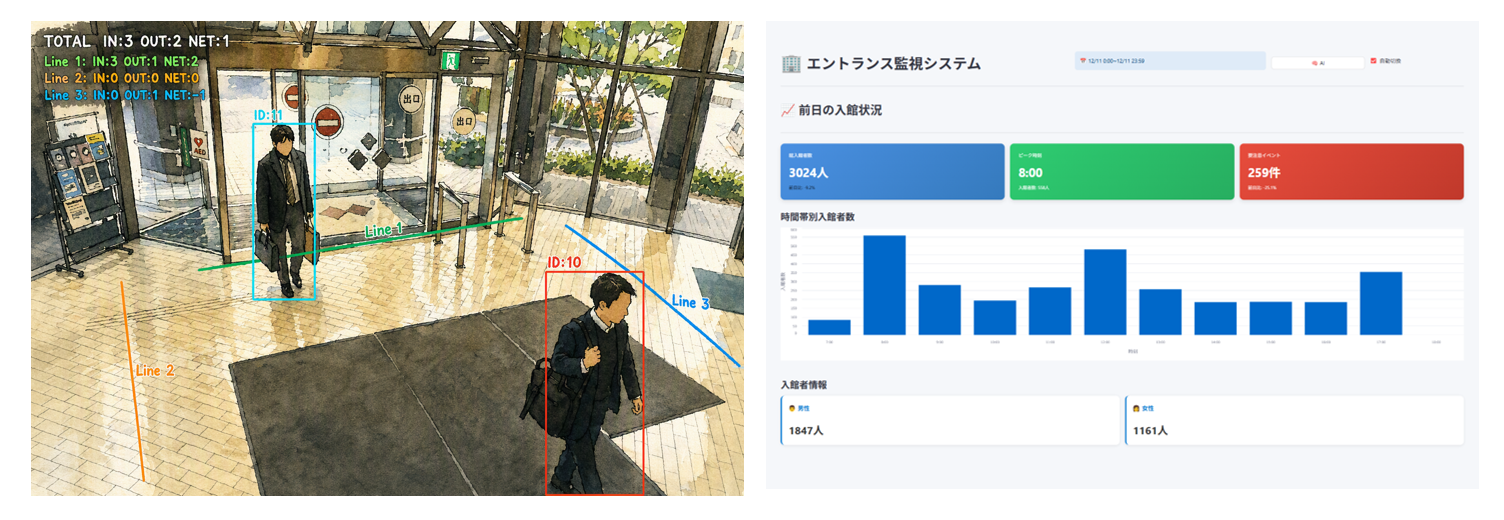
Targeting unstructured data from entrance cameras, the team developed a prototype that consistently connected edge, cloud, and generative AI to transform video into understandable, searchable, and usable information. On the field side, camera video was connected to Raspberry Pi for edge-side data generation. Person detection used AITRIOS (CSV26) to generate structured metadata such as counts and positions. Both detection metadata and source video files were sent to Azure in an event-driven manner.
On the cloud side, Event Hubs and Event Grid separated data reception from processing triggers, adopting a scalable and loosely coupled architecture. Events triggered Azure Functions, which acquired and transformed video files and detection metadata before handing them to analytics workflows.
At the core of video analytics, the project used a generative AI foundation with Azure Content Understanding and Azure OpenAI in Foundry Models. By analyzing video frame by frame and extracting behavioral context such as movement, dwell, and pass-through into text, the system enabled contextual understanding that is difficult with conventional image recognition alone. The team also compared multiple approaches, including Azure AI Video Indexer, to select methods suitable for the use case.
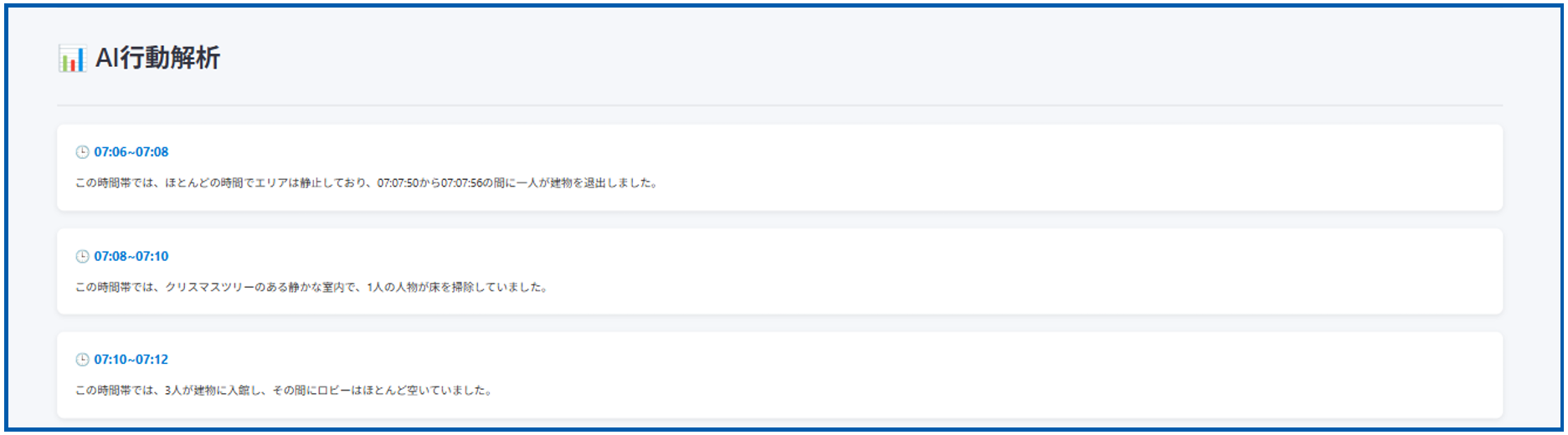
Behavior analysis leveraging Azure Content Understanding
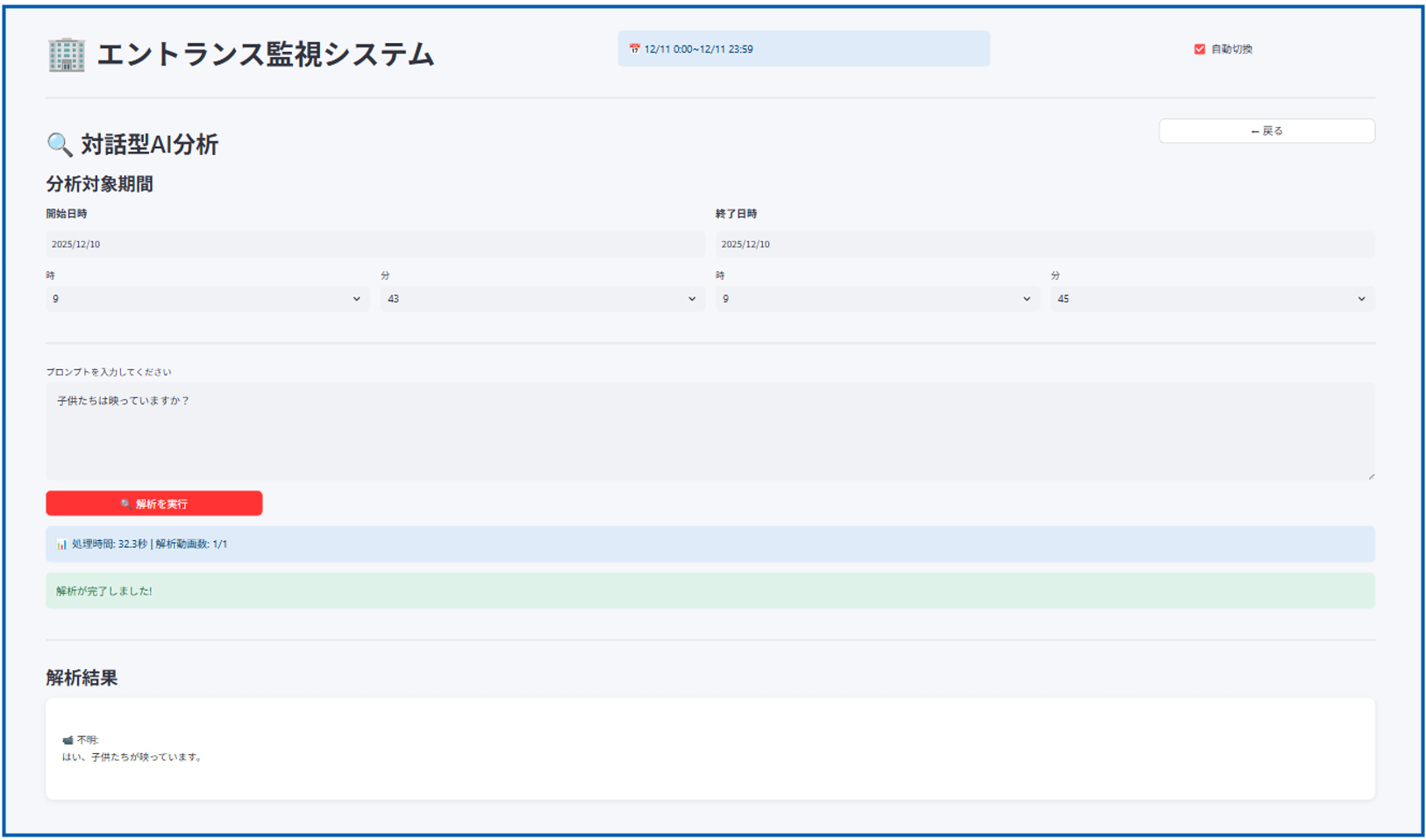
Analysis outputs and metadata were stored in Azure Blob Storage and managed as a data lake for downstream processing. In the retrieval and utilization phase, Azure Cosmos DB was used to hold generative AI outputs with a flexible schema. The front-end accepted natural-language questions, and Azure OpenAI generated answers using analysis results stored in Cosmos DB as context. Generated responses were returned to clients through an application on Azure App Service, enabling retrieval and Q&A based on video data.
This architecture demonstrated a practical model that converts unstructured camera video into understandable operational data through an event-driven, generative AI-centered design, and showed a realistic DX pattern for SMEs applying generative AI to business operations.

Architecture diagram of the next-generation entrance monitoring system
Beyond Technology
In this demonstration, the entrance of Kobe Commerce, Industry and Trade Center Building was used as the field site, and the effectiveness of a next-generation entrance monitoring system that analyzes camera video data with generative AI was validated. By leveraging Microsoft Foundry (Azure OpenAI in Foundry Models and Azure Content Understanding), the project enabled contextual understanding that was difficult with conventional image recognition and transformed video from simple records into actionable information for facility operations.
Specifically, the team validated multiple analyses, including automatic counting of entrants and exits, classification of behavior patterns such as pass-through, dwell, and stops, and visibility into time-based congestion. Compared with conventional sensor-based monitoring, this confirmed more flexible and detailed analysis capability.
In addition, the system design assumes non-identifiable data processing, including policies such as not storing face images or personal identifiers. This is an important outcome, showing that operations can preserve safety and trust for facility users while still using generative AI.
Through this initiative, Kyokko Electric and Kobe Lab challenged new value creation with the regional community and will continue to pursue sustainable growth through technology innovation and co-innovation.