
“In this project, students visited our facilities to learn about our business operations and work processes, and then engaged directly with employees to understand real business challenges.
In the process, they brought flexible thinking combined with AI technology to the highly specialized field of patent translation, making this a truly meaningful co-innovation opportunity.
Through the students' proactive efforts, we also gained many insights and inspirations.”
Company Overview
Sysmex Corporation is a global healthcare company originating from Japan, centered on clinical testing of blood, urine, and other specimens. The company handles everything from developing clinical testing instruments, reagents, and related software to manufacturing, sales, and import/export. Its primary testing areas include hematology, hemostasis, and urinalysis.
Centered on medical institutions such as national hospitals and universities, Sysmex provides products and services to over 190 countries and regions worldwide, guided by the "Sysmex Way" corporate philosophy and a mission to "Shape the advancement of healthcare," supporting the advancement of medicine and healthy lives through the creation of new testing technologies.
In recent years, the company has focused on leveraging AI and data science, building a secure in-house generative AI platform on Microsoft Azure and actively pursuing DX across its operations. As a supporting member since its inception, Sysmex has backed the "Microsoft AI Co‑Innovation Lab KOBE" (hereafter "Kobe Lab") in its home city of Kobe, promoting advanced business operations and innovation through industry-government-academia collaboration.
Project Purpose and Background (Significance of Co‑Innovation)
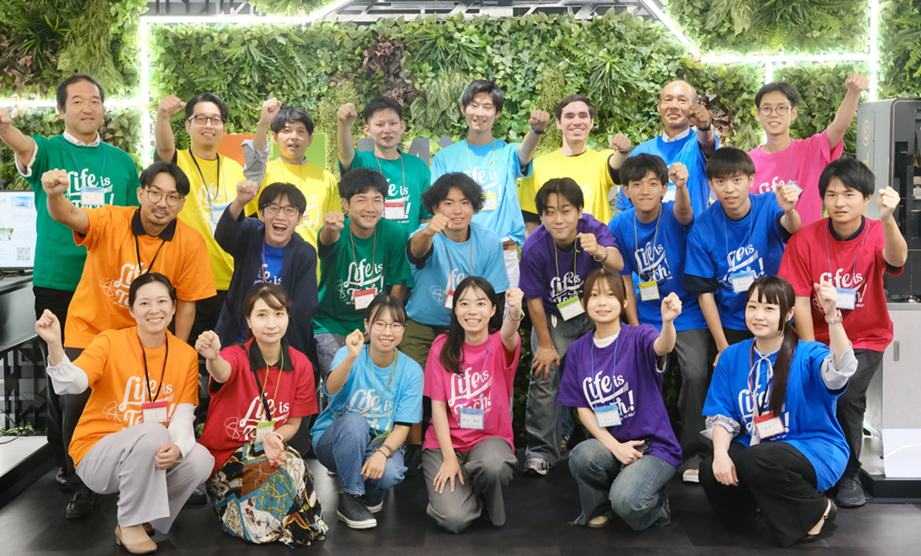
This project was organized as a "Student × Company Co-Development Project" led by the City of Kobe, and Sysmex participated with the goal of DX talent development and problem-solving through industry-academia co-innovation.
This program, where university students and companies jointly tackle real business challenges, goes beyond mere technical training — it aims to generate innovation rooted in real workplace problems. A distinctive feature is that industry, government, and academia united to carry out the project over approximately five months.
Significance for the Company
By redefining corporate challenges through the fresh perspectives of students, it becomes possible to discover new solutions and approaches different from conventional ones. Furthermore, this is also positioned as a platform where the company supports talent development and industry-academia collaboration while contributing to regional innovation, offering benefits in both fostering a DX-promoting culture and creating social value.
Significance for Students
Rather than abstract exercises, this is a valuable opportunity to face real challenges confronting companies and experience an end-to-end project from requirements definition to prototype development and validation. By collaborating with industry mentors and Microsoft engineers, students learn practical skills and team development methodologies, cultivating the ability to apply academic learning to real-world settings. It also serves as a place to develop a perspective of "creating value with AI" rather than "developing AI itself," fostering a mindset of using cutting-edge technology as tools to solve social challenges.
Program Structure
The program was conducted from September 2025 through early 2026 as a long-term co-innovation process combining advance preparation and learning with a 5-day sprint development. In the initial phase, introductory meetings and pre-training were held between the Sysmex team and the student team. Subsequently, during the onboarding phase — which included challenge sharing and technical discussions from the Sysmex side — project goal alignment, data preparation, and Azure AI basic operations training were conducted to lay the groundwork for short-term development.
Next, a 5-day development sprint was held with support from Microsoft engineers, during which the student team and Sysmex representatives intensively worked on prototyping an AI solution to address workplace challenges. During the 5-day development period, students took the lead in building "an AI system that automatically detects translation errors in patent documents and suggests improvements," successfully implementing two key features: (1) high-accuracy OCR analysis of PDF patent documents, and (2) mistranslation assessment and correction suggestions using large language models (LLMs).
At the conclusion of the sprint, a final presentation was held where the developed prototype was demonstrated and results were shared.

Microsoft Foundry Services and Technologies
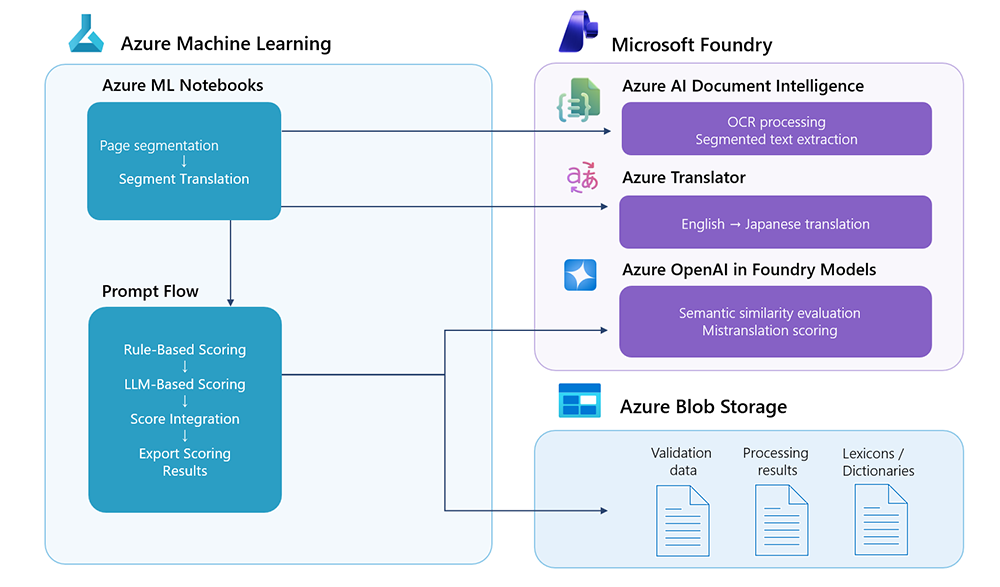
On the Azure cloud platform, leveraging Microsoft Azure as the foundational cloud, the team built pipelines using various Azure Machine Learning services, along with Azure OpenAI Service and Microsoft Foundry Tools, to build and validate an AI-powered patent translation quality improvement solution.
The architecture centered on Azure Machine Learning as the experimentation and development platform, with Azure ML Notebooks and Prompt Flow integrating and managing the entire processing pipeline.
Validation data was processed within Notebooks, with Azure AI Document Intelligence from Microsoft Foundry Tools performing segment-level OCR to extract structured text. The extracted text was then machine-translated via Azure AI Translator to generate high-quality baseline translations, with results stored in Azure Blob Storage.
Translation results were evaluated on Prompt Flow using rule-based scoring with embedding models and LLM-based mistranslation scoring via Azure OpenAI (GPT). By outputting the final scoring results, the architecture enables end-to-end execution of translation quality verification.
Architecture Diagram
Sprint Development and Technical Highlights
During the 5-day development sprint, the team combined the above technologies to build a two-tier translation checking AI. First, Document Intelligence was used to extract text and structural data from patent PDFs, then the extracted content was machine-translated via Azure Translator to obtain Japanese translations. Next, mistranslation risk assessment algorithms using LLM (GPT models) were executed on Prompt Flow, and if sentences with high mistranslation probability were found, LLMs suggested more appropriate translation alternatives. In parallel, rule-based mistranslation detection logic that does not rely on LLMs was also developed (e.g., scoring based on terminology dictionary matching and named entity extraction), aiming for high-accuracy evaluation through a hybrid of AI and rules. Scores from these multiple approaches were ultimately integrated, resulting in a prototype that highlights suspicious passages in translations and presents correction suggestions to users.
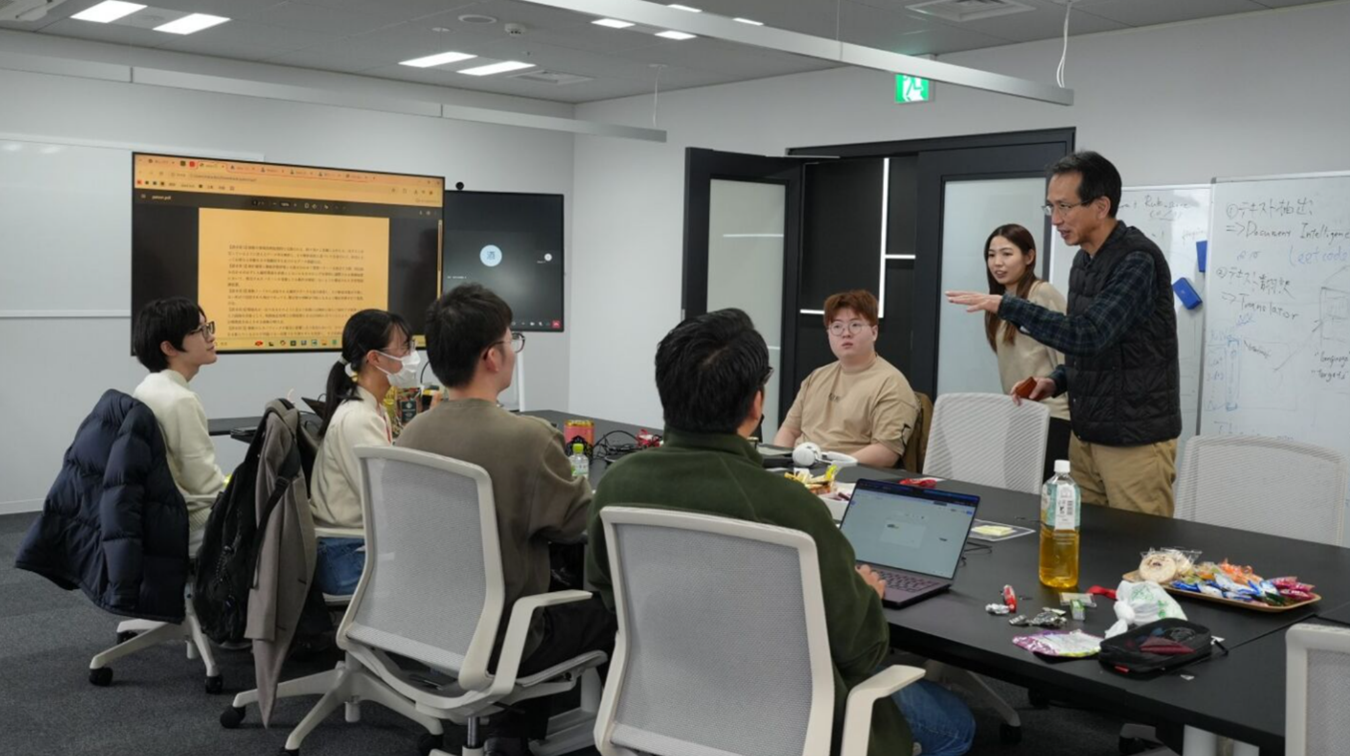
During this sprint period, the Microsoft engineering team supported technology selection and cloud environment setup, while the student team remained the lead developers. Students iterated autonomously on implementation and testing without fear of failure, gaining the experience of building a working AI system in just one week. The Microsoft side served as code reviewers and mentors, providing an environment where technical questions could be resolved on the spot when students hit roadblocks. Through this experimental and speedy development, all participants realized that verification that would conventionally take months to years can be achieved in an extremely short period (5 days).
Student Learning and Outcomes
Students experienced AI development aligned with real-world challenges, going through the entire process from problem definition to validation. The company gained fresh ideas and problem-solving insights through co-innovation with the next generation, gaining confidence in work efficiency improvement and DX advancement through AI utilization. It served as a place to experience development firsthand. Through repeated trial and error on patent document data accumulated within the company and the AI solution development platform (Azure environment), it became a significant learning opportunity to cultivate applied skills not found in textbooks. Below is a summary of the students' key outcomes.
Improved Upstream Thinking Skills
Through discussions with Sysmex teams and design workshops, students cultivated the ability to grasp the essence of challenges and decompose and define them at a solvable level. They learned the importance of problem analysis and requirements organization before technical implementation, and their problem-framing skills improved.
Practical Cutting-Edge Technology Skills
Students gained experience building and validating systems on Azure cloud, making full use of the latest technologies such as generative AI and AI-OCR. They acquired development skills to apply classroom knowledge to real projects and deliver results in short timeframes.
Team Development and Project Management
Through collaborating with professional engineers and peers of the same generation, students acquired thinking methodologies, team development practices, and proactive learning habits.
© Case Study