

Since we first established our Office of Responsible AI in 2019, we have been driven by the belief that the powerful benefits of AI won’t be fully realized or shared widely if people don’t trust the technology. The daily practice of earning trust requires those building and deploying AI to deeply consider the nuances of the countries and cultures where they’re being utilized.
Context matters. How useful and effective AI can be to a society is influenced by many overlapping factors, including socio-economic structures, cultural norms, and laws—all of which can vary significantly around the world. Not only do large-scale societal forces influence the adoption of AI, but also the everyday challenges individuals face and how fit-for-purpose an AI solution may be in their lives.
As a company that serves people and organizations around the world, we actively seek to better understand these dynamics. Doing so helps ensure we’re developing and deploying trustworthy technology that’s broadly beneficial, rather than only useful in a specific context.
In our second annual Responsible AI Transparency Report we highlight a number of ways in which we seek feedback from global stakeholders—one of which is our Global Perspectives: Responsible AI Fellowship program, hosted in partnership with the Stimson Center. This program pulls in AI experts from across the Global Majority with the intention of learning as much from them about the unique uses and potential misuses of AI in their respective regions.
Earlier this year, a number of these fellows traveled to Paris for the AI Action Summit. We took the opportunity to record conversations focusing on what it would take for AI to be adopted widely in the fellows’ respective regions, while exploring both the potential pitfalls to watch out for and the opportunities at our fingertips.
As we march towards the upcoming AI Impact Summit in India, we hope you’ll find these insights as inspiring and informative as we do. In a few weeks, we will also share case studies authored by the fellows on the Stimson Center’s website that brings these insights to life. Stay tuned!
Focusing on opportunities: Narun Popattanachai

Narun is a lawyer in the Thai government’s Office of the Council of State where he works on digital transformation. He’s currently leading the government’s efforts to reform Thailand’s Electronic Transaction Act as well as introduce the Digital Platform Economy Bill. Both of these pieces of legislation aim to provide a future-proof, AI-ready legal and regulatory framework that enables sustainable growth for Thailand’s digital economic sector.
“From my experience,” Narun says, “there are more opportunities in deploying AI in society than there are threats. The threat actually comes from the fact that we might not think too carefully about the deployment. It’s not AI in and of itself, but it’s the missed deployment or badly deployed AI models that could create problems.”
Narun stresses the importance of governance design questions for the global diffusion of AI. “AI is one of the excellent examples, if not probably the most pertinent,” he says, “of how society and economy move so fast that we have to grapple with not just the change of technology but a change in the way we think about how we should live together.”
Facilitating broad adoption: Jibu Elias

Jibu is an AI ethicist, activist, and researcher who is widely recognized as the foremost authority on India’s AI ecosystem. He currently serves as the Country Lead for India as part of the Mozilla Foundation’s Responsible Computing Challenge. Jibu’s efforts center around creating a unified AI ecosystem in India, with a strong emphasis on mitigating the digital divide engendered by technologies like AI.
Jibu notes a report pointing out that in 2018, an American household created one data point every six seconds, while the whole of the country of Mozambique had only 6% Internet penetration.
“What will happen to people from those countries?” Jibu asks. “How do we ensure that they also get the benefit of this technology? It’s very important that you hear people from different cultures, different regions, different economies, because their experiences and learnings on this technology might be entirely different from what somebody living in Paris or China might be experiencing.”
Combatting harmful content online: Branka Panic

Branka is the Founder and Executive Director of AI for Peace, a US-based think tank that focuses on ensuring that AI benefits peace, security, and sustainable development. Much of Branka’s work takes place in conflict settings that can easily be pushed to the boiling point by hate speech and false or misleading content. Branka is part of a team that’s building AI tools to combat these harms and help sustain peace in these fragile settings.
A political scientist and expert in international security, international development policy, and peacebuilding, Branka also focuses on making sure that diverse voices influence the creation of AI and related technologies.
“Because some of these impacts can be different in different countries, it’s really important to understand that we need to include voices from these countries,” Branka says. “When we start our conversations, we actually realize how many things we don’t understand about other regions and how much more effective our work is when we hear all of these voices and include them in our discussions.”
Embracing mobile-forward technology: Aziz Soltobaev
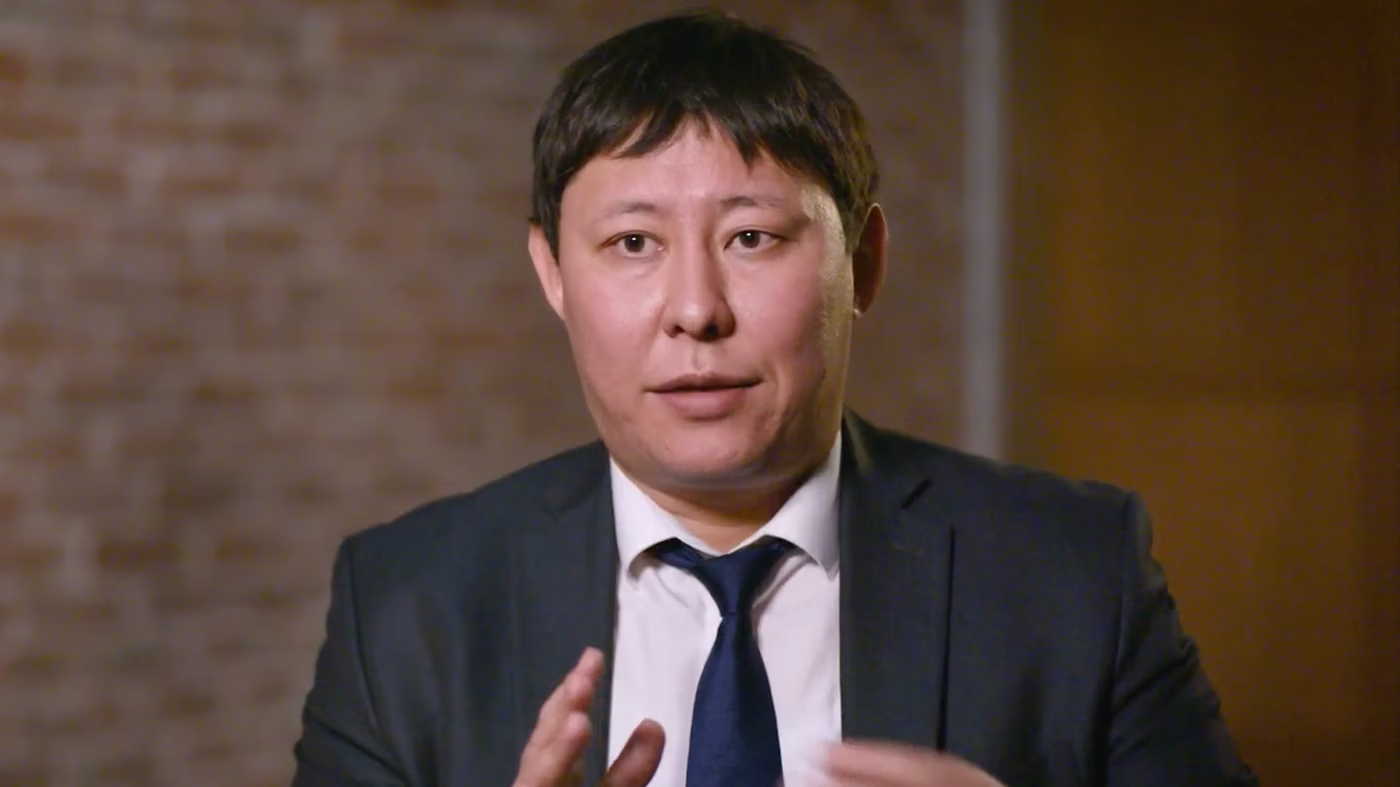
Originally from Kyrgyzstan, Aziz is an expert in promoting tech entrepreneurship and fostering the digital economy, with a focus on building country-level capacity. He has served as a policy adviser to various government offices and contributed to the development of numerous national strategies. Aziz is the co-founder and programs manager for the Internet Society Kyrgyz Chapter, where he has led various projects related to digital skills, Internet connectivity, internet of things, AI and edtech.
“The Global North assumed that all countries and all people in the Global South would need computer skills in order to be able to work with applications and increase labor competitiveness,” Aziz says, “But it turned out that developing countries—especially in the Asian continent—choose a bit different path. They’ve been more mobile-focused. That would indicate that the way they interact with information, or through the Internet, is way different than the Global North assumed it would be.”
Making assumptions and tailoring applications to the Global North won’t help facilitate the broad adoption of AI. But by gathering the perspectives of experts around the world, listening closely to their experiences, and using their insights to inform how we build and diffuse technology, we can help facilitate AI adoption around the world.