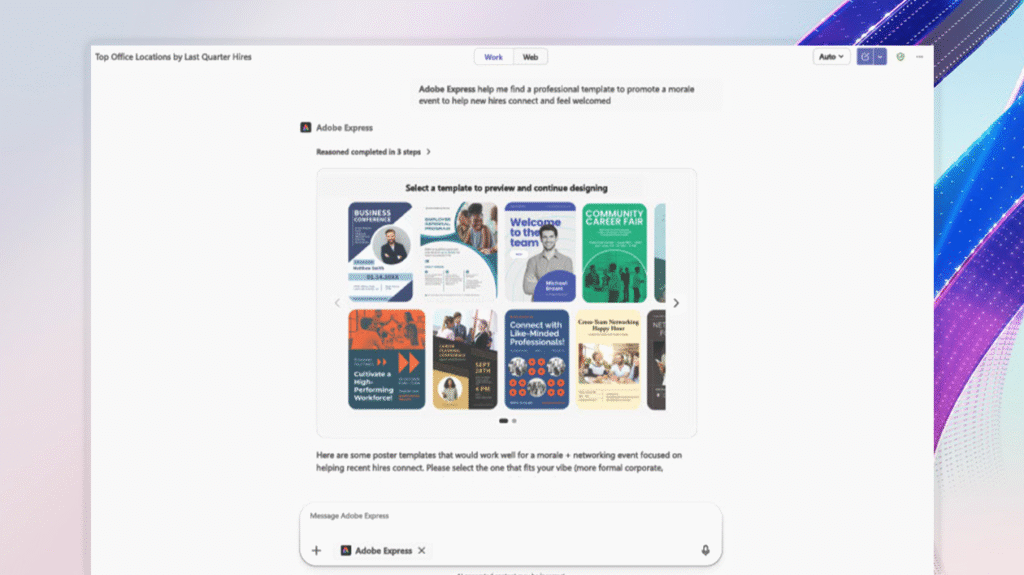
Before 2025, most AI agents were still experimental: narrow in scope, manually triggered, and siloed to individuals or teams. Over the past 12 months, that’s changed dramatically. Organizations have moved from exploring AI to expecting measurable impact from their agents.
This shift marks the moment AI moved from helping people do work faster to helping organizations optimize their workflows.
Microsoft Copilot Studio has played a central role in this transition.
In 2025, we laid the groundwork for what scalable, impactful agentic work should look like. In 2026, we believe the organizations that benefit most will be the ones that build on that foundation. These six trends define what organizations need to make adoption stick in 2026 and beyond:
- Ability for anyone to turn intent into agents
- Agents that can own workflows from end to end
- Power to coordinate agents for real outcomes
- Flexibility to control your agent models
- Agents that can act across your systems
- Capability to scale agents without sacrificing control
Organizations that have all six aren’t just experimenting with agents. They’re operationalizing them, turning curiosity into confidence, and transmuting innovation into sustained business value.
1. Ability for anyone to turn intent into agents
Historically, building an agent meant translating business intent into technical instructions. This process slowed adoption and limited who could participate. In 2025, that barrier fell away. Conversation became the agent-making interface in both Copilot Studio and the Agent Builder in Microsoft 365 Copilot Chat. Now, people can describe what they want done using natural language and create an agent to do it. These agents can interpret intent, context, and goals thanks to their underlying model and knowledge, not specially built code.
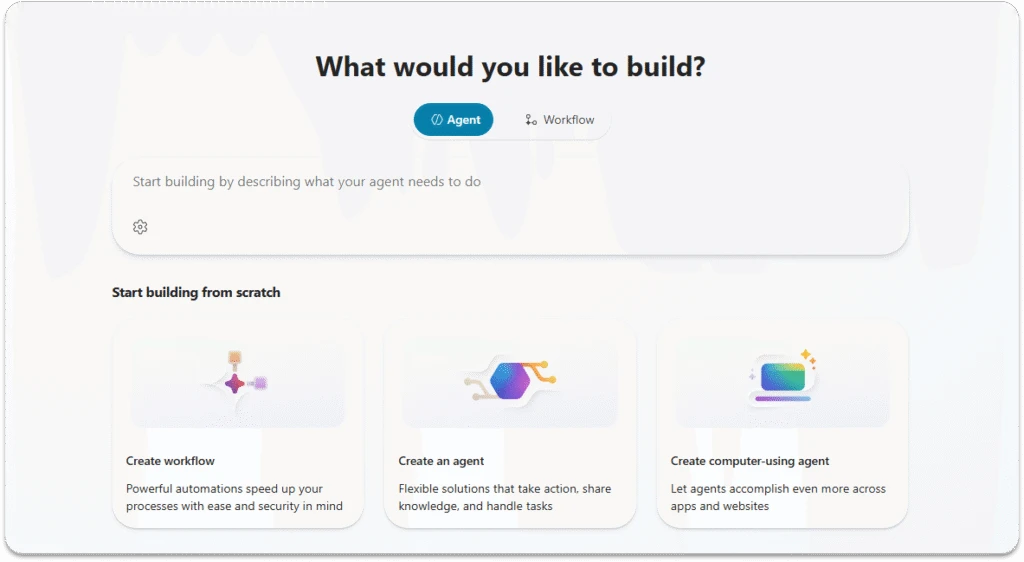
That shift is designed to empower everyone on your team to build agents. Sales leaders, operations managers, and human resource (HR) officials no longer need to wait for technical assistance to automate everyday work. Meanwhile, IT teams retain clarity and structure under the hood, with agents grounded in logic that can be reviewed, refined, and governed—all in Copilot Studio.
The results? Faster fast agent creation, broader participation, and fewer translation gaps between business needs and technical execution.
For example, a sales operations manager can now describe and publish an agent that:
- Monitors pipeline changes, such as changed estimated close dates.
- Flags deals that may be at risk, based on predefined criteria (e.g., no activity with stakeholders for over a month).
- Notifies account owners with recommended next steps based on the type of flag.
The payoff: More people can build knowledgeable, context-aware, and helpful agents, which can translate to less bottlenecking on centralized teams and faster time to value.
2. Agents that can own workflows from end to end
For many teams, early adoption wins came from AI assistance: drafting content, summarizing meetings, answering questions. Useful, but incremental. In 2025, agents crossed an important threshold; they evolved from helping with work to handling it on your behalf. With agent flows and the Workflows Agent, agents can now own repeatable processes from end to end, automatically advancing work when required.
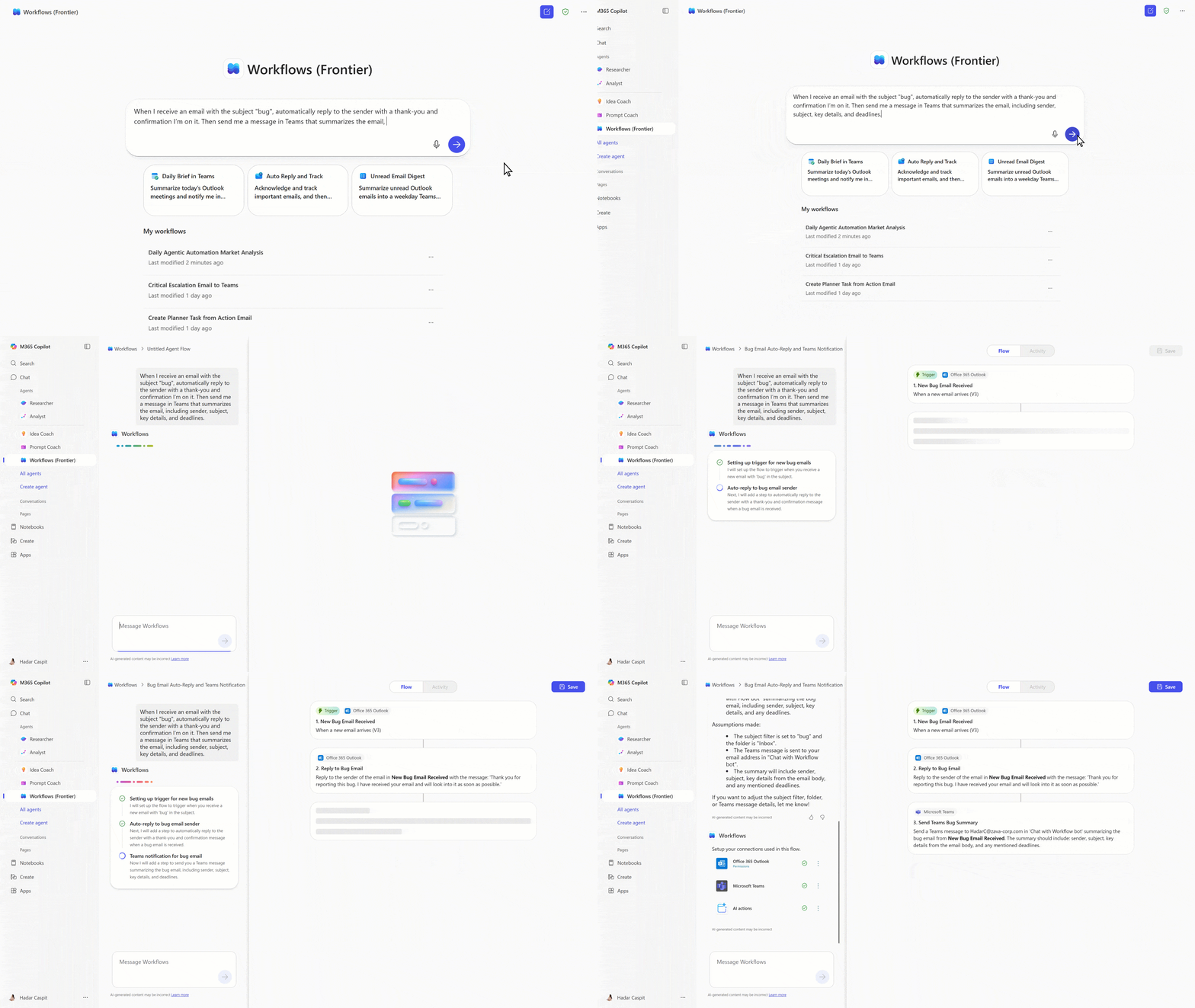
In other words, agents unlock new opportunities to streamline and scale how work gets done. An onboarding process no longer stalls due to a missed handoff. A request doesn’t linger in a queue waiting for manual follow-up. Agents move work along reliably with automated approvals, escalating to humans only when judgment is required. For leaders, that can mean faster cycle times and fewer hidden bottlenecks. For teams, it can translate to more time spent on decisions—not coordination.
For example, a company could use Copilot Studio to automate a multi-step process for expense submission, validation, and reimbursement. The process:
- Triggers when an employee submits a wellness or reimbursement request.
- Guides the employee through required forms and documentation in a single, user-friendly flow.
- Validates submissions against global wellness policy rules and regional guidelines.
- Routes requests across the appropriate software as a service (SaaS) tools and internal HR systems.
- Escalates exceptions to a human only when needed.
The payoff: Faster resolutions using consistent criteria, less potential for human error, and a daily pain point made smoother with an agent.
3. Power to coordinate agents for real outcomes
Often, meaningful business outcomes don’t happen in a single step or system. As soon as agents move beyond simple tasks, coordination becomes increasingly challenging. Multi-agent systems addressed this complexity head-on in 2025, allowing agents to specialize, delegate, and collaborate toward shared goals.
Instead of designing one agent to handle every step, organizations can now compose agents that mirror how teams already work. One agent might monitor signals, while another gathers or validates information, and a third prepares recommendations or takes action.
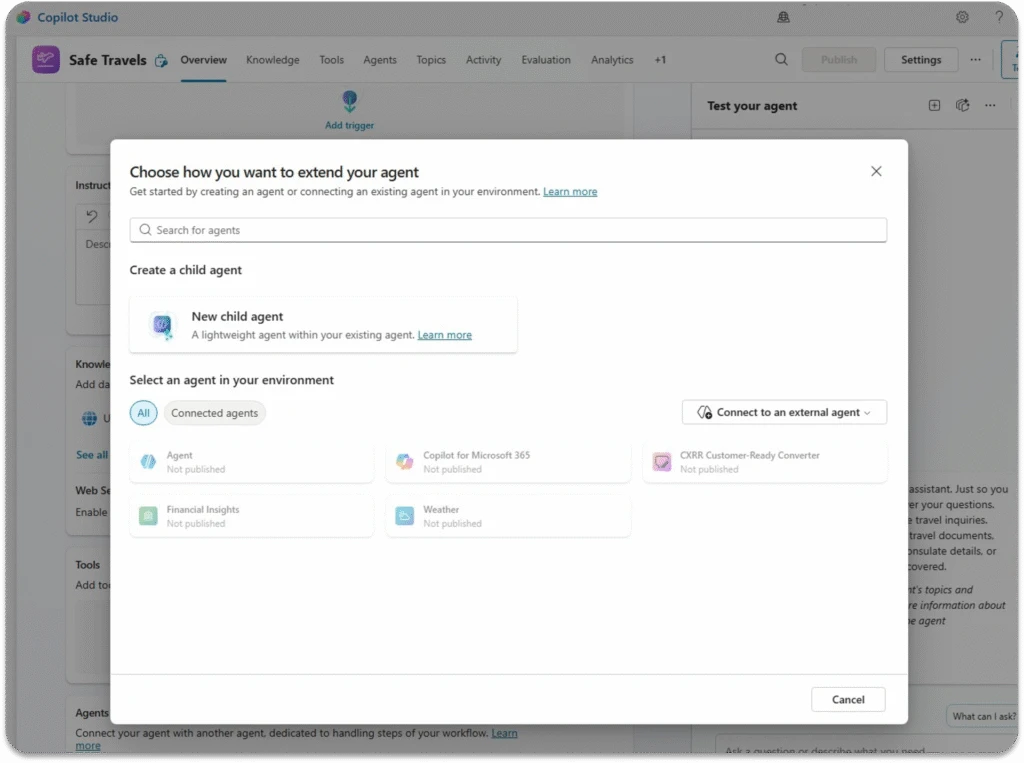
Together, these agents are designed deliver outcomes that would be difficult for any single agent to manage alone. More importantly, they remove a layer of decision-making from the stakeholder. Instead of figuring out which system or agent holds the right answer, you can simply ask your question and let the agentic system coordinate the rest. Complex workflows become easier to reason about, evolve, and scale—without adding mental overhead for the people involved.
For example, a manufacturing company might use:
- One agent grounded in internal policy and safety documentation.
- Another agent trained on equipment manuals and training materials.
- A third agent connected to supplier-provided expertise.
- A coordinating agent that evaluates each question and routes it to the right source automatically.
The payoff: More clarity around which system or agent to use—just ask, and the right expertise can come together behind the scenes. This can help keep complex work cohesive, not cobbled together.
4. Flexibility to control your agent models
As agents moved into real business workflows, one reality became clear: not every task has the same requirements or permissions. Some scenarios call for deeper reasoning. Others prioritize repeatability and efficiency at scale. Still, others must meet strict regulatory, security, or data residency standards.
In 2025, Copilot Studio expanded model choice to meet those needs. It now supports Anthropic models, chat and reasoning-specific models, access to thousands of models through Microsoft Foundry, and bring-your-own-model options. You can select the right model for each workload while IT teams maintain policy alignment and oversight. This gives your organization flexibility in how agents behave and perform, without fragmenting the experience.
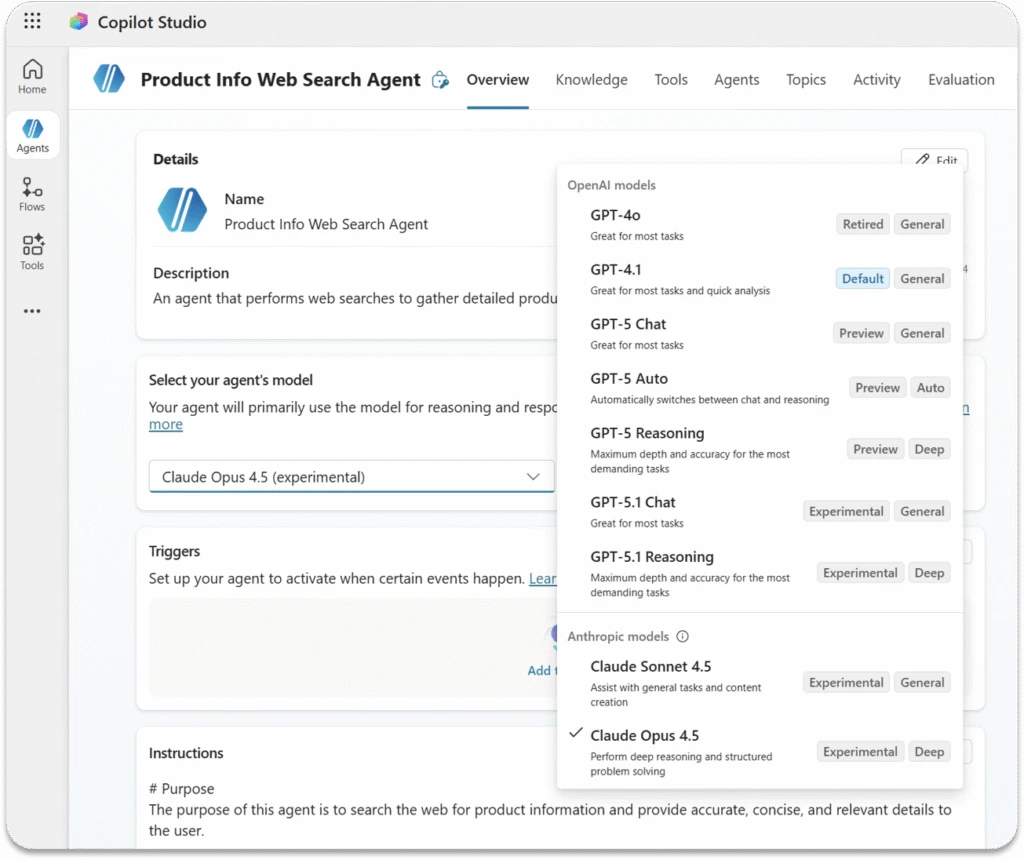
For example, an organization in a regulated field might use:
- One model optimized for policy interpretation and complex reasoning.
- Another tuned for cost efficiency in high-volume, repeatable requests.
- Central governance to ensure each model is applied appropriately.
The payoff: Instead of compromising between performance and compliance, agents can be configured to match the realities of the work they support—and evolve as those requirements change.
5. Agents that can act across your systems
For years, AI has been good at suggesting what people should do, but it hasn’t been equipped to help make it happen. In 2025, capabilities like Model Context Protocol (MCP) and computer use began to close that gap. Agents can now connect to systems, navigate interfaces, and take action across tools—not just give recommendations.
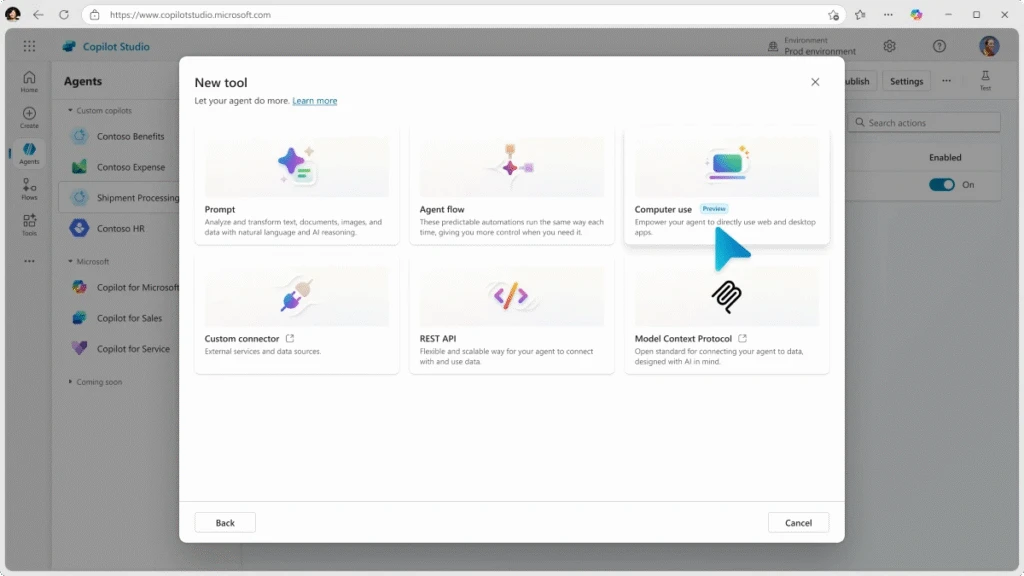
This addresses one of the biggest gaps in early AI adoption by reducing the handoffs that drastically slow work. When agents can act across environments to update records, trigger workflows, and interact with real systems (like clicking around a website and filling out form fields), work moves forward automatically, at any time of day. This can help reduce delays, manual errors, and the risk that important follow-ups get lost between tools or teams.
For example, an operations agent could autonomously:
- Identify a supply issue based on predefined signals.
- Update the system of record with the latest status.
- Fill out and file a ticket to initiate remediation.
- Notify relevant stakeholders with context and next steps.
The payoff: Faster response times, fewer handoffs, and agents that operate across real-world systems, not just chat windows.
6. Capability to scale agents without sacrificing control
Widespread agent adoption raises a familiar concern: How do you prevent innovation from outpacing governance? Leaders want to move quickly, but not at the expense of visibility, security, or cost control. In 2025, Copilot Studio addressed that gap by bringing lifecycle management, agent evaluations, and enterprise controls directly into the agent experience.
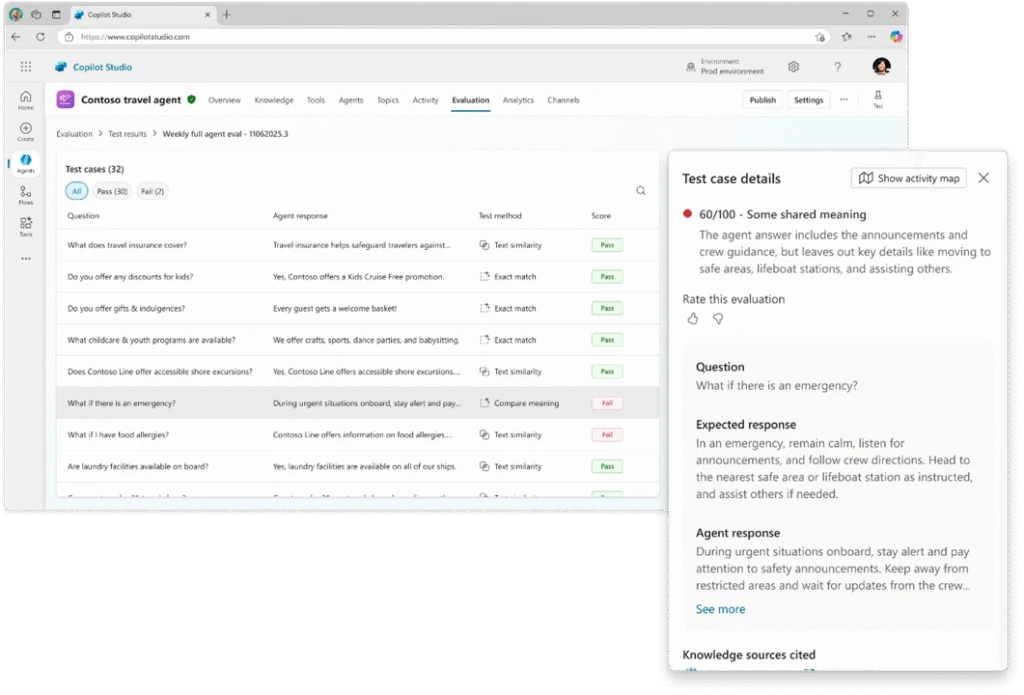
Organizations can now understand which agents are in use, how they’re performing, and what they cost across environments. Admin controls are designed to align agent behavior with intended use, while agent evaluations support ongoing quality and improvement. Paired with Microsoft Agent 365, organizations get a unified view of agents across Microsoft 365 Copilot and Copilot Studio, giving business and IT leaders the clarity needed to scale with confidence.
For example, IT leaders can:
- See which agents are used, by whom, and at what cost.
- Evaluate agent quality and performance over time.
- Communicate performance insights to business leaders to help increase buy-in, investment, and adoption.
- Apply consistent governance without slowing innovation.
The payoff: Agents can move from pilots to production faster, with fewer surprises and clearer business impact.
How to turn agentic momentum into results
The question for 2026 isn’t whether agents will be used—it’s how deliberately they’ll be put to work. Over the past year, the foundations for scalable agent adoption came together. The opportunity now is to move from experimentation to widespread execution.
We believe organizations that’ll get the most value in the year ahead will do three things consistently:
- Broaden who builds by empowering business teams to create and refine agents in partnership with IT teams, who provide guardrails without stifling creativity.
- Standardize how agents are shared and reused, so successful patterns move beyond individual productivity into team and enterprise workflows.
- Measure what matters as a matter of course, using visibility into usage, quality, and cost to guide where agents are expanded, improved, or retired.
When business and IT teams operate from the same foundation, agents stop being side projects and start becoming part of how work happens. That’s how teams move faster, reduce rework, and work together with AI and automation to create true business transformation.
Where to start—and how to go further
Your best agentic year isn’t defined by how many agents you build, but by how many people rely on them to get work done. Copilot Studio gives you the foundation to do exactly that. Now, 2026 is about building out, driving adoption, and scaling up.
Try this three-step plan for building and scaling your agent strategy with Copilot Studio:
- Get quick wins. Start by focusing on business-to-employee (B2E) assistive agents. Try downloading the Employee Self-Service Agent from the Agent Store.
- Create a Center of Excellence (COE). Set up a central team that can help triage cross-team needs and get the broader organization comfortable with agents. This could be a representative from every department, or made up of agent champions (regardless of where they sit in their org). A great COE can help reduce geographic silos and bring consistency to an AI strategy.
- Measure and reward adoption. What gets measured gets focus and investment. Compare the situation today with the situation post-agent adoption. Did the agent provide value? Has it improved what you set out to change? Prove the progress, and then you can move onto the next process.
Get started today and turn agent curiosity into capability, confidence, and commitment this year.