
Responsible AI Transparency Report 2026
Our third annual Responsible AI Transparency Report shows how we advance trustworthy AI and contribute to the broader ecosystem.
Share
Key trends over the last year
AI diffusion accelerates as gaps widen
As AI capabilities continue to evolve and AI adoption continues to rise, our Global AI Diffusion Report highlights a widening divide in who is accessing and benefiting from AI, with disparities across geographies and languages. Investment and partnership are critical to closing gaps and addressing challenges in the Global South.
Chatbot use for personal support grows
Conversational AI services have become a primary interface for interacting with AI models, with people increasingly turning to chatbots for personal advice, health-related questions, and emotional support. These uses offer clear potential benefits while also raising important risks.
Generative and agentic AI capabilities expand
As AI becomes more capable, risks and mitigations are evolving. Because generative AI applications increasingly link multiple models, tools, and data sources and agentic systems add greater interconnection, action, and autonomy, risk is increasingly shaped by access, permissions, memory, and use over time, requiring more dynamic governance.
Exposure to AI misuse increases
As AI technologies have become more accessible and capable, malicious actors have increasingly used them to scale fraud, impersonation, deepfakes, and socially engineered attacks. These technologies can enable more realistic attacks at scale, disproportionately affecting vulnerable groups and eroding trust in AI.
AI regulation evolves rapidly
Regulatory activity continues to intensify, with new legislation emerging as existing requirements shift to enforcement. Uncertainty persists around interpretation, timelines, and interoperability across jurisdictions even as deployers and end users require trust and assurance.
Taken together, these trends reflect a shift from an era focused primarily on model capabilities to one increasingly defined by application deployment, real-world use, and societal impact.
Natasha Crampton
Chief Responsible AI Officer
Natasha Crampton, Chief Responsible AI Officer, reflects on the people, practices, and systems behind our responsible AI work, and how this report helps show that work in action.

Responsible AI Transparency
Overview
Scaling adaptable governance
AI has the potential to benefit people, organizations, and communities in every part of the world if we earn and sustain trust in how we develop and deploy AI. For Microsoft, that means adapting with rigor as technology and risks continue to evolve rapidly—staying grounded in core commitments while investing in the strategies, tools, and teams that enable our customers and partners to use our AI technologies with justified confidence.
Our AI principles
Microsoft’s AI principles continue to serve as the north star of our approach to AI governance. Over multiple waves of innovation and the rise of agentic AI, these principles have informed the creation of our Responsible AI Standard and guided its evolution to today.

How we develop, release, and operate AI responsibly
At Microsoft, we align this work with the NIST AI Risk Management Framework (RMF) functions of Govern, Map, Measure, and Manage, complemented by a central pre-release oversight process to verify that risks have been appropriately addressed before release.
Explore the framework
Select Map, Measure, Manage, or Govern to discover Microsoft’s 2025-2026 progress on each risk management function.
Map
We enhanced AI risk taxonomies; introduced new agentic AI threat modeling practices; and launched an emerging tech program to address new risks from frontier AI capabilities.
Measure
We expanded internal evaluation capabilities in risk coverage and tools; established partnerships with government institutes to advance evaluation; and leveraged a new external testing framework for Copilot Health.
Manage
We implemented new or expanded guardrails, including prompt injection defenses and safety classifier coverage; established new templates for transparency documentation; and strengthened governance capabilities for agents.
Govern
We re-engineered our Responsible AI Standard; developed new tooling; and invested in our Responsible AI Governance Community.
What we have accomplished at scale
~20,000
Delivered responsible AI training to nearly 20,000 engineers, policymakers, and customers.
100+
Reviewed 100+ enacted and proposed laws and engaged over 80 of our employees from 30+ teams to shape our re-engineered Responsible AI Standard.
250+
Consulted with over 250 licensed clinicians from over two dozen countries as well as everyday users to assess the clarity, helpfulness, and safety of Copilot Health pre-release.
6
Advanced AI reliability measurement across more languages, expanding MLCommons AILuminate benchmarking capacity with research on 6 locales across Asia and launching PazaBench with coverage of 39 African languages.

Responsible AI TRANSPARENCY
Governing the AI tech stack
Meeting the agentic moment
AI systems are evolving, becoming more capable and interconnected, and executing multi-step actions. Linking together multiple models, tools, services, and applications to complete increasingly complex tasks expands the risk landscape.
In response, we strengthened our governance approach. This evolution includes a comprehensive re-engineering of our Responsible AI Standard, enabling agility as AI capabilities and risks continue to emerge, as well as a focus on practical tools to enable our customers and the ecosystem.
How we’ve adapted the Responsible AI Standard to an evolving landscape
Developer and deployer
Two new chapters in the Standard clearly separate developer and deployer responsibilities, reflecting how AI moves from development into real-world use.
AI tech stack
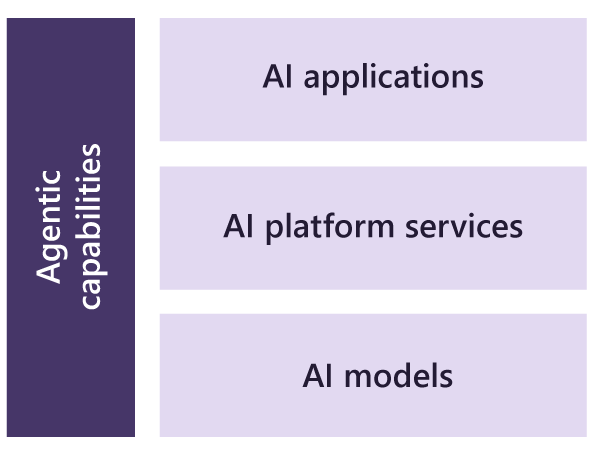
Requirements are now tailored across AI models, platform services, and applications, and safeguards match how agentic capabilities weave through the AI tech stack.
Risk‑based rules
The Standard now separates core requirements from scenario‑specific ones, applying additional safeguards where AI use poses higher potential risk.
Security-aligned
The refreshed Standard integrates previously standalone policies and more closely aligns with security requirements like the Security Development Lifecycle.

Agentic capabilities
Microsoft’s AI technologies span the technology stack—from models to the platforms that support their deployment to the applications that bring AI to life for users.
Agentic capabilities apply across layers of the AI tech stack. AI agents and multi-agent systems are enabled by models that are optimized for agentic use and may operate as part of platform services or applications, performing multi-step tasks by managing how models interact with tools, data, or environments.
The updated Responsible AI Standard sets requirements that address how agentic capabilities weave through the AI tech stack and integrates appropriate safeguards throughout the AI lifecycle.

The bottom line
As AI capabilities advance, new risks are emerging, and the importance of dynamic governance across the AI lifecycle is growing—informing how we fundamentally refreshed our Responsible AI Standard and strengthened our readiness to operationalize it.
Responsible AI Transparency
Using AI Responsibly
Lessons from deploying AI
Our commitment to responsible AI extends beyond the AI technologies that Microsoft builds and operates. The updated Responsible AI Standard introduces a new Deployer Chapter that establishes requirements for how we deploy third-party AI applications at Microsoft, helping ensure risks are managed and people remain at the center of deployment decisions.
Key steps in our AI deployment governance
Assess
Assess the provider’s documentation for the application’s capabilities, limitations, safeguards, and monitoring features to support responsible deployment.
Deploy
Review deployment-specific risks, implement mitigations and oversight, and ensure that AI supports human judgment and accountability.
Detect and respond
Monitor performance, user feedback, and incidents after launch to identify issues, take corrective action, and continuously improve.
Inform
Inform users to support responsible use, including about the application’s intended uses and limitations and the safeguards we’ve implemented.


The bottom line
As AI adoption grows, Microsoft is advancing responsible deployment practices to assess risks, implement safeguards, support informed use, and monitor AI system performance.
Responsible AI Transparency
Building Together
Investing in standards and tools
Our commitment to responsible AI extends to how we support and learn from the ecosystem. We invest to prepare customers, partners, and the public to use AI technologies that are trustworthy and beneficial and to strengthen our feedback loops with experts and user communities.
Advancing research
Microsoft invests in foundational research and collaborative partnerships to strengthen the methodologies that underpin responsible AI.
Developing standards
Microsoft actively contributes to industry and multistakeholder forums to rapidly advance the shared practices, tools, and standards needed to define and implement effective AI governance.
Equipping customers
Microsoft invests in compliance, tools, and training to help customers and partners innovate with AI while advancing governance, security, and accountability.
Supporting communities
Microsoft partners globally to strengthen AI literacy, support young people and older adults, and advance how AI reflects the needs and perspectives of people around the world.
Learning from others
Microsoft tunes into everyday users, AI developers, and experts in AI and other domains, helping ensure our AI governance practices reflect broad experiences and insights.

The bottom line
Building and deploying AI responsibly requires collaboration. We contribute to and learn from the AI ecosystem to identify risks, build safeguards, and earn trust together.
Navigate the report topics
Take a deeper dive into our 2026 Responsible AI Transparency report. Navigate to specific sections of the report below.