

Today marks an extraordinary milestone for the Puget Sound region. For the first time, we have an integrated, regional light rail system, with trains now traveling across Lake Washington on a floating bridge.
Microsoft embraced this vision early on, more than two decades ago, because we understood what it could mean for our employees and for the communities where we live and work.
This progress did not come easily or through the actions of any one organization. It required sustained public‑private partnership — a model that made today’s milestone possible.
Progress is not a solitary endeavor
Brad Smith, Vice Chair and President, Microsoft
Let’s go on the journey.
The founding gift

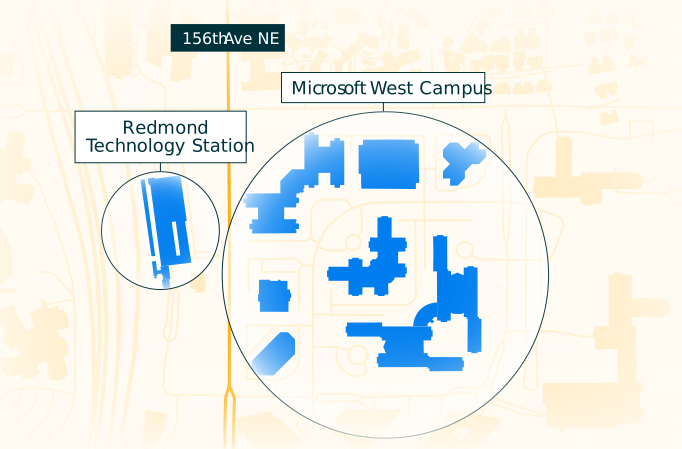
Microsoft donates 10 acres of land worth $8.7 million for a light rail station at Overlake, destined to become Redmond Technology Station.
This prime location next to Microsoft’s campus enables planning for the East Link station in Redmond at much lower cost.
Sending a message
Microsoft steps up to support the ‘Roads & Transit’ campaign, Seattle Prop.1, the ballot initiative to expand light rail across Puget Sound.
The measure narrowly fails, but the big message is clear: the Eastside’s largest employer believes in light rail and will help turn a vision into reality.
Winning the vote
Microsoft doubles-down, providing funds and vocal public support for Sound Transit 2’s revised ballot measure campaign.
These major campaign contributions helped voters hear the plan for a more connected region: voters passed Sound Transit 2 with 58% approval.
It’s the turning point that sets the East Link project in motion. For the first time, a light rail line connecting Seattle, Bellevue, and Redmond has voter-approval for massive regional and federal funding.
$1.7
billion
transit expansion
36
new miles
of light rail
Holding the line
Progress on the East Link was nearly stopped due to Initiative 1125, which would have blocked light rail on I-90 and other transit projects across the region.
Microsoft jumps in as the biggest supporter of the “No” campaign to help raise awareness of the impacts on critical pieces of the project. Voters agreed and chose to reject I-1125, protecting critical funding and right-of-way for East Link.
Bridging the gaps
Microsoft shifts its focus to turning an idea into concrete, steel, and rail cars, funding major infrastructure that will vastly improve station access.
Microsoft funds the original design to build a pedestrian/cycle bridge over State Route 520 to the Redmond Technology Station.
Spanning a busy freeway, an iconic white canopy-peaked bridge becomes part of the vision, infrastructure that will eventually connect the new Redmond Technology Station to Microsoft’s west campus, a regional bike trail, and King County Metro bus service.
Creating a connected hub
Thinking even bigger
Microsoft steps up again to support the Sound Transit 3 (ST3) “Yes” campaign, to help spread awareness of the project. Microsoft is the biggest corporate donor to the campaign.
Voters pass ST3, affirming the region’s need for transit. This authorizes $54 billion for transit expansions, including extending East Link to Redmond’s Downtown and further regional lines.
Staying on track
The project comes under threat again, this time from Initiative 976, which seeks to cut the vehicle excise taxes which are a key source of Sound Transit funding.
Microsoft strongly opposes I-976.
Building better connections
On the land donated by Microsoft nearly two decades earlier, Sound Transit opens a 300-space park-and-ride garage at Redmond Technology Station. This public facility helps residents access transit options more easily.
King County Metro Transit buses and Microsoft Connector Bus service and campus shuttles begin using the convenient new station, further knitting campus commute resources into the public transit hub. The connected system makes it easier for employees to reduce single occupancy trips to Microsoft’s campus.
All aboard
Light rail arrives on the Eastside. Tens of thousands of residents celebrate as the first light rail segment—the 2-Line—opens between South Bellevue and Redmond Technology Station.
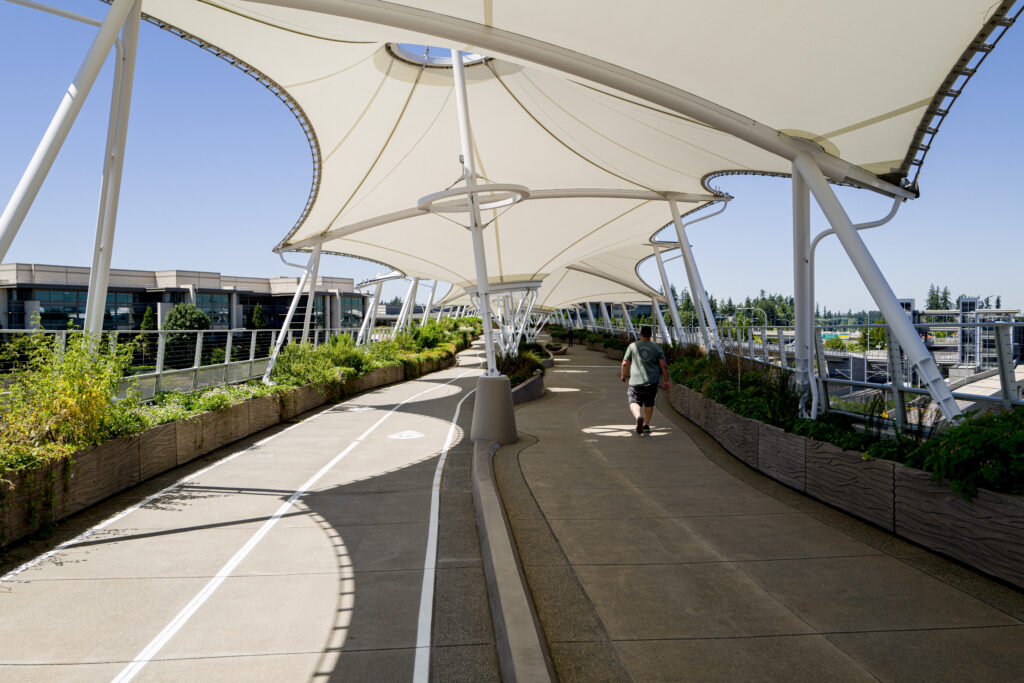
Funded by Microsoft and delivered through a public‑private partnership, the 1,100‑foot white‑canopy pedestrian bridge connects the community to light rail with a safer, more accessible crossing. The bridge is owned by the City of Redmond, with Microsoft continuing to support its long‑term maintenance.
Through a unique partnership with Sound Transit, the City of Redmond, and Washington State, Microsoft has invested in enhancing connectivity around the rail line:

Bike trails

Cycle tracks

Sidewalks
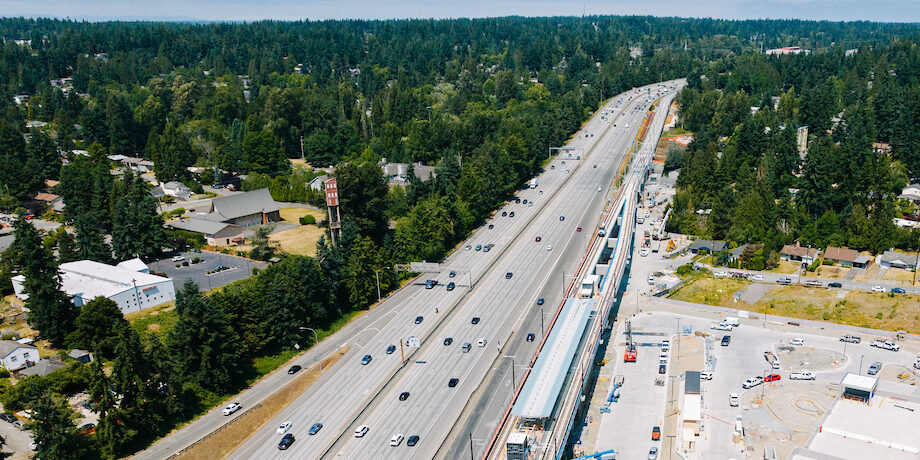
Road upgrades

New underpass
By car, foot, or bike, these connections make it easier for people to access the rail line, increasing light rail ridership and making the project even more effective upon opening.
History is made
The East Link Extension achieves an engineering first, something never before attempted in transit history: the world’s first light rail passenger service across a floating bridge.
The first ever Crosslake Connection train departs, fully connecting Seattle and points north and south to Eastside stations across Lake Washington.

The pontoon structure stretches
5,700
ft
Trains can travel safely at speeds up to
55
mph

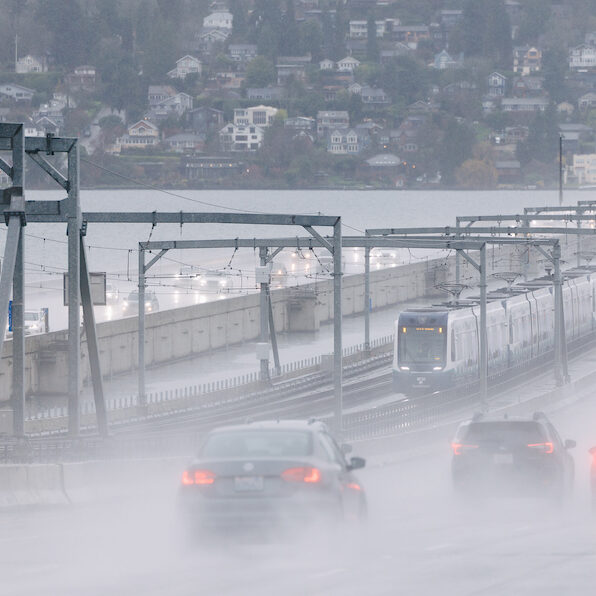
The bridge is built to move with water and wind while keeping the rail steady
On track for real community benefits

15 minutes
travel from Bellevue to Seattle
25 minutes
travel from Redmond Technology to Seattle
3,000-4,000
daily riders expected at new stations
15,000
new housing units projected in Bellevue
30,000
new jobs projected in Bellevue
A transportation victory for the community
After 24 years from the gifting of land to voter approvals and completion, light rail to the Eastside will transform how an entire region moves, connects, and grows together.
The project succeeded because Microsoft, Sound Transit, local governments, community advocates, engineering firms, other business leaders, and thousands of workers joined forces to achieve something never done before.
Microsoft has demonstrated its commitment to community development by contributing over $400 million towards regional infrastructure and growth initiatives. This significant investment showcases how partnerships with corporations can drive lasting, positive change within communities.
Microsoft has invested in many ways…

Unwavering advocacy

Boosting public perception

Filling funding gaps

Accelerating project development
The result is a transit system that serves everyone: employees, small business owners, students, families, and communities.
This is a true community win that will make the region more connected, sustainable, and economically vibrant for generations to come.
