The renewable energy sector faces mounting complexity as rapid wind and solar expansion, distributed grids, and sustainability imperatives collide with rising demand, reliability challenges, and heightened energy security pressure. Historically, sector AI adoption has lagged due to fragmented operations, tight economics, and risk sensitivity. Geographically dispersed portfolios, operated across multiple vendors and legacy systems, have made data integration and enterprise-wide AI deployment difficult to scale.
As a result, organizations are increasingly recognizing the need for data context that unifies operations, systems, and decision‑making, reshaping how they think about AI and its role. Building on this foundation, energy organizations are now placing autonomous AI agents at the core of their operations, enabling significant productivity gains and accelerating innovation.
These agentic workflows allow AI systems to plan, decide, and act with minimal human input, freeing employees for strategic oversight. According to Microsoft’s Work Trend Index, over 80% of business leaders expect AI agents to expand workforce capacity and be integrated into strategy within the next 12 to 18 months. For energy companies, this shift is not just hype; it’s a real opportunity to overcome operational bottlenecks and workforce shortages.
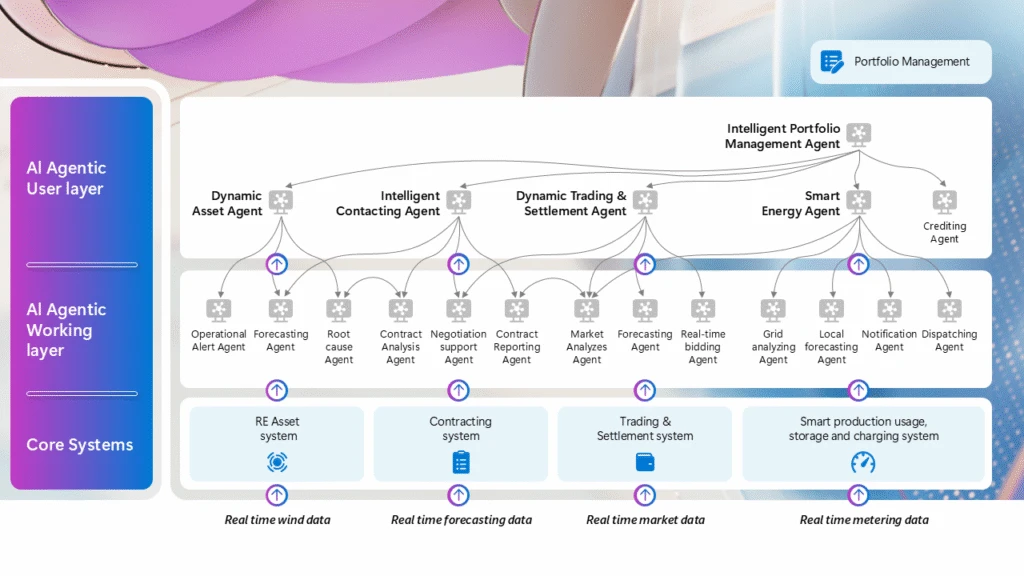
Rewiring renewable operations for speed, resilience, and scale
Agentic AI represents a fundamental shift in how renewable energy organizations operate, moving beyond analytics and decision support to autonomous, context‑aware systems that can plan, decide, and act across the value chain. By orchestrating complex workflows across planning, operations, compliance, and markets, AI agents enable organizations to realize the Energy Frontier. Speed, resilience, sustainability, and scalability are built directly into daily operations. The result is a step‑change in performance, freeing human teams to focus on oversight, strategy, and innovation rather than manual coordination.
Project planning and resource assessment
From the earliest stages of project development, AI systems can rapidly analyze vast datasets like climate records, geospatial information, and regulatory constraints to identify the most promising sites for new wind, solar, or hydro installations. This accelerates project timelines and improves the accuracy of yield predictions, giving developers a competitive edge.
Supervised autonomous operations
Once assets are operational, AI agents serve as vigilant guardians, continuously monitoring equipment health and performance. By analyzing high-frequency real-time sensor data, these systems can detect subtle anomalies and predict failures well before they occur, enabling proactive maintenance and minimizing costly downtime. The scheduling of repairs, coordination of crews, and management of spare parts are increasingly handled by interconnected AI agents, ensuring that resources are deployed efficiently and that maintenance activities are timed to maximize asset availability and minimize operational disruption.
Procurement and compliance
Administrative and compliance tasks, traditionally a source of bottlenecks and risk, are also being transformed. AI-powered workflows automate the management of contracts, procurement, and regulatory filings, adapting instantly to new requirements and reducing the risk of errors or missed deadlines. Carbon accounting and environmental, social, and governance (ESG) reporting, which require the aggregation and analysis of diverse operational data, will be performed autonomously, enhancing transparency and credibility with stakeholders.
Logistics control
Supply chain and logistics operations benefit from the AI agent’s ability to forecast needs, optimize inventory, and coordinate deliveries, making organizations more resilient to disruptions and more agile in responding to market changes. In the field, AI agents empower technicians with real-time troubleshooting guidance, bridging skills gaps and improving safety, while advanced forecasting agents provide hyper-local weather predictions that inform operational decisions and grid interactions.
Forecasting
On the commercial side, AI agents are revolutionizing energy trading and market participation. By synthesizing weather forecasts, market prices, and grid conditions, these systems enable renewable operators to maximize revenue and manage risk with unprecedented speed and precision. High-performance computing further amplifies these capabilities, allowing for real-time optimization of grid operations, wind farm layouts, solar irradiance forecasts, and energy storage dispatch.
Collectively, these agentic workflows create a networked intelligence, continuously learning and adapting to drive efficiency, reliability, and sustainability across the organization. The result is a step-change in performance, moving energy firms from reactive, human-intensive processes to proactive, data-driven strategies that unlock new levels of performance and value.
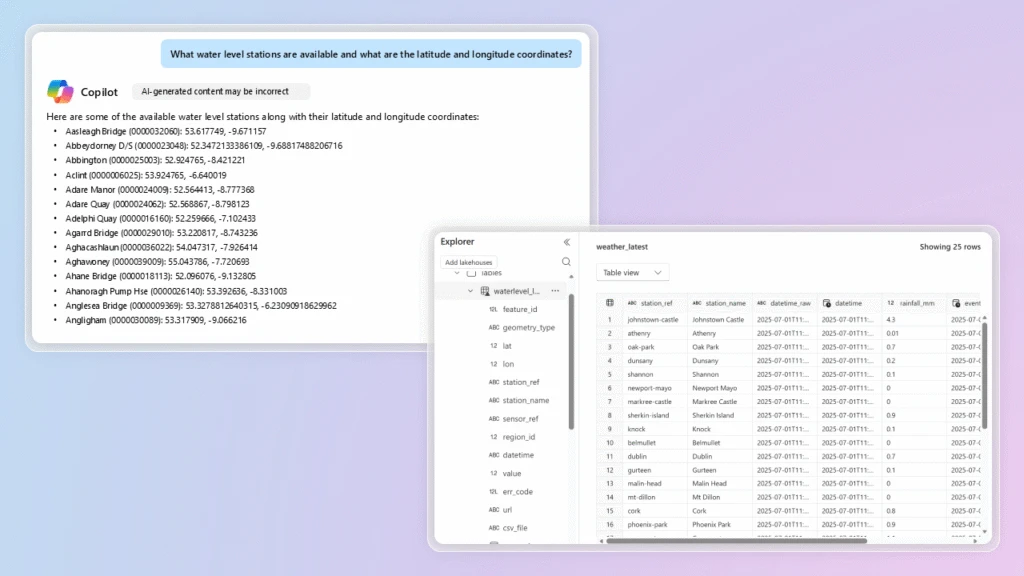
Top agent use cases in the renewable energy sector
In practical terms, companies are now building a catalogue of agents to deliver business value and are implementing many different solutions. In the table below, we outline some examples of agents that are being discussed and built across the renewable energy sector.
| Use Case | Agentic Workflow | Business Impact | Technology Enablers |
|---|---|---|---|
| Renewable Resource Assessment | Autonomous analysis of climate, GIS, and policy data to identify optimal sites | Accelerates project planning, improves yield predictions, reduces risk of suboptimal investments | ML, geospatial analytics |
| Asset Performance Monitoring | 24/7 AI monitoring of equipment health and performance | Minimizes downtime, reduces maintenance costs, increases energy output and safety | ML, IoT, predictive analytics |
| Automated Procurement & Compliance Management | AI manages contracts, regulatory changes, and filings | Speeds up procurement cycles, ensures compliance, reduces errors and legal risks | NLP, workflow automation |
| Predictive Maintenance Scheduling | AI plans repairs, coordinates crews and parts based on predictive insights | Maximizes asset availability, reduces emergency repairs, optimizes workforce utilization | Predictive analytics, scheduling algorithms |
| Carbon Accounting & Reporting | AI aggregates and reports carbon metrics from diverse sources | Ensures accurate ESG reporting, supports compliance, enhances credibility with stakeholders | Data integration, automation |
| Supply Chain & Inventory Management | AI forecasts needs, places orders, tracks inventory, and optimizes logistics | Reduces costs, prevents delays, improves capital efficiency and resilience | ML, digital twins, logistics optimization |
| Intelligent Engineering Tendering | AI drafts and evaluates tenders/proposals, checks compliance | Speeds up procurement, improves document quality, increases competition and inclusivity | NLP, document automation |
| Wind & Solar Operations Co-Pilot | AI assists field teams with troubleshooting and guidance | Reduces repair times, bridges skills gaps, improves safety and workforce productivity | Chatbots, AR, multimodal AI |
| Trading & Market Forecasting Agent | AI forecasts and executes energy trades based on market and weather data | Maximizes revenue, manages risk, improves cash flow predictability | ML, market analytics |
| Local & Regional Weather Forecasting | ML-enhanced hyper-local forecasts for operational decisions | Improves asset scheduling, safety, and grid integration, reduces reserve costs | Deep learning, HPC |
| Logistics & Supply Coordination Agents | Coordinated AI agents orchestrate maintenance logistics and supply chain | Ensures seamless operations, minimizes downtime, lowers O\&M costs | Workflow automation, IoT |
| AI Emulators for Energy (Physics-Informed Operations) | Real-time physics emulation for operational optimization (e.g., wake steering) | Increases energy output, extends asset life, reduces maintenance | Neural networks, physics-informed AI |
| HPC-Driven Optimal Power Flow (Grid Optimization) | HPC+AI optimize electricity flows and grid dispatch | Lowers system costs, improves reliability, enables higher renewable integration | HPC, optimization algorithms |
| HPC-Driven Wind Farm Layout Optimization | HPC simulations for optimal turbine placement | Maximizes energy yield, reduces development risk, improves project economics | HPC, CFD, genetic algorithms |
| HPC-Driven Solar Irradiance Forecasting | HPC processes satellite data for precise solar forecasts | Improves grid integration, reduces balancing costs, enables better market bidding | HPC, atmospheric models |
| HPC-Driven Energy Storage Dispatch Modelling | HPC-powered agents optimize battery and storage dispatch | Maximizes storage value, improves reliability, reduces degradation and costs | HPC, optimization, battery models |
Building confidence at scale: Intelligence meets trust
The key to success for agentic AI in renewable energy organizations, particularly as they scale AI, is trust. This is at the heart of Microsoft IQ, which combines advanced AI capabilities with built-in security, governance, compliance, and human accountability. In environments where AI decisions affect grid reliability, asset safety, regulatory compliance, and capital planning, trust is critical. Microsoft IQ allows autonomous agents to reason and act across complex workflows while staying within clear guardrails and maintaining transparency. The result is confidence at scale: energy companies can move faster, automate more, and unlock greater value from AI, without sacrificing control, safety, or credibility as they advance toward the Energy Frontier.
Realizing the Energy Frontier in your business
Agentic AI is already reshaping how energy organizations operate, delivering measurable improvements across efficiency, productivity, agility, reliability, and sustainability. By automating repetitive and data-intensive tasks, AI agents reduce operational burden while enabling teams to focus on strategic work and innovation.
The combined impact of predictive maintenance, intelligent procurement, forecasting, and high-performance computing-driven optimization created a connected, continuously learning system—turning renewable variability into a strategic advantage and enabling faster, more informed decision-making.
Strategic steps for business decision-makers:
- Pilot high-impact use cases aligned with operational priorities such as asset monitoring or forecasting.
- Invest in data foundations and governance to ensure AI agents operate effectively.
- Scale by integrating agents across workflows to unlock compounding value.
- Prioritize workforce enablement to drive adoption and trust.
Organizations that take these steps won’t just improve operations; they will operate faster, smarter, and more resiliently, turning AI into a strategic differentiator. By combining intelligence, trust, and human expertise, energy companies can unlock the full potential of AI, achieve higher asset performance, lower costs, and better sustainability outcomes and confidently step into the Energy Frontier.