Customers expect support that resolves issues quickly, delivers consistent answers, and works seamlessly across channels. For organizations, this creates a familiar tension: how do you deliver high‑quality service at scale without losing control over cost, compliance, or experience?
That’s why we’re excited to announce the general availability of real‑time voice agents in Microsoft Copilot Studio launching in Dynamics 365 Contact Center. These agents are designed for nuanced, high‑impact interactions where voice experiences need to adapt in the moment—while still operating within trusted, enterprise‑grade solutions.
Real-time voice agents build on the momentum of Copilot Studio as a proven, enterprise-scale platform. Over 80% of Fortune 500 companies now have active agents built using our low-code/no-code tools, creating a strong foundation for bringing real-time, conversational voice experiences into their customer workflows.1 This widespread adoption shows how ready organizations are to extend their existing Copilot-powered agents into natural, responsive voice interactions.
Why AI voice support needs to go off script
For decades, menu‑based interactive voice response (IVR) systems provided predictability, reliability, and compliance at scale. Over time, organizations layered in speech recognition and automation to reduce friction and manage growing call volumes more efficiently. These approaches remain critical today and continue to power successful customer service operations across industries.
What’s changed is not the importance of voice, but the expectations customers now bring into voice interactions. Conversations rarely follow a straight line. Customers interrupt, clarify, change direction mid‑call, or introduce urgency without warning. When that happens, rigid interaction models can struggle to keep up, even when the underlying systems are reliable.
Meanwhile, across industries, contact centers are under pressure to do more with less. Interaction volumes continue to rise, margins are tighter, and customer expectations are shaped by digital experiences that feel fast, personal, and responsive. Many teams are already exploring AI through chatbots, voice automation, or workflow tools, but scaling those experiments into production voice experiences that customers trust is far harder than running a pilot.
Voice, in particular, exposes gaps immediately. Latency, awkward handoffs, or missing context are noticed in real time, often at the most critical moments. That’s why simply adding automation isn’t enough. As organizations move toward agentic, AI‑first service models, voice needs to work as part of a unified service layer: one where understanding, reasoning, and action happen together, and where context carries forward if escalation is required.
Meeting this bar doesn’t require replacing the voice systems that already work. It requires extending them with capabilities designed specifically for live, conversational interactions. This makes it possible to move beyond scripted interactions without treating voice as an isolated AI experiment.
Meet real-time voice agents for AI voice support
Real‑time voice agents represent a new premium mode within voice agents that sits under the broader category of conversational AI. They are optimized for low‑latency, interruptible, speech‑to‑speech conversations with real‑time reasoning. This distinction helps teams choose the right interaction model for each scenario without treating all voice interactions as equal.
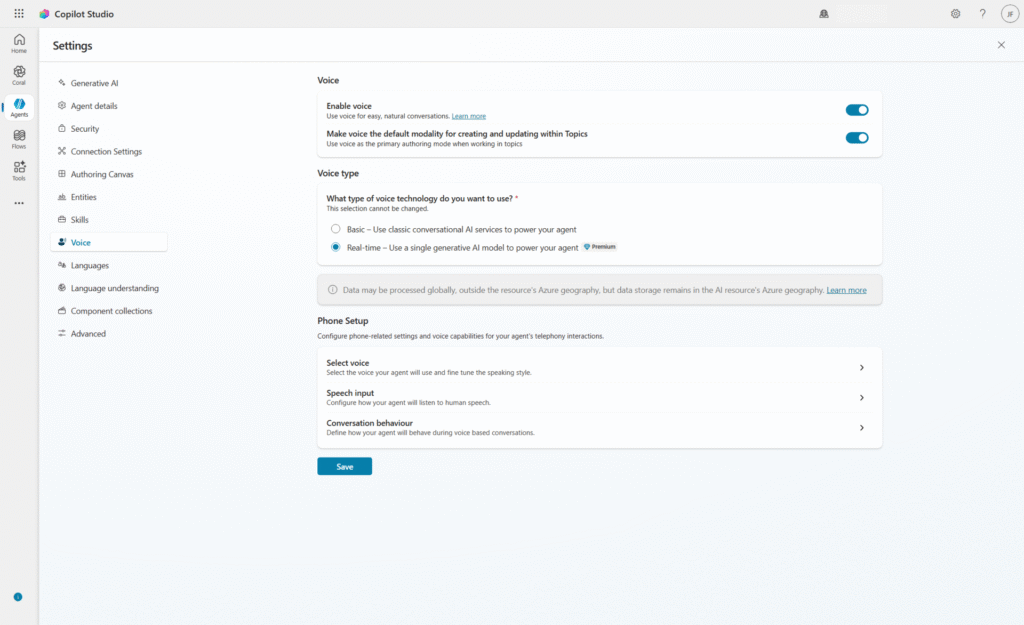
These agents can move from intent to action to confirmation within a single interaction. They can retrieve or update information mid‑conversation and take action as the interaction unfolds. Customers can get faster resolution, while service teams can maintain consistent experiences and centralized operational control. This also frees human agents to focus their time and energy on conversations where judgment and empathy matter most.
High-volume self-service, designed for everyday voice interactions
Real-time voice agents are built for the high volume, business-to-consumer (B2C) interactions that define customer service at scale. These everyday inbound calls make up the majority of customer engagement across industries. To support this breadth, Copilot Studio enables organizations to grow their voice strategy—starting with deterministic, template-driven flows and expanding into dynamic, real-time voice agents as needs evolve.
Copilot Studio provides a documented set of external voice agent templates designed for unauthenticated, customer-facing interactions across both Copilot Studio and Dynamics 365 Contact Center, covering many of the core workflows customer service teams handle today, including:
- Billing and payments, which are among the most frequent and sensitive contact center interactions. Customers want clarity and resolution in the same call, not a handoff or follow-up. These scenarios often start with deterministic flows—confirming identity, checking balances, or processing payments—but can switch to dynamic, real-time voice agents that explain charges, respond to questions, and adapt tone as situations become more urgent.
- Order and reservation support across retail, travel, and hospitality, which often requires more dynamic handling. What begins as a simple status check can quickly shift into a change request or issue resolution. Real-time voice agents adapt to these pivots by grounding responses in live order or reservation data. They’re designed to act while preserving relevant context, supporting organizations as they evolve from structured flows to more flexible conversational automation.
- Eligibility and verification scenarios in healthcare, financial services, telecom, and the public sector, which rely on accuracy and trust. Deterministic steps—collecting required information, confirming eligibility criteria—can be paired with dynamic voice capabilities that answer questions as they arise and help preserve continuity if escalation or additional support is needed.
- Appointment scheduling and changes often involve interruptions and evolving preferences. Organizations can begin with predictable scheduling flows and grow into dynamic, real-time voice agents that let customers book, reschedule, or confirm details conversationally, without unnecessary restarting or repeating information as needs shift.
- Account and membership management, which often spans multiple tasks, from updating personal details to managing subscriptions or reviewing benefits. Deterministic updates can be combined with dynamic, context-aware voice interactions that stay connected to live account data, keeping these conversations efficient, accurate, and natural from start to finish.

From conversation to resolution, without breaking flow
Real‑time voice agents are built for real customer service environments, where escalation is a natural part of resolution rather than a failure of automation. At launch, these experiences are delivered through Dynamics 365 Contact Center, with conversation context carrying forward automatically, helping reduce the need for customers to restate information when human judgement is required.
As part of the Copilot Studio product roadmap, real‑time voice agents will also extend to Microsoft Teams Phone and additional Copilot Studio digital apps and channels, enabling organizations to bring consistent, context‑aware voice experiences to more customer touchpoints over time.
Voice automation designed for trust, control, and evolution at scale
For IT teams, voice automation has always been high impact but high risk. Feedback from early internal deployments reinforces the importance of pairing conversational intelligence with enterprise‑grade governance and lifecycle controls.
Innovation in voice does not require giving up control or predictability. Voice is a high‑stakes interaction surface, and customers notice immediately when experiences feel unreliable or inconsistent.
Copilot Studio takes a deliberate approach to real‑time voice by selecting the right models for the right moments, including the latest frontier models, optimized for the right balance of quality, latency, and reliability, without placing that complexity on customers. Built on Microsoft’s enterprise foundations for security, governance, and operational oversight, real‑time voice agents help organizations innovate with confidence while preserving trust.
Get started with Copilot Studio
Support for real-time voice agents is now generally available in North America for Dynamics 365 Contact Center, with language support, additional regions, and broader customer touchpoints expanding over time as part of Copilot Studio’s global rollout.
Learn more about real-time voice agents and sign back in to Copilot Studio to start scaling customer support with agents today.
New to Copilot Studio? Discover how you can transform your business by building, evaluating, managing, and scaling custom AI agents—all in one place. Sign up for a free trial of Copilot Studio today.
1 Source: Microsoft usage data, 2026.