Microsoft accelerates telecom return on intelligence with a unified, trusted AI platform
AI is delivering real, measurable returns for telecom
AI is already delivering measurable business impact across industries, and telecom is among the leaders. A recent IDC study shows operators are achieving 2.8 times return on generative and agentic AI investments, with many leading companies reaching up to 5 times return. Frontier telecoms are realizing even greater returns from AI by making it foundational to how their business operates—from employees and core workflows to the end‑to‑end value chain. These leaders are moving beyond incremental efficiency by using an end-to-end AI platform and unified data approach that embeds AI into everyday operations, enabling faster decisions, tighter execution, and continuous performance improvements across their organization.
With more than 80% of the Fortune 500 building active AI agents, Microsoft Copilot is rapidly becoming essential to how employees think, collaborate, and deliver results. As AI proves its value, telecoms are moving beyond pilots to connected intelligence that elevates customer experiences, replaces manual workflows with autonomous operations, hardens and self‑heals networks, and drives new revenue opportunities. Connected intelligence will differentiate fast-moving telecoms across every area of business operation.
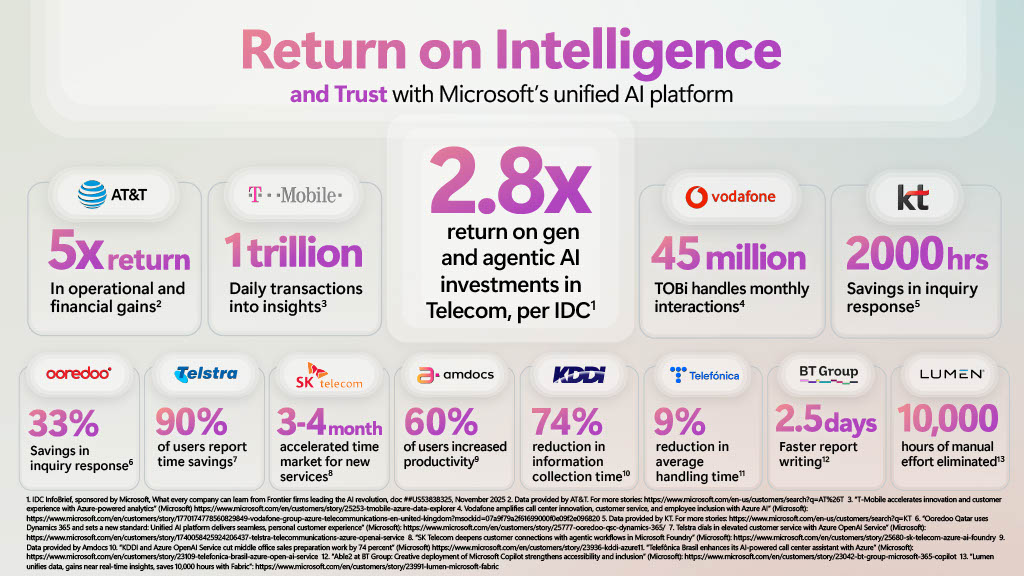
Read more about Frontier telecoms here.
Return on intelligence and trust
For telecoms, achieving value from scalable AI depends on two factors: intelligence and trust. Built from three complementary IQ elements—Work IQ, Fabric IQ, and Foundry IQ—Microsoft IQ is the intelligence layer that connects AI, data, and context across the business. It gives AI agents deep awareness of how people work, how the business operates, and how decisions are made. This intelligence layer accelerates decisions, improves customer experiences, automates operations and networks, and unlocks new ways to monetize AI‑based services. Trust is built through Microsoft’s carrier‑grade control plane, which provides built‑in monitoring and governance across the entire AI platform, including AI agents from our partner ecosystem, to allow telecoms to innovate responsibly, support regulatory compliance, and scale AI with confidence.
At MWC 2026, Microsoft is announcing new technologies that will help telecoms move forward with AI and use intelligence to drive the business. Microsoft delivers this through a single platform that brings AI, unified data, trust, and governance together to enable telecoms with connected, actionable insights to accelerate innovation and growth.
Building the sovereign, AI-ready edge for telecom
For telecoms, thriving in the era of agentic intelligence begins with a resilient foundation. Today, we’re advancing Microsoft Sovereign Cloud with fully disconnected operations, extending cloud capabilities and AI-ready infrastructure deeper into operator networks than ever before. As demand accelerates for low-latency services, real-time processing, and stronger assurances around data sovereignty and regulatory compliance, the edge has become a critical extension of telecom networks and foundational layer of modern digital infrastructure. This is especially true for regulated industries and mission-critical scenarios where operational resilience and control over data are paramount.
To support these confidential environments, Azure Local offers full stack capabilities that support customers across connected, intermittently connected, and fully disconnected modes. This is essential for sovereign environments where uninterrupted access to operational, network, or customer-facing systems is non-negotiable. Azure Local disconnected operations keeps critical services running securely without connectivity to the cloud. At the same time, Foundry Local will be able to offer modern infrastructure and support for large AI models. Using the latest graphics processing unit (GPU) infrastructure from partners like NVIDIA means customers with sovereign needs will now be able to run models locally on their own hardware, inside strict sovereign boundaries enabling powerful, local AI inferencing in fully disconnected environments.
Customers can deploy and govern workloads inside their own datacenters, using familiar Microsoft Azure experiences and consistent policies, without depending on continuous connection to public cloud services.
AT&T uses Azure to support its cloud and edge strategy, enabling consistent operations across a distributed network footprint. By applying Azure’s management and governance capabilities across environments, AT&T can bring compute and data processing closer to where services are delivered while maintaining strong security and operational oversight.
“As we expand our network edge capabilities, Azure plays a key role in helping us apply cloud-native principles across our distributed infrastructure. The scalability and flexibility of Azure’s adaptive cloud approach allow us to deploy services closer to our customers, maintaining control while providing the reliability and performance they expect from AT&T. This long-standing partnership enables us to innovate and deliver next-generation experiences at the edge.”
—Sherry McCaughan, Vice President, Mobility Core and Services
Azure’s cloud-native management capabilities and global platform enable organizations like AT&T to modernize and scale edge environments, supporting next-generation services while maintaining consistent governance, security, and operational control. Native management capabilities and a global platform enable organizations like AT&T to modernize and scale edge environments, supporting next generation services while maintaining consistent governance, security, and operational control.
We’re also investing in multi-rack deployment capabilities for Azure Local, extending scale points to support large-scale infrastructure for the most demanding, mission-critical workloads. Customers will be able to expand from single-node and cluster deployments to multi-rack environments designed for high availability, fault isolation, and operational simplicity at scale. Multi-rack deployment on Azure Local is currently in preview and will be available in the coming months.
Microsoft is collaborating with telecom operators to deliver sovereign cloud platforms and managed services that combine hyperscale innovation with local control, enabling enterprises to meet data residency, regulatory, and security requirements while accelerating trusted digital and AI transformation.
Agentic customer experiences that drive growth
With this foundation in place, telecoms can move beyond isolated use cases to scale intelligence across experiences and growth models. The same agentic capabilities that transform customer engagement also unlock new ways to monetize services, reduce cost to serve, and create differentiated value.
Today, telecom customer journeys are fragmented. Customers often switch channels to complete tasks, driving abandonment and cost. AI agents turn customer intent into end‑to‑end action across systems. Microsoft is now offering a telecom agentic store reference framework to replace click‑based journeys with natural‑language interaction. Coordinated AI agents handle discovery, sales, service, billing, and partner offers in the background—customers state their goal and agents deliver the outcome. The result is higher digital completion, faster resolution, and better experiences. This framework also creates a new monetization platform, enabling federated AI marketplaces with built‑in identity, billing, and sovereign deployment for trusted ecosystem commerce at scale. Telecoms are already working with Microsoft and system integrators to adopt this architecture—unifying sales and service, reducing cost‑to‑serve, and creating a scalable foundation for partner‑led innovation.
FiberCop modernizes edge cloud and contact center
FiberCop runs Italy’s most advanced, far-reaching and pervasive digital network infrastructure. FiberCop recently announced that it has integrated Azure Local into its network, transforming the access infrastructure into an edge cloud platform capable of delivering cloud-native services, virtualized network functions, and advanced workloads while meeting sovereignty and compliance requirements. Today, FiberCop announces that it is accelerating its agentic transformation, moving to an AI‑first contact center model where autonomous AI agents, Copilot, and human expertise work together. By adopting Dynamics 365 Contact Center, FiberCop has begun modernizing customer engagement with unified data, intelligent routing, and AI‑powered self‑service and assisted service that delivers more efficient operations and better customer experiences at scale.
Introducing Ericsson Enterprise 5G Connect to reimagine customer experience
Ericsson announces ongoing collaboration with Microsoft introducing the Ericsson Enterprise 5G Connect solution—validated on Microsoft Surface 5G Copilot+ PCs and built on top of Windows 11’s Enterprise Cellular Managed Connectivity (ECMC) capabilities. This new offering enables enterprises to centrally manage secure, seamless 5G connectivity for mobile and hybrid employees, using automatic network switching and robust policy enforcement to enhance productivity and security. IT teams gain scalable management and control, while end users benefit from uninterrupted, AI-powered experiences across private and public 5G networks. The solution is currently being piloted by Ericsson and is in private preview. To learn more, visit our Windows IT Pro blog.
Intelligent business operations, built for telecom
Delivering connected customer experiences depends on what happens behind the scenes. Telecom operations require trusted, governed access to network and customer data. That’s why operators are moving from legacy data warehouses to a modern lakehouse that unifies business and network data.
Microsoft Fabric provides a single, policy‑governed data foundation for real‑time, operational, and analytical data to speed AI insights at scale. Building on this foundation, today we’re announcing Azure Databricks Lakebase will be available in March 2026, giving telecom operators a managed PostgreSQL environment with next generation separation of storage and compute for transactional data, providing instant availability, instant clones, and scale-to-zero. This brings online transaction processing (OLTP) capabilities to the Databricks Data Intelligence Platform on Azure designed for developer performance with low total cost of ownership (TCO), eliminating the traditional gap between operational systems and the lakehouse.
Partners are building on this data foundation as well. For example, Nokia integrates its data suite with Fabric to securely unify network telemetry and reduce AI use case development time by up to 80%.
MTN transforms fraud prevention with AI
In today’s rapidly evolving digital landscape, identity theft and first-party fraud are escalating at alarming rates, posing significant risks to individuals and businesses across South Africa. MTN has made a bold move to transform its fraud management approach by harnessing advanced Microsoft technologies. Shifting from traditional, reactive methods to a proactive, AI-powered ecosystem, MTN is not only protecting its customers and strengthening revenue defenses but also reinforcing national digital resilience and contributing to a safer, more secure digital economy for all.
Amdocs powers intelligent business operations
Amdocs is making several announcements with Microsoft that deepen integration to deliver next-generation solutions. The first is AI-powered application modernization through the Amdocs Agentic Services platform, embedding Microsoft AI solutions such as Azure OpenAI and Microsoft Foundry into end-to-end modernization and migration to Azure. Second, Amdocs Cognitive Core platform built on amAIz, offering prebuilt agent libraries, cross-domain insights, and telecom-specific AI that integrates with any business or operating system stack and runs securely on Azure. Colt Technology is working with Amdocs and Microsoft to streamline operations and accelerate service delivery with real-time insight.
To learn more about transforming the OSS/BSS with agentic AI, read this blog.
Power autonomous networks with built-in trust and control
As intelligence is embedded across data and operations, the next frontier is the network itself. Agent-driven operations enables networks to move from reactive management to autonomous executions that respond faster, reduce risk, and improve resilience at scale.
Learn more about NOA
Read the blogTo help operators move from pilots to production at scale, Microsoft is evolving its network operations agent (NOA) reference architecture—a proven framework shaped by real world deployments, industry collaboration, and learnings from Microsoft’s NetAI program.
NOA is built for today’s telecom realities: exploding event volumes, rising complexity, and persistent skills gaps. The latest evolution deepens integration with Microsoft AI and collaboration platforms, strengthens alignment with open standards, and delivers a modular, production-ready path to autonomy—without compromising telco-grade safety, governance, or human oversight. Operators engage AI directly through Microsoft 365 Copilot and Microsoft Teams, while Microsoft Foundry and the Microsoft Agent Framework provide a governed, observable runtime for multi-agent orchestration at scale. Expanded support for TM Forum Open APIs helps ensure interoperability across existing business and operations support systems, making NOA an open, secure foundation for autonomous networks. Read more about NOA.
Leading operators such as Far EasTone Telecom and Vodafone are already applying this blueprint to modernize network operations, reduce human error, accelerate recovery times, and enable engineers to focus on higher value work.
Far EasTone Telecom (FET) is turning agentic AI into real operations impact
FET exemplifies how leading operators are turning this architecture into real operational impact. FET is using the NOA framework to redefine cloud native network operations by embedding agentic AI across its NOC and change management workflows. Today, nearly 60% of its NOC operations are AI-assisted, with about 10,500 operational tasks executed per month, including incident summaries, automated ticket closure, network checks, and proactive voice notifications. AI agents now handle largescale alarm correlation and root cause analysis in seconds, supporting nearly 7,000 monthly operational queries with an average response time of 16 seconds, and enabling most maintenance actions to complete within one minute. This shift has significantly reduced human error, accelerated recovery times, and allowed engineers to focus on higher value work.
Vodafone’s journey toward intelligent network operations
Vodafone is working with Microsoft to apply this proven AI‑powered blueprint for autonomous network operations across transport infrastructure and field‑force management. The collaboration combines Vodafone’s deep network expertise with Microsoft Foundry and the NOA framework to modernize how large‑scale telecom networks are operated.
This blueprint is built on Microsoft’s own experience running autonomous agents across its global Azure transport network, where AI continuously monitors performance, identifies root causes, and autonomously manages more than 65% of fiber‑break field dispatches—improving time to repair by up to 25% and accelerating root‑cause analysis by 80%. By applying these proven capabilities to Vodafone’s transport network, the two companies are accelerating the shift toward intelligent, automated transport network operations across the telecom industry.
“By working with Microsoft, we’re combining deep network expertise with proven AI‑powered operations to create something greater than either could achieve alone. Together, we’re building intelligent, automated transport network operations that empower our teams and deliver faster, more resilient connectivity networks for our customers.”
—Alberto Ripepi, Chief Network Officer, Vodafone
Other operators, including AT&T, T-Mobile, Telefónica, and MEO, are adopting Microsoft Foundry as a blueprint for scaling agentic AI across complex, multi-vendor networks.
Today, Kenmei announces it is collaborating with Microsoft to help operators accelerate their path toward autonomous networks by combining Kenmei’s telecom intelligence offer with Azure and Microsoft Fabric to enable scalable analytics and agentic AI–powered operations. Already in use at leading operators like Telefónica and Etisalat (e&), this collaboration brings proven deployments into a broader cloud and AI ecosystem designed to reduce manual effort, speed decision‑making, and unlock new levels of network automation.
Microsoft achieves global milestone to extend internet access with Starlink
As telecoms scale intelligence across networks, operations, and experiences, connectivity remains the starting point. Because AI only delivers impact where access exists, expanding internet access is foundational to an intelligent and inclusive telecom future.
Today, 2.2 billion people around the world remain unconnected.1 To help overcome this barrier, Microsoft pledged to bring access to 250 million people by 2025. We are pleased to share that we’ve expanded internet access to 299 million people through the power of technology and partnerships in communities around the globe. But we know there is more work to do to support unconnected communities and enable global participation in the AI economy.
In support of this on-going effort, we are unveiling a new collaboration with Starlink designed to bring Microsoft’s experience with governments, local operators, and community partners together. With more than 9,000 satellites in low-Earth orbit, Starlink will extend digital infrastructure to rural, agricultural, and hard-to-reach communities. You can read more about how we met this milestone and are continuing to extend AI-enabled connectivity aligned with community needs.
Join us at MWC 2026 to learn more
Frontier telecoms are already proving what’s possible when AI, data, trust, and governance come together on a single platform to power faster operations, autonomous networks, intent-driven engagement, and real return on intelligence.
Join Microsoft At MWC 2026 to see how operators and partners are moving from AI promise to production through real deployments, live demos, and customer stories.
1Facts and Figures 2025, ITU.