
Dev Diaries: GitHub Copilot at Ramp: Fueling a 10x developer mindset
Coding is a deeply creative act. It’s part engineering, part imagination. You’re writing syntax that brings ideas to life, translating ideas into logic, designing systems, and solving real-world problems. But it’s also fast-paced, ever-evolving and filled with constant learning curves.
That’s where AI comes in. With tools like GitHub Copilot, developers are gaining a powerful edge – coding faster and thinking bigger.
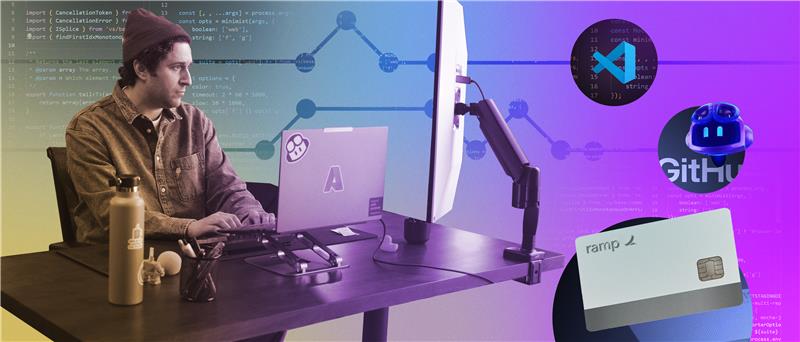
It’s a new reality that Austin Ray is already building toward. As AI DevX Lead and Staff Software Engineer at Ramp, he’s pushing the boundaries of how developers work and what they can create.
“We’re moving into an era of builders,” says Austin. “Code is turning into a byproduct of good specs and guardrails. The real work is choosing the right thing to build and proving it delivers.”
Leading the way to better dev experiences
Austin started coding at 11, building Flash games for him and his friends to play. That early curiosity became a career and, eventually, a mission.
Today, he leads Ramp’s AI Developer Experience team, where he empowers 300+ engineers with modern tooling, fosters an AI-first developer culture and builds scalable systems that streamline workflows.
“My day usually splits in two,” explains Austin. “In the first half, I’m leading the developer community around AI tooling and coding agents. And in the second half, I’m building platforms to help our AI tooling and coding agents perform even better.”
GitHub Copilot as a developer’s supercharger
“We share tribal knowledge every day,” says Austin. “In this fast-changing field, open, honest discussion is how we level up. There’s no substitute for devs helping devs.”
GitHub Enterprise plays a foundational role in Ramp’s engineering ecosystem. Pull requests (PRs) drive collaboration with clarity and traceability. GitHub Actions, meanwhile, handles the critical behind-the-scenes work, serving as the core engine of Ramp’s CI/CD and significantly increasing developer productivity via automated checks and actions on PRs.
“Many important conversations about Ramp’s codebase and product happen in PRs.” explains Austin. “The history of these conversations associated with the code they’re discussing is a goldmine for devs and coding agents when fixing related bugs and building related features. And GitHub’s PR system is amazing. GitHub Actions let us spin up automations that improve everything from testing to deployment. It fits seamlessly into our dev processes, and now powers our agent development too.”
For Austin, GitHub Copilot takes that flow to the next level. He relies on it daily in PyCharm, supercharging both productivity and thinking.
“GitHub Copilot boosts my productivity by at least 30%. It helps me finish my thoughts and stay at a higher level of abstraction. It reduces cognitive load, lowers activation energy and helps me avoid writer’s block.’ I stay in the zone longer.”
Other features, such as autocomplete, are also delivering value for Austin, allowing him to reduce repetitive manual tasks and save time.
“GitHub Copilot autocomplete is the main feature I use. It’s uniquely effective – other tools just aren’t the same. For repetitive tasks, it’s a slam dunk. You just keep pressing that tab key until you’re done.”
As Austin explains, “The future is about optimizing your workday around coding agents working in parallel. Your job is to lay the concrete for that highway – let the agents do the dev work and jump in only when you’re needed.”
Riding the AI wave
Austin believes we’re at the edge of something exponential, and developers need to ride that wave.
Inspired by the shift, Austin is working on the next evolution: running agents at scale.
“We’re past the local agent phase. Now we’re asking: how do we deploy these agents reliably in the cloud? How do we give developers the tools to offload work safely and scalably? That’s what I’m building.”
His advice to fellow developers:
- Stay open to how your role might evolve.
- Be flexible, use the best tools available.
- Follow your curiosity. Experiment boldly.
- Develop strong opinions about code quality and taste.
- And most of all, use agents often.
“Work with them daily. Learn their quirks. Just like becoming a senior engineer, it takes time and exposure. But once you get there, you’ll see further. You’ll plan better. You’ll ship smarter. And that’s how you stay in the game.”
It’s this kind of developer-led momentum that Azure AI Foundry is designed to support; bringing together product teams and forward-thinking engineers to experiment, learn, and push AI experiences forward.
Austin’s journey at Ramp is one of curiosity and evolution. With GitHub Copilot and Azure AI Foundry by his side, he’s writing code to shape what’s next.
As he explains, “There’s a moment when you first start using GitHub Copilot where you understand that software development has fundamentally changed forever. I remember texting everybody, all my friends who were developers, and telling them you have to start using this. It is definitely the future. You will be more productive immediately.”
Quick five with Austin Ray
Tabs or spaces?
Spaces.
Dark mode or light mode?
Dark.
Open source or closed source?
Depends. Open source was the way, but with agents and unified direction, closed source might offer better product velocity.
Favorite shortcut?
Command + Tab. App switching, all day.
Coding music?
My “Gotta Go Fast” playlist. House, techno, whatever gets the tempo up.
Discover how RAMP is transforming customer experiences with Azure AI Services.
See how they harness AI to deliver smarter, faster solutions.