

Jianfeng Gao
Technical Fellow & Corporate Vice President
À propos
Jianfeng Gao is a Technical Fellow & Corporate Vice President at Microsoft, and a Fellow of IEEE, ACM, ACL, and AAIA. He also serves as an Adjunct Professor at the University of Washington.
Jianfeng sets Microsoft’s company-wide direction for AI models that power Microsoft’s most important products and platforms, bridging long-term research with near-term business impact across Bing, Ads, Azure AI, Office/M365, and Copilot. He also leads a strategic, Microsoft Research–backed investment to strengthen core AI capabilities, such as multimodal reasoning, agentic coding, tool use, planning, and long context modeling, critical to building world‑class, in-house frontier models. Together, this provides single-point accountability for improving AI quality, lowering cost, and accelerating time‑to‑market through deep cross‑company partnerships.
Earlier in his career, Jianfeng was a Distinguished Scientist and Vice President at Microsoft Research (MSR). As a co‑founder and long-time leader of Deep Learning Group at MSR, he helped launch Microsoft’s first large-scale AI systems for Bing search and Ads and led the development of foundational models that now underpin products across Microsoft. In the post-GPT era, his teams have continued to shape Microsoft’s generative AI capabilities through developing multimodal and agentic AI systems and improving modeling techniques to make large AI models more efficient, practical and scalable for real-world use.
From 2006 to 2014, he was Principal Researcher at Natural Language Processing Group at Microsoft Research, Redmond. He worked on Web search, Bing Speller, query understanding and reformulation, ads prediction, and statistical machine translation. He is the co-inventor of the Orthant-Wise Limited-memory Quasi-Newton (OWL-QN) method, one of the most popular variants of L-BFGS for optimizing sparse linear models, and the co-inventor of deep structured semantic models (DSSM) which have been widely used in many commercial systems e.g., web search and online ads prediction etc.
From 2005 to 2006, he was a research lead in Natural Interactive Services Division at Microsoft. He worked on Project X, an effort of developing natural user interface for Windows.
From 1999 to 2005, he was Research Lead in Natural Language Computing Group at Microsoft Research Asia. He and his colleagues developed the first Chinese speech recognition system released with Microsoft Office, the Chinese/Japanese Input Method Editors (IME) which were the leading products in the market, and the natural language platform for Windows Vista.
Currently, he live with his family in Woodinville, WA.
Microsoft Research Podcast
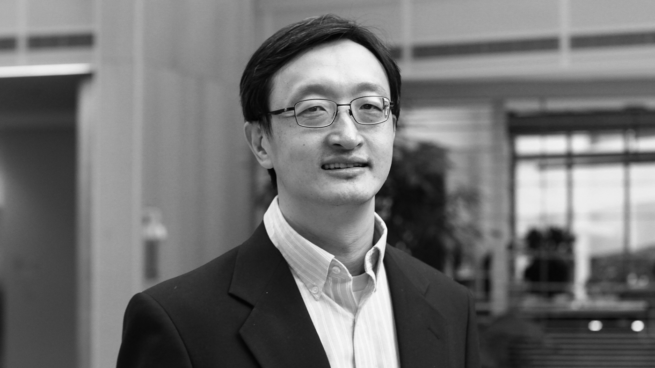
Going deep on deep learning with Dr. Jianfeng Gao
Episode 104 | January 29, 2020 - Dr. Jianfeng Gao is a veteran computer scientist, an IEEE Fellow and the current head of the Deep Learning Group at Microsoft Research. He and his team are exploring novel approaches to advancing the state-of-the-art on deep learning in areas like NLP, computer vision, multi-modal intelligence and conversational AI. On the podcast, Dr. Gao gives us an overview of the deep learning landscape and talks about his latest work on Multi-task Deep Neural Networks, Unified Language Modeling and vision-language pre-training. He also unpacks the science behind task-oriented dialog systems as well as social chatbots like Microsoft Xiaoice, and gives us some great book recommendations along the way!