

Analog Optical Computer (AOC)
As industries increasingly rely on AI models and complex optimization, computing demands are soaring—just as digital hardware reaches its limits. To meet this challenge, Microsoft Research has developed the Analog Optical Computer (AOC): the world’s first unconventional computing system capable of accelerating real-world AI inference and optimization workloads.
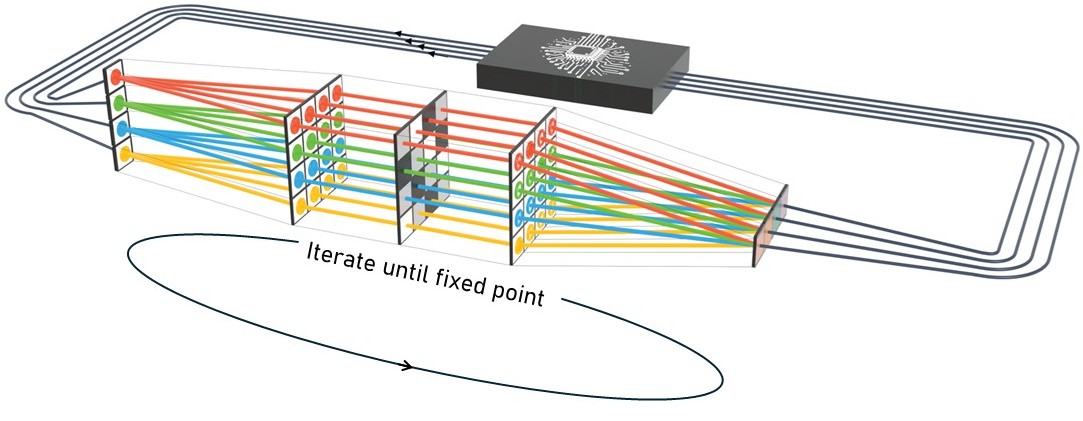
At scale the AOC has the potential to solve problems 100x faster or more energy efficiently, than digital systems. This can be achieved by leveraging the parallelism of light and physical processes to perform computations, and avoiding the separation of compute from memory, operating on both continuous and binary data and adopting asynchronous operation.
Built from low-cost, scalable, and high-volume optical and analog electronics, AOC operates at room temperature. A key innovation of AOC lies in the co-design of hardware and applications, reminiscent of the co-evolution between GPUs and deep learning models.
To realize its potential, close collaboration on real industry applications is key.
In partnership with Barclays, we solved a scaled-down version of a high-value financial optimization problem on AOC hardware. Similarly, with the Microsoft Health Futures team, we demonstrated the reconstruction of representative small-scale MRI data, pointing to better patient experiences through faster imaging.
AOC also runs neural models for image recognition (e.g. MNIST and Fashion MNIST) and nonlinear curve fitting. Beyond what is running on hardware today, we trained a billion-parameter language model on GPUs that applies test-time compute compatible with AOC’s capabilities.
A quick tour of our AOC lab to highlight the cutting-edge work happening in this space can be viewed, here.
AOC was featured both at Microsoft Build (opens in new tab) — our segment begins at 57:47 — and at Microsoft Ignite (opens in new tab) — our segment begins at 41:20 — on Inside Azure Innovations with Mark Russinovich.
We are partnering with M365 Research on this research.