

Rack-scale Computing
設立年月日:January 1, 2013年
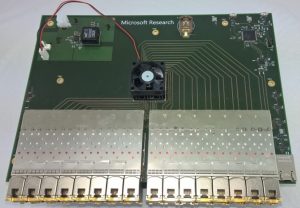
New hardware technology such as systems- and networks-on-chip (SOCs and NOCs), switchless network fabrics, silicon photonics, and RDMA, are redefining the landscape of data center computing, enabling interconnecting thousands of cores at high speed at the scale of today’s racks. We refer to this new class of hardware as rack-scale computers (RSCs) because the rack is increasingly replacing the individual server as the basic building block of modern data centers. Early examples of RSCs have already appeared on the market from manufactures such as AMD SeaMicro (opens in new tab), HP (opens in new tab), and Intel (opens in new tab) and similar solutions are being deployed at large-scale companies such as Facebook (opens in new tab)and Microsoft (opens in new tab).
These new hardware trends challenge traditional assumptions and force us to rethink existing software architectures. The goal of the Rack-scale Computing project is to perform a cross-layer redesign of the way the hardware, OS, storage and network stacks, and applications are built and interact in that new context. The key insight is that by co-designing different layers of the stack, it is possible to achieve both better performance and higher efficiency.
These new hardware trends challenge traditional assumptions and force us to rethink existing software architectures. The goal of the Rack-scale Computing project is to perform a cross-layer redesign of the way the hardware, OS, storage and network stacks, and applications are built and interact in that new context. The key insight is that by co-designing different layers of the stack, it is possible to achieve both better performance and higher efficiency.
In our early CamCube work, we explored the opportunities provided by distributed switching fabrics and the benefits of tightly integrating applications and networks. Our on-going efforts are focused on supporting efficient access to rack-scale resources. In the Pelican project we are designing a cost-effective storage appliance for cold data. The R2C2 project aims at designing a clean-slate network stack, purposely optimized for rack-scale computers. Finally, in the Flamingo project, we are working on solutions to automate the design of rack-scale computers.
-
-
News
- Paper on “XFabric: a Reconfigurable In-Rack Network for Rack-Scale Computers” presented at NSDI 2016 (opens in new tab)
- Paper on “Flamingo: Enabling Evolvable HDD-based Near-Line Storage” presented at FAST 2016 (opens in new tab)
- Paper on “R2C2: A Network Stack for Rack-scale Computers” accepted at SIGCOMM 2015 (opens in new tab)
- Dagstuhl seminar on Rack-scale Computing (opens in new tab) (October 11-16, 2015)
- The slides of the Second Rack-scale Computing Workshop are online
- Maze: A Rack-scale Emulation Platform
- Paper on “Pelican: A Building Block for Exascale Cold Data Storage” accepted at OSDI 2014 (opens in new tab)
External Collaborators
- Pamela Delgado (EPFL)
- Stavros Nikolaou (Cornell University)
- Kaveh Razavi (VUA)
- Xiaohan Zhao (UCSB)
- Xiaozhou Li (Princeton)
Related Links



人数

Austin Donnelly
Senior Principal Research Engineer Lead

Dushyanth Narayanan
Senior Principal Researcher

Hitesh Ballani
Partner Researcher

Paolo Costa
Partner Research Manager

Richard Black
Partner Research Manager

Sergey Legtchenko
Principal Researcher