
Skip to main content Why Microsoft Security AI-powered cybersecurity Cloud security Data security & governance Identity & network access Privacy & risk management Security for AI Unified SecOps Zero Trust Microsoft Defender Microsoft Entra Microsoft Intune Microsoft Priva Microsoft Purview Microsoft Sentinel Microsoft Security Copilot Microsoft Entra ID (Azure Active Directory) Microsoft Entra Agent ID Microsoft Entra External ID Microsoft Entra ID Governance Microsoft Entra ID Protection Microsoft Entra Internet Access Microsoft Entra Private Access Microsoft Entra Permissions Management Microsoft Entra Verified ID Microsoft Entra Workload ID Microsoft Entra Domain Services Azure Key Vault Microsoft Sentinel Microsoft Defender for Cloud Microsoft Defender XDR Microsoft Defender for Endpoint Microsoft Defender for Office 365 Microsoft Defender for Identity Microsoft Defender for Cloud Apps Microsoft Security Exposure Management Microsoft Defender Vulnerability Management Microsoft Defender Threat Intelligence Microsoft Defender Suite for Business Premium Microsoft Defender for Cloud Microsoft Defender Cloud Security Posture Mgmt Microsoft Defender External Attack Surface Management Azure Firewall Azure Web App Firewall Azure DDoS Protection GitHub Advanced Security Microsoft Defender for Endpoint Microsoft Defender XDR Microsoft Defender for Business Microsoft Intune core capabilities Microsoft Defender for IoT Microsoft Defender Vulnerability Management Microsoft Intune Advanced Analytics Microsoft Intune Endpoint Privilege Management Microsoft Intune Enterprise Application Management Microsoft Intune Remote Help Microsoft Cloud PKI Microsoft Purview Communication Compliance Microsoft Purview Compliance Manager Microsoft Purview Data Lifecycle Management Microsoft Purview eDiscovery Microsoft Purview Audit Microsoft Priva Risk Management Microsoft Priva Subject Rights Requests Microsoft Purview Data Governance Microsoft Purview Suite for Business Premium Microsoft Purview data security capabilities Pricing Services Partners Cybersecurity awareness Customer stories Security 101 Product trials How we protect Microsoft Industry recognition Microsoft Security Insider Microsoft Digital Defense Report Security Response Center Microsoft Security Blog Microsoft Security Events Microsoft Tech Community Documentation Technical Content Library Training & certifications Compliance Program for Microsoft Cloud Microsoft Trust Center Security Engineering Portal Service Trust Portal Microsoft Secure Future Initiative Business Solutions Hub Contact Sales Start free trial Microsoft Security Azure Dynamics 365 Microsoft 365 Microsoft Teams Windows 365 Microsoft AI Azure Space Mixed reality Microsoft HoloLens Microsoft Viva Quantum computing Sustainability Education Automotive Financial services Government Healthcare Manufacturing Retail Find a partner Become a partner Partner Network Microsoft Marketplace Marketplace Rewards Software development companies Blog Microsoft Advertising Developer Center Documentation Events Licensing Microsoft Learn Microsoft Research View Sitemap

Worms are the cause of many cyber headaches. They can easily replicate themselves to spread malicious malware to other computers in your network. As the field responders providing Microsoft enterprise customers with onsite assistance to serious cybersecurity threats, our Detection and Response Team (DART) has seen quite a few worms. If you’ve met the DART Team, then you know your worms are our concern and that’s why we keep an eye out for BlueKeep.

Protect against BlueKeep

This summer, the DART team has been preparing for CVE-2019-0708, colloquially known as BlueKeep, and has some advice on how you can protect your network. The BlueKeep vulnerability is “wormable,” meaning it creates the risk of a large-scale outbreak due to its ability to replicate and propagate, similar to Conficker and WannaCry. Conficker has been widely estimated to have impacted 10- to 12-million computer systems worldwide. WannaCry was responsible for approximately $300 million in damages at just one global enterprise.

To protect against BlueKeep, we strongly recommend you apply the Windows Update, which includes a patch for the vulnerability. If you use Remote Desktop in your environment, it’s very important to apply all the updates. If you have Remote Desktop Protocol (RDP) listening on the internet, we also strongly encourage you to move the RDP listener behind some type of second factor authentication, such as VPN, SSL Tunnel, or RDP gateway.

You also want to enable Network Level Authentication (NLA), which is a mitigation to prevent un-authenticated access to the RDP tunnel. NLA forces users to authenticate before connecting to remote systems, which dramatically decreases the chance of success for RDP-based worms. The DART team highly recommends you enable NLA regardless of this patch, as it mitigates a whole slew of other attacks against RDP.

If you’re already aware of the BlueKeep remediation methods, but are thinking about testing it before going live, we recommend that you deploy the patch. It’s important to note that the exploit code is now publicly and widely available to everyone, including malicious actors. By exploiting a vulnerable RDP system, attackers will also have access to all user credentials used on the RDP system.

Why the urgency?

Via open source telemetry, we see more than 400,000 endpoints lacking any form of network level authentication, which puts each of these systems potentially at risk from a worm-based weaponization of the BlueKeep vulnerability.

The timeline between patch release and the appearance of a worm outbreak is difficult to predict and varies from case to case. As always, the DART team is ready for the worst-case scenario. We also want to help our customers be prepared, so we’re sharing a few previous worms and the timeline from patch to attack. Hopefully, this will encourage everyone to patch immediately.
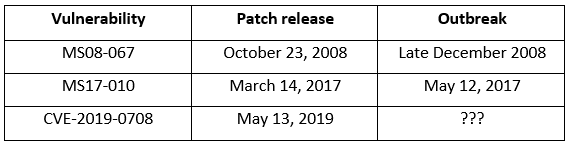
Chart showing vulnerability, patch release, and outbreak. Vulnerability: MS08-067; Patch release: October 23, 2008; Outbreak: late December 2008. Vulnerability: MS17-010; Patch release: March 14, 2017; Outbreak: May 12, 2017. Vulnerability: CVE-2019-0708; Patch release: May 13, 2019; Outbreak column shows three question marks.

Learn more

To learn more about DART, our engagements, and how they are delivered by experienced cybersecurity professionals who devote 100 percent of their time to providing cybersecurity solutions to customers worldwide, please contact your account executive. Bookmark the Security blog to keep up with our expert coverage on security matters. Also, follow us at @MSFTSecurity for the latest news and updates on cybersecurity.

This document is for informational purposes only and Microsoft makes no warranties, express or implied, in this blog.

Related posts