Knowledge workers have all been there.
Maybe you’re a product manager with a backlog that you can’t ever get to. Perhaps you’re a designer who can never seem to get engineering resources assigned to you. Or maybe you’re a program manager who routinely gets stuck copying data between systems by hand.
These are common challenges knowledge workers face everywhere, including here at Microsoft. A year ago, AI enthusiasts knew agents with tools could fix these problems—they just didn’t know where to start.
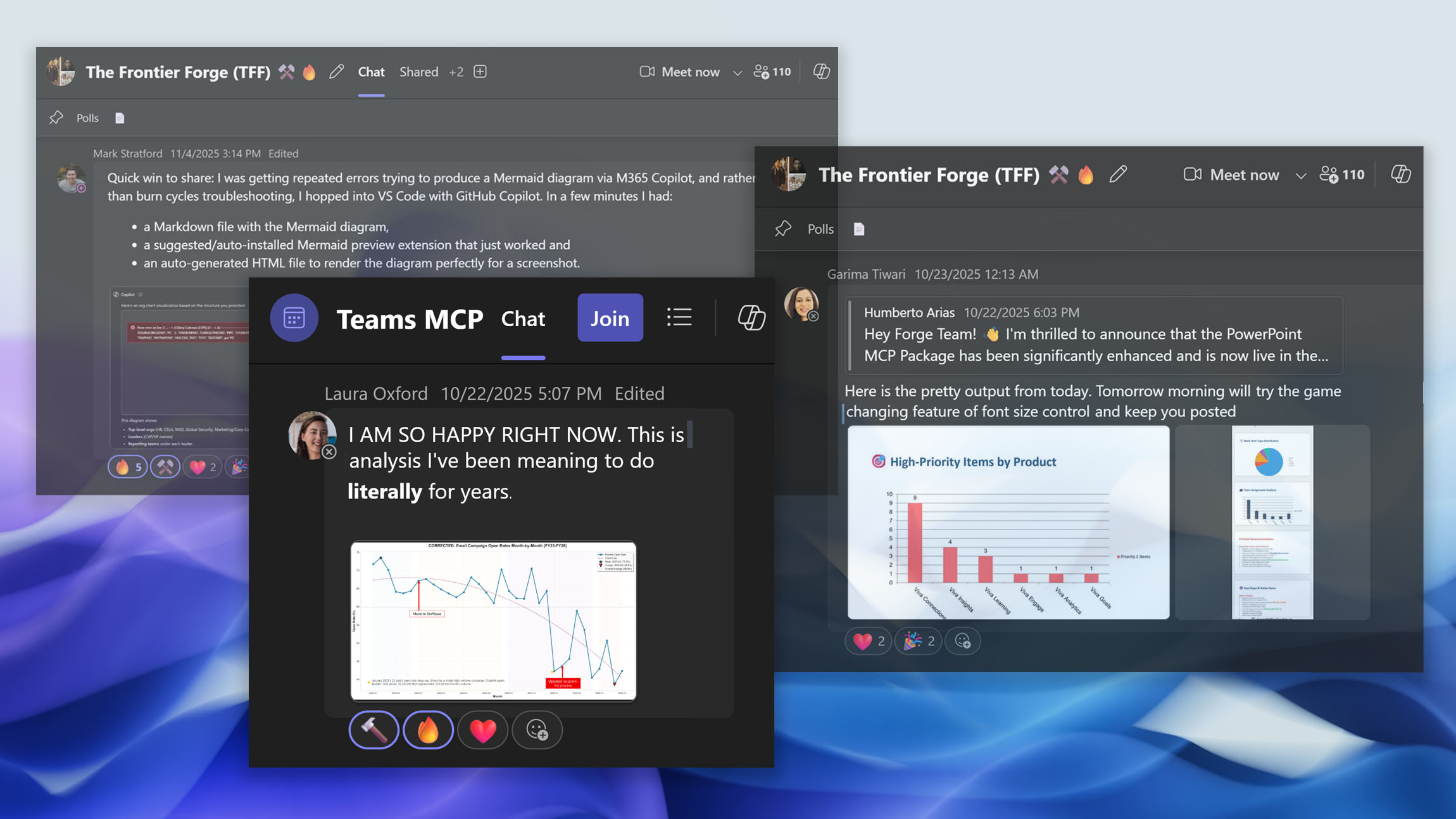
Some of our employees in Microsoft Digital, the company’s IT organization and Customer Zero for the company, took a grassroots approach to solving this problem. They built something called the Frontier Forge, our pro‑code “harness” that enables our less-technical employees to get work done with agents. They use it to quickly build agentic instructions and instantly share their solutions with peers, which accelerates our productivity across the company.
The Frontier Forge represents a cultural shift in how our product managers, designers, program managers and other “I’m not an engineer but I want to build stuff” employees now apply AI tools directly to their work.
What first began as a hackathon experiment has evolved into a thriving Microsoft-internal community with nearly 100 engaged contributors, an active Teams channel, and a GitHub repository filled with templates, learning modules, and ready-to-use AI agents. The impact is measurable: Forecasting, backlog grooming and communication tasks that collectively took weeks now take hours or minutes.

“I saw myself and others spending too much of our time on data wrangling and admin tasks when we wanted to be strategizing. Nobody was building what felt truly agentic. So, we did it ourselves.”
Brett Reifers, senior product manager, Microsoft Digital
Employees who never saw themselves as technical are now building sophisticated data visualizations, automating workflows, creating prototypes, and generating learning modules. These were capabilities previously reserved for specialized engineering teams.
The “Forge” is where it’s all happening now.
From a hackathon to a movement
In early 2025, Brett Reifers, a senior product manager in Microsoft Digital, spotted a problem he couldn’t ignore. His peers, smart and driven product managers, kept asking the same question: “How do I use agents for my actual work?”
Beginner tutorials about prompt engineering felt trivial. Advanced agents with tools assumed engineering expertise. The middle ground, where AI meets real jobs, didn’t exist.
“I saw myself and others spending too much of our time on data wrangling and admin tasks when we wanted to be strategizing,” Reifers says. “Nobody was building what felt truly agentic. So, we did it ourselves.”
So, Reifers partnered with colleague Humberto Arias, a senior product manager in Microsoft Digital whose work explores the intersection of AI and productivity. Arias had been independently researching agentic solutions that could click through interfaces, open applications, and complete tasks autonomously.
The insight that unlocked everything came from a deceptively simple observation:
“Everything on the internet is a form—every site, mobile app, every click,” Reifers says. “If agents could fill out my forms in Azure DevOps, they could handle any web-based task.”
They pitched the concept of Copilot fulfilling form-based processes as an entry for Microsoft’s annual hackathon to Sean MacDonald, partner director of product management in Microsoft Employee Experience. MacDonald immediately recognized its potential.
“My reaction was simply, ‘This sounds amazing,’” MacDonald says. “This solution was exactly what we needed.”
The event proved agents could automate PM workflows: managing Azure DevOps items, generating summaries, and querying data systems. After the hackathon validated the concept, Arias suggested pushing the project to GitHub for wider exposure. Reifers then used GitHub Copilot itself, recursively using the very tools they were building, to open source the first Frontier Forge repository in 15 minutes.
A pro-code environment with natural language accessibility
The Forge combines GitHub Copilot, Visual Studio Code (VS Code), and MCPs into a framework that makes professional development tools easily accessible to non-engineers.
“The Frontier Forge is a place where you can learn regardless of your skill level. You can adopt what’s out there, even if you don’t know where to start.”
Sean MacDonald, partner director of product management, Microsoft Employee Experience
The core idea: Give employees a workspace seeded with community-created templates, learning modules, and custom agents tailored to Microsoft Digital contexts. Then let them build from there.
For MacDonald, the Forge has proven to be an accessible entry point for almost anyone, regardless of experience.
“The Frontier Forge is a place where you can learn regardless of your skill level,” MacDonald says. “You can adopt what’s out there, even if you don’t know where to start.”

An architecture for context-first AI
The technical architecture of The Frontier Forge leverages three layers simultaneously:
- VS Code provides the enterprise managed workspace where everything happens.
- GitHub Copilot offers chat functionality and AI assistance, with access to multiple models including Claude, GPT, and Gemini.
- Tools like Model Context Protocols (MCPs) act as standardized connectors that let agents access tools, data, and services locally. This unlocked what Copilot could decide and do with user approval.

“With GitHub Copilot and MCPs, there are literally no boundaries. It’s hard to explain just how transformational this can be for a product manager. Whatever you ask is transformed into code with a purpose, allowing you to do something you couldn’t before.”
Humberto Arias, senior product manager, Microsoft Digital
The MCPs connect to services like Azure DevOps (for roadmap planning and backlog management), Microsoft Documentation, Figma (for design work), and dozens of other platforms that are essential to product manager workflows. New MCPs appear daily, expanding capabilities organically as the community builds them.
Employees can even ask GitHub Copilot to build custom MCPs for services lacking official integrations. When Arias needed a PowerPoint creator that didn’t exist, he asked GitHub Copilot to create one.
“With GitHub Copilot and MCPs, there are literally no boundaries,” Arias says. “It’s hard to explain just how transformational this can be for a product manager. Whatever you ask is transformed into code with a purpose, allowing you to do something you couldn’t before.”
The shift from prompt engineering towards context engineering is another reason why the Forge works. Its workspace settings, agent instructions, skills and hooks provide a harness with guardrails that help colleagues adopt and use this.
The Forge provides a curated starting point: Microsoft Digital-specific templates, governance frameworks, security guidelines grounded in Microsoft’s Responsible AI framework, and working examples employees can immediately use and modify.
Transformational impact
The productivity gains generated by The Frontier Forge are very real. Our employees report saving weeks or even months on certain projects, especially those that previously required extensive manual work or specialized technical skills.
Case in point: Laura Oxford, a senior content program manager in Microsoft Digital, had four years’ worth of Excel files and communication metrics reports. She had always intended to use the data to create marketing forecasts, but she could never find the necessary time or resources to perform the analysis.
“The key to creating the agent was going deep into the context. It was an iterative conversation, going back and forth to fine-tune the agent until I was consistently getting the output I wanted. But it truly was just a conversation—no tech skills needed.”
Laura Oxford, senior content program manager, Microsoft Digital
Through iterative, conversation-based prompting, Oxford’s agent analyzed patterns, created projections, and produced visualizations. Oxford now has a robust historical analysis that enables prediction of future campaign performance.
“The key to creating the agent was going deep into the context,” Oxford says. “It was an iterative conversation, going back and forth to fine-tune the agent until I was consistently getting the output I wanted. But it truly was just a conversation—no tech skills needed.”
Drafting clear, executive-ready communications for complex initiatives was what brought Mark Stratford, a senior product manager with the email and calendaring service team in Microsoft Digital, to the Forge.
Before the Forge, communicating status updates to leadership meant he had to manually synthesize data from CSVs, track several approval chains at once—often in messy emails—and iterate on visualizations for what seemed like days and days.
Put more succinctly, these tasks are time-consuming chores that are perfect for AI.
“The Forge’s architecture changes how you think about the problem,” Stratford says. “Instead of iterating on prompts, you declare intent and desired outcome. The Forge’s architecture handles the rest.”
Using this pattern, Stratford created:
- Over a dozen interactive dashboards for portfolio roadmaps, migration tracking, and service health monitoring.
- Approval matrix visualizations mapping multi-stakeholder sign-off dependencies.
- Data analysis pipelines transforming raw telemetry into executive-ready narratives.

“I didn’t need to fight ambiguity or handhold the model. The architecture gave the agent a stable, skills-driven foundation from the start, which dramatically accelerated development time and improved clarity.”
Mark Stratford, senior product manager, Microsoft Digital
The Forge’s clean separation between intent, constraints, tools, and data inputs eliminated the prompt-tuning loop. Stratford mapped his objectives into the agent framework once, relying on built-in structure and guardrails.
His analysis and drafting time dropped from days to minutes. Outputs like roadmaps and data visualizations went directly into decision workflows with no manual cleanup required.
“I didn’t need to fight ambiguity or handhold the model,” Stratford says. “The architecture gave the agent a stable, skills-driven foundation from the start, which dramatically accelerated development time and improved clarity.”
Building community and sharing knowledge
A simple continuously improving repository has grown into something larger: a community of nearly 100 enthusiasts. Contributors are building templates, learning modules, and specialized MCPs tailored to their job functions. Teams are sharing wins and unlocked achievements.
“At its core, The Frontier Forge is an open-source, community‑driven experience. It’s a safer environment that will help people learn and apply Microsoft’s AI at work.”
Brett Reifers, senior product manager, Microsoft Digital
The Forge succeeds because of its emphasis on community and knowledge sharing. Its GitHub repository serves as collaborative workspace where employees contribute agents, templates, and learning resources.
This sharing culture creates a compounding cycle. One employee’s outcome becomes another’s starting point. Contributors share useful agents immediately, without lengthy approvals. This grassroots approach lets innovation spread at the pace of curiosity.
“At its core, The Frontier Forge is an open-source, community‑driven experience,” Reifers says. “The Forge is a safer environment that will help people learn and apply Microsoft’s AI at work.”
Building a safe-to-fail path
For IT leaders looking to replicate something like the Forge, MacDonald’s guidance starts with reframing the challenge.
“Find the people who are super curious and who want to learn. They will be the ones who drive innovation with AI agents and other newly developed tools.”
Sean MacDonald, partner director of product management, Microsoft Employee Experience
The barrier to agent adoption for non-engineering roles isn’t access to tools. It’s all about giving them the confidence needed to build them and then put them to work. Providing a safe, hands-on environment where people can learn at their own pace, regardless of skill level, has been an essential key to success.
Another key has been to empower the people in your organization who are eager to innovate and try new things. The Forge began with two curious product managers who decided to experiment and then shared their idea with peers.
“Find the people who are super curious and who want to learn,” MacDonald says. “They will be the ones who drive innovation with AI agents and other newly developed tools.”
For IT leaders currently trying to prepare their organizations for an AI-driven future, the story shows that the answer isn’t to wait around for perfect tools or comprehensive employee training.
“The leaders that create safe spaces for non-engineers to build with AI now will compound that advantage for years,” Reifers says. “The ones that wait will spend 2027 trying to catch-up.”
Our knowledge workers don’t need to wait for help any longer, now they can forge their own path with an agent or other AI tool they build themselves.

Key takeaways
Here are some insights your leaders can use to build grassroots-led, AI-forward communities in your organization:
- Start with volunteers, not mandates. The Forge grew to 100 contributors with zero top-down requirements. Organic growth from curious employees creates sustainable adoption.
- Highlight your quick wins. Reifers’ and Arias’ live demos of MCPs, Oxford’s 90-minute forecast and Stratford’s 20-minute drafts became the recruiting pitch for the next wave of adopters. Show your people results like these, then hand them the tools.
- Lower barriers without lowering standards. Accessibility and quality aren’t mutually exclusive. Governance and security are non-negotiable. Configure it all into the harness.
- Prioritize knowledge sharing and attribution. When one person solves a problem and shares it, dozens benefit immediately. Reward provenance.
- Ship fast, improve later. The Forge repo was built in 15 minutes. Four months later, it contained 50+ templates and agents. As much of 80% what is produced in the Forge is rewritten every other week as tools evolve. Ship MVPs and evolve based on real usage.
- Reframe outcomes > tools. Shifting from “developer tool” to “Copilot workspace” helps knowledge workers see they belong.


Related links
- See how we enable Microsoft employees to build AI agents that help them complete important tasks.
- Learn more about GitHub Copilot for Azure.
- Discover how we’re transforming our employee experience with AI.
- Take a course on building AI agents for beginners in GitHub Copilot.
- Follow our step-by-step guide to building API-powered agents.
- Find out how continuous improvement helps us identify agentic opportunities, and how it can help your company, too.

We’d like to hear from you!