

The AI revolution is reaching everyone. As AI agents become more mainstream, we’ve seen the powerful impact they can have on all kinds of work and a wide variety of roles.
At Microsoft, we’re leading the way in exploring how workers can use AI agents to help them save time, automate workflows, and amplify human impact. It’s all part of our journey to becoming an AI-first Frontier Firm.
As part of this AI transformation, the Microsoft Azure AI marketing team is modernizing its work through intelligence on tap. Together with a group of Microsoft Foundry developers, the team has been using Foundry to create agent-based tools that are changing the way the marketers work and accelerating their impact.
Microsoft Foundry is our unified, enterprise‑grade Azure platform for building, deploying, and governing AI models and agents—bringing development, operations, security, and governance together in one place.
Marketing: Human challenges, AI opportunities
Marketers today face a challenging work landscape. They’re responsible for reaching diverse and dynamic audiences, adjusting to rapidly shifting market conditions, and promoting ever-expanding product portfolios with tight branding and messaging control—all under intense time pressure at an escalating scale.
At Microsoft, our marketing organization is no exception. It has experienced a 40% year-over-year increase in product launches. This job function is also highly multi-disciplinary, with many marketing professionals wearing different hats and adapting to new capabilities, often involving an array of disparate tools.
It can be an overwhelming space, which makes it easy to overlook outdated content and terminology, produce incomplete materials, or misalign messaging. All of that pressure doesn’t just lead to poor performance, but also employee burnout. It’s not surprising that plenty of marketers feel overtaxed.
“Frontier marketing is about helping our team navigate the AI transition to thrive in their roles. Contrary to people’s fears about AI, this technology is tremendously helpful for amplifying marketers’ ability to connect products and services to their audiences.”
Don Scott, general manager, Azure AI Marketing
Leaders on our Azure AI marketing team recognized these challenges, so they started exploring ways that AI could make their workers’ jobs easier. Two new AI-driven projects have come out of this effort:
- MarThrive: A marketing platform featuring a suite of complementary agents and grounded data designed to improve blog quality, assist with product launches, and deliver competitive intelligence on demand.
- AI Messaging Assistant: A generative AI application grounded in 100,000-plus proprietary customer voices that embeds this intelligence directly into marketing workflows, influencing business decisions in real time.
These tools benefit from the power of AI agents while keeping human creativity firmly at the center of our marketers’ work. Both represent function-aligned agentic design aimed specifically to meet the needs of our marketing team.
These aren’t generic AI platforms. They’re tools built by marketers, for marketers. And they’re a big part of equipping our marketing team to embrace the world of the Frontier Firm.
“Frontier marketing is about helping our team navigate the AI transition to thrive in their roles,” says Don Scott, general manager for Azure AI Marketing. “Contrary to people’s fears about AI, this technology is tremendously helpful for amplifying marketers’ ability to connect products and services to their audiences.”
But these capabilities don’t happen by accident. Before either tool could come to fruition, we first needed to ensure we had a tightly unified, AI-ready marketing data ecosystem.
“If you feed your agents the right data, they’ll be so much more useful,” says Brett Mills-Meiner, a director of AI intake and platform strategy for Microsoft Foundry. “Agent development isn’t the hard part—it’s getting the data in the right place.”
MarThrive: An agentic toolkit built for marketers
After a months-long effort to build secure, scalable integrations across core systems, the marketing team had an agentic toolkit they could use to accelerate product launches. They dubbed it MarThrive.
The creation process relied on a strong strategic vision and close alignment between marketers and AI agent developers.

“AI allows the people who do the work to be a lot closer to the technology they’re using.”
Brett Mills-Meiner, director of AI intake and platform strategy, Microsoft Foundry
The process for developing MarThrive started with getting a handle on the tasks and human needs that AI can fulfill. In many ways, the platform acted as an internal proving ground for agentic patterns by making use of Microsoft Foundry’s platform capabilities.
It was also a way to establish closer collaboration between employees who have specific business needs and Microsoft Foundry developers who can build more complex agents.
“We knew we wanted to use Microsoft Foundry to empower our own organization,” Mills-Meiner says. “AI allows the people who do the work to be a lot closer to the technology they’re using.”
The Azure AI marketing team began by establishing what it wanted to accomplish, the ideal capabilities for the necessary tools, and what their functional requirements would be. One major step was defining the specifications and workflows the tool needed to support. Another was getting the live data connections set up, which helped them properly contextualize and ground the agents (with FoundryIQ playing a big role in getting the most from the organizational data).
The main goal was to improve the consistency of the many blogs and messaging surfaces the team oversees, while also minimizing the need for review. From there, it was a matter of experimenting with how individual agents could accomplish those goals.
The results were astounding, as the tool enabled a small team to generate a host of agents on a very tight timeline. In just three weeks, the agent-builder team created 12 agents and released them over 12 days: Azure AI marketing’s so-called “12 Days of Shipmas.” The agents covered a wide variety of functions, as shown here:
- Blog Tree Explorer
- Edit Suggester
- Voice Profiler
- Social Copy Generator
- Calibration Studio
- Field Alert Generator
- Blog Q&A
- Microsoft Learn Docs Quality Tester
- Launch Readiness
- Shipmas Agent
- Blog Draft Writer
- BOM Generator
MarThrive users in action
Sharmila Chockalingam and Jenn Cockrell are both senior product marketing managers on the Microsoft Foundry team. The agents they access through MarThrive have become instrumental to their work and productivity.

“We typically don’t get all the information about a model until a few days before its launch on Foundry; the MarThrive tool has made rapid iteration and review possible.”
Sharmila Chockalingam, product marketing director, Microsoft Foundry Models
One of Chockalingam’s greatest challenges has been working with partner contributors to launch third-party models as they get added to Foundry. Model releases vary in scope, so they require a spectrum of marketing assets like blog posts, social copy, pitch decks, sizzle videos, product demos, and FAQs.
For Chockalingam, MarThrive provides the greatest value through the Social Copy Generator and Edit Suggester. These agents help her get incoming copy from model partners into consistent shape quickly. Meanwhile, the BOM Generator agent helps her team rapidly spool up full complements of assets to support launches properly.
“On one of our major, late-breaking model launches, MarThrive really proved how crucial it could be,” Chockalingam says. “We typically don’t get all the information about a model until a few days before its launch on Foundry; the MarThrive tool has made rapid iteration and review possible.”
One of Cockrell’s areas of responsibility is managing one of our Tech Community blogs. This blog relies heavily on multiple internal and community contributors, so it can be a challenge to review output and ensure quality at scale.

“The main benefit is the single pane of glass that gives marketers access to the agents they need.”
Jenn Cockrell, senior product marketing manager, Microsoft Foundry
The Blog Grader agent provides an initial scrub of a contributor’s work, giving immediate feedback and a grade for aspects like technical depth and visuals. From there, Cockrell can provide contributors with specific, actionable feedback so they can improve their submissions.
At a more strategic level, the Blog Tree Explorer helps her position different blog posts within our overall approach to content. It also gives her team the comprehensive visibility it needs to establish baseline standards around branding, quality, and best practices.
“MarThrive really only rolled out in December of last year, and we’ve already seen immediate value and better output, as well as improvements to the AI tool,” Cockrell says. “The main benefit is the single pane of glass that gives marketers access to the agents they need.”
To keep our blog quality standards fresh and evolving, the team uses an agent that connects to the rest of the MarThrive ecosystem: Calibration Studio.
When a blog post performs particularly well, the team works with this agent to apply its learnings to other tools like the Edit Suggester and Blog Grader. This produces a multi-agent workflow that relies on human judgment to make adjustments that align with our priorities as a business.
Thanks to these tools, the team has seen the conventional product marketing cycle shrink from 18 months to as low as 18 hours. We’ve also boosted our blog post engagement metrics by 10–12 points.
On the popular Microsoft Tech Community site, publishing a blog post used to involve at least a week of reviews and communication back-and-forth between the author and our marketers. With an average of 250 posts a year by our marketing team, that was no small commitment.
Today, writers submit their work, and a product marketing manager can run the draft through the Blog Grader agent. If their post gets a high enough score, the marketer will proceed with publication. That translates to at least four hours of time saved per post for our product marketing managers.
The overall result is a substantial reduction in human effort while quality improves, velocity increases, and our marketers can spend more time on strategy and big-picture guidance.
The AI Messaging Assistant: An audience marketing ally
As the discipline of marketing has modernized, the possibilities for reaching highly tailored and targeted segments have only increased. But to be truly effective, this requires greater granularity and deeper insights, all in the context of accelerating market changes. That analysis takes time—time that marketers don’t usually have.
With that pressure in mind, the Azure AI market research team set out to augment its ability to flow audience insights directly into their work. The result was the AI Messaging Assistant.
At the outset of this project, there were questions about whether to use Microsoft Copilot Studio or Microsoft Foundry to create the AI Messaging Assistant tool. The team eventually decided that Foundry offered the end-to-end capabilities it needed—from building, deploying, and governing the agent to iterating and updating it as time went on.
Research is a very specific discipline, so creating this tool relied on close collaboration between the Microsoft Foundry team, data scientists, and researchers. The core goal was to help the research team scale their skills by extending their work through AI agents.
In defining the solution, the teams mapped the process from research to marketing output, identifying processes that often get left by the wayside in day-to-day workflows because of time pressure and resourcing.
The AI Messaging Assistant was built to bridge those gaps. It accesses our rich store of customer intelligence and builds models on top of it, then applies that data to produce outputs grounded in what real audiences actually think, feel, and prioritize.
Marketers select their audience and parameters and the tool generates or refines content accordingly, including messaging, naming, and feature prioritization. Because every output is rooted in real customer intelligence, the result is marketing content that is more personalized, engaging, and relevant to the audiences that matter most.

“As the speed of marketing increases, the AI Messaging Assistant makes sure we can still represent the voice of the customer. We’re closing the gap between marketer intent and marketing output.”
Robert Graves, senior director, Data Management and Science
A simple user interface was crucial to keeping the process streamlined. Users access the AI Messaging Assistant through an easy-to-manage web portal, then select from 12 different audiences. Examples include gamers and Microsoft 365 users on the consumer side, or IT decision-makers and developers in the commercial space.
Then the user chooses a pre-made output type to guide their messaging. While marketers mostly use the tool for last-mile naming and messaging support, researchers have more flexibility to pore over data through a blank workbook.
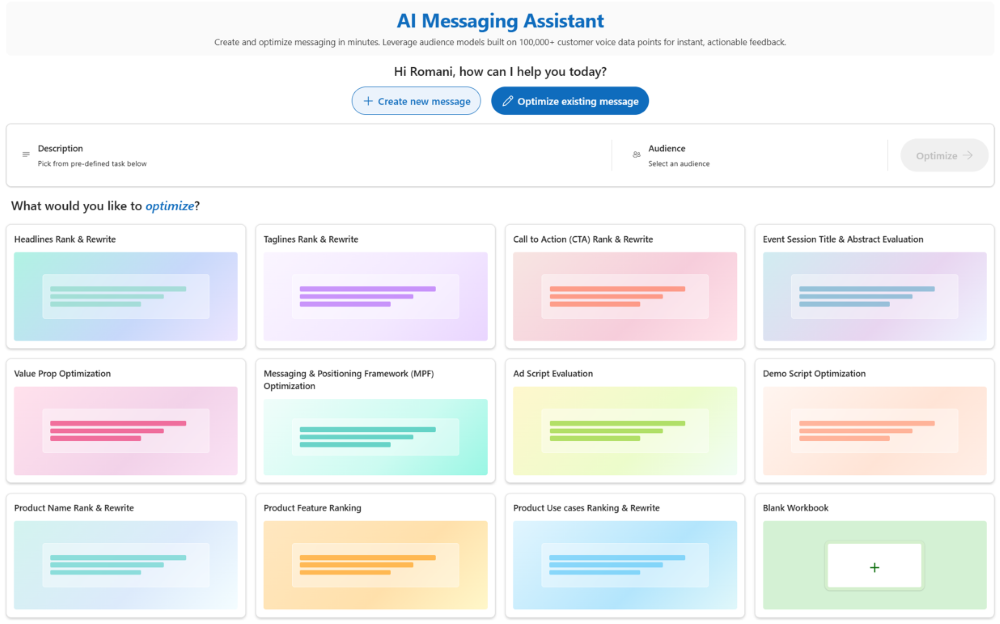
The AI Messaging Assistant is not designed to replace humans. Instead, it expands what our human researchers and marketers can do, extending customer intelligence into decisions and moments that would otherwise be out of reach. The process remains human-led. Marketers set the parameters, assess the output, and make the final decisions before deploying.
“A lot of use cases are things we normally wouldn’t have time to research,” says Robert Graves, senior director with Data Management and Science. “As the speed of marketing increases, the AI Messaging Assistant makes sure we can still represent the voice of the customer. We’re closing the gap between marketer intent and marketing output.”
AI Messaging Assistant user in action
Ben Loeb is a product marketing manager on the Microsoft Edge team. His work focuses on ways we’re bringing AI into the browsing experience.
Perceptions of AI, habits around using it, and even the nature of engaging with the internet all mean that the browser marketplace is in a constant state of change. Agile intelligence is key.
“This is a highly competitive space, so we need to adapt quickly,” Loeb says. “We’re always thinking with an audience lens to create messaging that resonates.”
In the course of Loeb’s day-to-day tasks, he tends to use the AI Messaging Assistant to work with pre-built prompts for research projects he’s conducting and populate them with elements specific to a particular initiative. Typically, he’ll specify the product he’s working on, identify the perceptions or attributes he wants to work with, and give the agent the context it needs to craft messaging or naming. He’ll then test the outputs against different audiences, like IT decision makers versus employee users.

“Now we don’t feel like we have to make a trade-off between research and velocity.”
Ben Loeb, product marketing manager, Microsoft Edge
For example, he might suggest that a feature name needs to combine the concept of innovation with objective descriptions of its functionality. The AI Messaging Assistant will deliver options based on the parameters he provides, and he can then take those suggestions through the final, human mile of refining and decision making.
Of course, any product or feature name will still need oversight from our product and branding teams. But the tool provides a starting point grounded in audience insights.
The Microsoft research team is a strategic asset. And like any high-value resource, its impact is greatest when focused on the decisions that most benefit from deep human expertise.
The AI Messaging Assistant expands what’s possible by providing initial intelligence that marketers can act on with confidence, backed by data rather than instinct alone. Teams no longer have to be selective about where customer voice enters the conversation—the tool ensures it’s present across a much broader range of decisions.
The immediate outcome for Loeb and his peers is that they save time and increase output, all while operating with greater confidence.
“Now we don’t feel like we have to make a trade-off between research and velocity,” Loeb says.
The impact has been quite dramatic. Thanks to the AI Messaging Assistant, message testing cycles have accelerated by up to 90%. We estimate the tool has generated at least $10 million in value to date; in one Windows 11 campaign, AI Messaging Assistant marketing enhancements contributed to sales that were 25% above target.
From a confidence standpoint, it’s clear that the Azure AI marketing team trusts and values this tool. So far, the AI Messaging Assistant has informed more than 250 significant business decisions.
Exploring opportunities for AI across the enterprise
The benefits of AI-driven tools like MarThrive and the AI Messaging Assistant aren’t unique to Microsoft. Our experience is just one part of a new approach to work, one where anyone can build the agents they need to make their jobs and lives easier.
This is true whether it’s simple agents that employees create through Copilot Studio Agent Builder or more advanced tools tailored to lines of business, created in partnership with professional developers using Copilot Studio or Microsoft Foundry. It’s clear there are opportunities everywhere for highly personalized, human-centered workflow reinvention.
With the right data foundations, a responsible outlook, a focus on human problems, and a process of experimentation and iteration, you can follow in our footsteps to seek out frontier transformation.
It’s important to note that in the case of both MarThrive and the AI Messaging Assistant, the end product isn’t static. Keeping these tools relevant and effective relies on regular evaluation, feedback loops, and continual calibration to ensure consistent quality.
“What we’ve discovered as we’ve enabled different disciplines to create agents is that there’s tremendous innovation waiting in all of these pockets,” Scott says.
Ultimately, these tools are about reducing cognitive load, not adding process. They’re about helping marketers thrive, not replacing them. And by accomplishing those goals, we’re driving greater impact in marketing: improved quality signals, more consistent application of standards, the ability for small teams to have an outsized impact, and faster experimentation without sacrificing trust.

Key takeaways
If you’re ready to start creating agents that support work in any discipline, consider taking these steps:
- You can use agents for every function. You may not be part of a technical team, but that doesn’t mean agents don’t have a place in your discipline. With simplified tools for agent creation, it’s important for all different parts of your organization to experiment with these initiatives.
- Assess challenges before building solutions. Identify problems where AI solutions could apply, then triage those use cases according to the greatest potential impact.
- These tools need iteration by users to ensure effectiveness. AI tools won’t get things right the first time. You need a good feedback loop to ensure they grow and evolve to fully meet your needs.
- Agentic tools represent a fundamental change in what humans focus on. Human oversight is the key component of Frontier Firm transformation. Think of the human’s role as creating the notion of what a good outcome will be, identifying the data sources needed to get there, and experimenting with AI solutions.
- Managing agents will require resources. Consider explicitly creating a role to manage the strategic planning of agent processes: identifying goals, setting targets, and managing feedback and iteration.

Try it out

Related links
- See how we’re becoming an AI-first frontier firm at Microsoft.
- Learn how we’re extending our infrastructure to manage agents at Microsoft by deploying Microsoft Agent 365.
- Find out how we’re powering agentic AI adoption at Microsoft: Our ‘Customer Zero’ story.
- Read our IT playbook for the AI era and explore ways Microsoft is becoming a Frontier Firm.
- Find out how we deployed the Employee Self‑Service Agent and explore our blueprint for enterprise‑scale success.
- See how knowledge workers are forging their own AI tools at Microsoft.
- Learn how we’re shaping AI management at Microsoft with Agent 365 and Copilot controls.
