This blog post is part of the Microsoft Intelligence Security Association guest blog series. To learn more about MISA, go here.
Barracuda Cloud Application Protection (CAP) platform features integrations with Microsoft Azure Active Directory (Azure AD) and Azure Security Center. A component of CAP, Barracuda WAF-as-a-Service is built on Microsoft Azure and provides advanced WAF capabilities in an easy to deploy and manage solution.
In our last blog, I spoke about how Barracuda and Microsoft are working together to remove barriers to faster public cloud adoption. The post focused on remote access, networks, and secure connectivity to public cloud. The topic of this blog post is to share some thoughts on how web applications in public cloud are secured.
Accelerating digital transformation
As I mentioned last time, digital transformation is fundamentally changing today’s enterprises, making digital assets—data and applications—key to doing business. Organizations are increasingly competing based on their digital agility, and of course web applications are central to how digital businesses operate today.
In order to develop and update applications faster, organizations are deploying DevOps processes and agile methodologies, and they are moving their infrastructure to the cloud. However, while applications are developed and deployed faster than ever, secure coding practices have not kept pace, resulting in a constantly growing number of open vulnerabilities that can be exploited.
At the same time, the threat environment is continuously evolving and becoming more challenging. Hackers are getting more sophisticated; they are now professional criminals or even nation states. In addition to manual hacking attacks, bots and botnets are increasingly used to attack enterprise infrastructures through web applications. These automated exploits are often executed as Distributed Denial of Service (or DDoS) attacks, at both network and application layer. And of course, malware is constantly getting more advanced. The growth in the number of unprotected application vulnerabilities, coupled with the increase in hacking and malware, has resulted in a perfect storm of data breaches. So, application security is a key requirement for successful digital transformation. A recent Microsoft Build 2020 blog post focused on how Microsoft is helping developers build more secure applications.
Is the latest health crisis going to slow down the digital transformation process? In fact, it appears the opposite is occurring—it is acting as a catalyst. In the last blog, we discussed how the sudden increase in remote work is accelerating the network evolution. In addition, similar changes are occurring in the applications landscape.
As people stay at home due to government orders, they are increasingly transacting online. Brick-and-mortar stores are closed, and to stay in business retailers and other businesses are shifting all their operations online.
Leveraging public cloud for web applications
Such rapid scaling of online operations is difficult and expensive to achieve using traditional datacenters. Fortunately, public cloud providers such as Microsoft Azure provide robust platforms that allow customers to quickly scale up application infrastructure—now things can be completed in days or even hours, instead of weeks or months. And of course, the flexibility that comes with public cloud deployments is especially valuable now, as there is a lot of uncertainty about how long lockdowns will continue and whether online capacity would need to be reduced in the future.
We have seen a significant increase in hacking, DDoS, and bot attacks during the last couple of months, so in addition to scaling up online capacity, it is critically important to ensure security and availability. Using a complete application security platform is the best way to protect applications from all attack vectors, including hacking, DDoS, bots, and even API attacks.
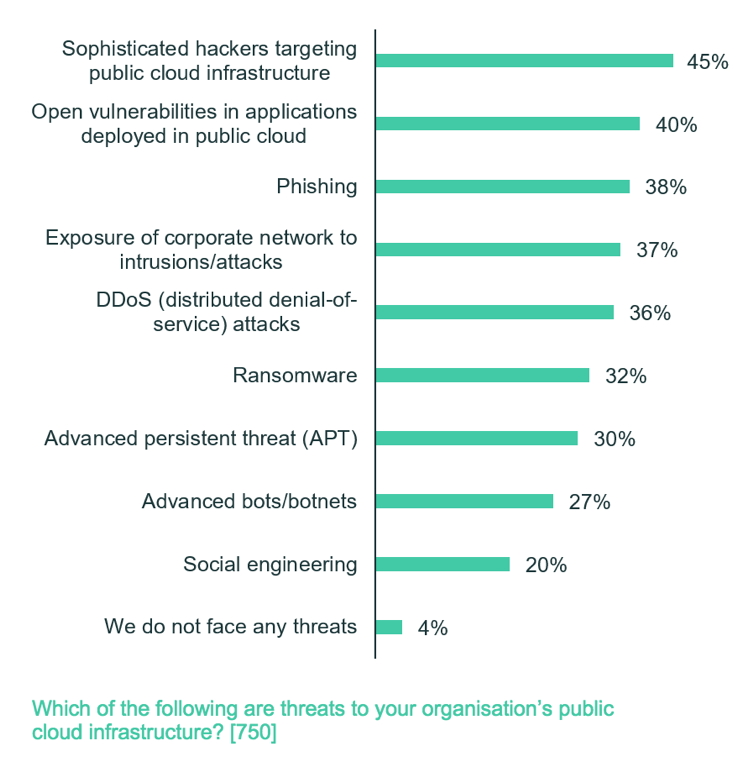
In the new report, Future shock: the cloud is the new network,1 published in February, Barracuda surveyed 750 IT decision makers responsible for their organizations’ cloud infrastructure. We learned that organizations are well on their way to moving their infrastructure to public cloud, with 45 percent of IT infrastructure already running in the cloud today and rising to an estimated 76 percent in 5 years.
At the same time, the top concern restricting an even faster adoption of public cloud is security, with 70 percent of the respondents indicating that security concerns restrict their organizations’ adoption of public cloud.
If you look at the type of security issues that are the biggest blockers to public cloud adoption, the top two are sophisticated hackers and open vulnerabilities in applications. Also on the list are DDoS attacks and advanced bots/botnets, and from conversations with both customers and analysts since the onset of COVID-19, it appears that both DDoS attacks and bot attacks have spiked up even higher.

About Barracuda
At Barracuda we strive to make the world a safer place. We believe every business deserves access to cloud-enabled, enterprise-grade security solutions that are easy to buy, deploy, and use. We protect email, networks, data, and applications with innovative solutions that grow and adapt with our customers’ journey. More than 150,000 organizations worldwide trust Barracuda to protect them—in ways they may not even know they are at risk—so they can focus on taking their business to the next level. For more information, visit barracuda.com.
View our integration videos
- Barracuda integrates with Azure Active Directory
- Barraduca Cloud Security Guardian integrates with Microsoft Graph Security API
For more information on Microsoft Security Solutions, visit our website. Bookmark the Security blog to keep up with our expert coverage on security matters. Also, follow us at @MSFTSecurity for the latest news and updates on cybersecurity.
1Future shock: the cloud is the new network, Barracuda, February 2020