
Boost creative problem solving with a diverse cybersecurity team
In cybersecurity, whether we are talking about cryptocurrency mining, supply chain attacks, attacks against IoT, or COVID-19-related phishing lures, we know that gaining the advantage over our adversaries requires greater diversity of data to improve our threat intelligence. If we are to future proof bias in tech however, our teams must also be as diverse, as the problems we are trying to solve.
Unfortunately, our cybersecurity teams don’t reflect this reality. A 2019 report by (ISC)2 found that less than 25 percent of cybersecurity professionals are women. People of color and women aren’t paid as well as white men and are underrepresented in management. Time and again, studies have found that gender-diverse teams make better business decisions 73 percent of the time. What’s more, teams that are also diverse in age and geographic location make better decisions 87 percent of the time. With a talent shortfall estimated between 1.5 million and 3.5 million, we must recruit, train, and retain cyber talent from a wide variety of backgrounds in order to maintain our advantage.
Diversity fuels innovation
You can see the evidence that diversity drives innovation when you look at artificial intelligence (AI) and machine learning. The AI capabilities built into Microsoft Security solutions are trained on 8 trillion daily threat signals from a wide variety of products, services, and feeds from around the globe (see Figure 1). Because the data is diverse, AI and machine learning algorithms can detect threats in milliseconds.
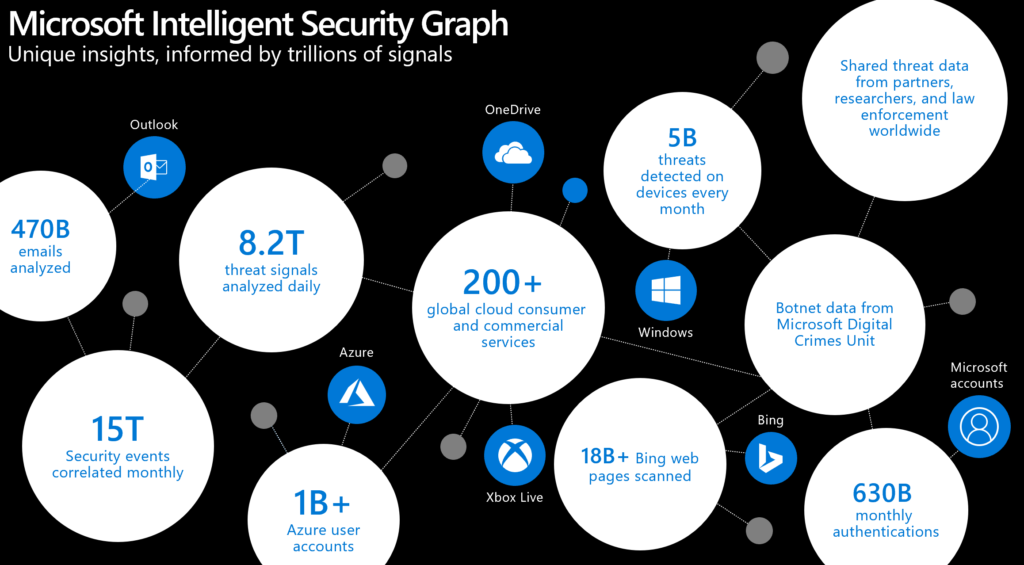
Figure 1: Trillions of signals from around the globe allow Microsoft Security solutions to rapidly detect and respond to threats.
Just last year, the World Economic Forum compiled several studies that provide further evidence that diversity sparks innovation. Cities with large immigration populations tend to have higher economic performance. Businesses with more diverse management teams have higher revenues. A C-suite with more women is likely to be more profitable. When people with different backgrounds and experiences collaborate, unique ideas can flourish. What’s more, if you want to build technology solutions that are inclusive of everyone, diverse teams help avoid bias and develop features that meet the needs of more people.
So how do you increase the diversity of your team? Expand the pipeline. Invest in your team. And create an inclusive culture.
Expand the pipeline
To recruit the very best people from all backgrounds, start by prioritizing unique perspectives. Machine learning, artificial intelligence, and quantum computing hold promise for addressing cyber threats; however, technology is not enough. Some problems can only be solved by people. You need teams that can anticipate what’s next and respond quickly in high-stress situations.
If everybody on the team has similar skills and backgrounds, you risk group think and a lack of creativity. It’s why diverse teams make better decisions than individuals 87 percent of the time (all-male teams only make better decisions than individuals 58 percent of the time).
To attract the diverse talent you need, expand your criteria. Look beyond the typical degrees, experience level, and certifications that you typically recruit for. Leverage training programs that help people acquire the technical skills you need. For example, BlackHoodie is a reverse engineering program for women. Consider people without college degrees, veterans, and people looking to switch careers. Work with colleges and other groups that represent disadvantaged communities, such as historically black colleges and universities.
Invest in your team
Cybersecurity teams around the globe are understaffed, while the amount of work continues to grow. Security operation center (SOC) analysts suffer from alert fatigue because they must monitor thousands of alerts—many of them false positives. Stress levels are high, and individuals work long hours. These work conditions can lead to burnout, which makes people less effective.
Reduce routine tasks with AI, machine learning, and automation. AI, machine learning, and automation can empower your team by reducing the noise, so people can focus on challenging threats that are, frankly, more fun. Azure Sentinel is a cloud-native SIEM that uses state of the art, scalable machine learning algorithms to correlate millions of low fidelity anomalies to present a few high-fidelity security incidents to analysts. Our research has shown that customers who use Azure Sentinel achieved a 90 percent reduction in alert fatigue.
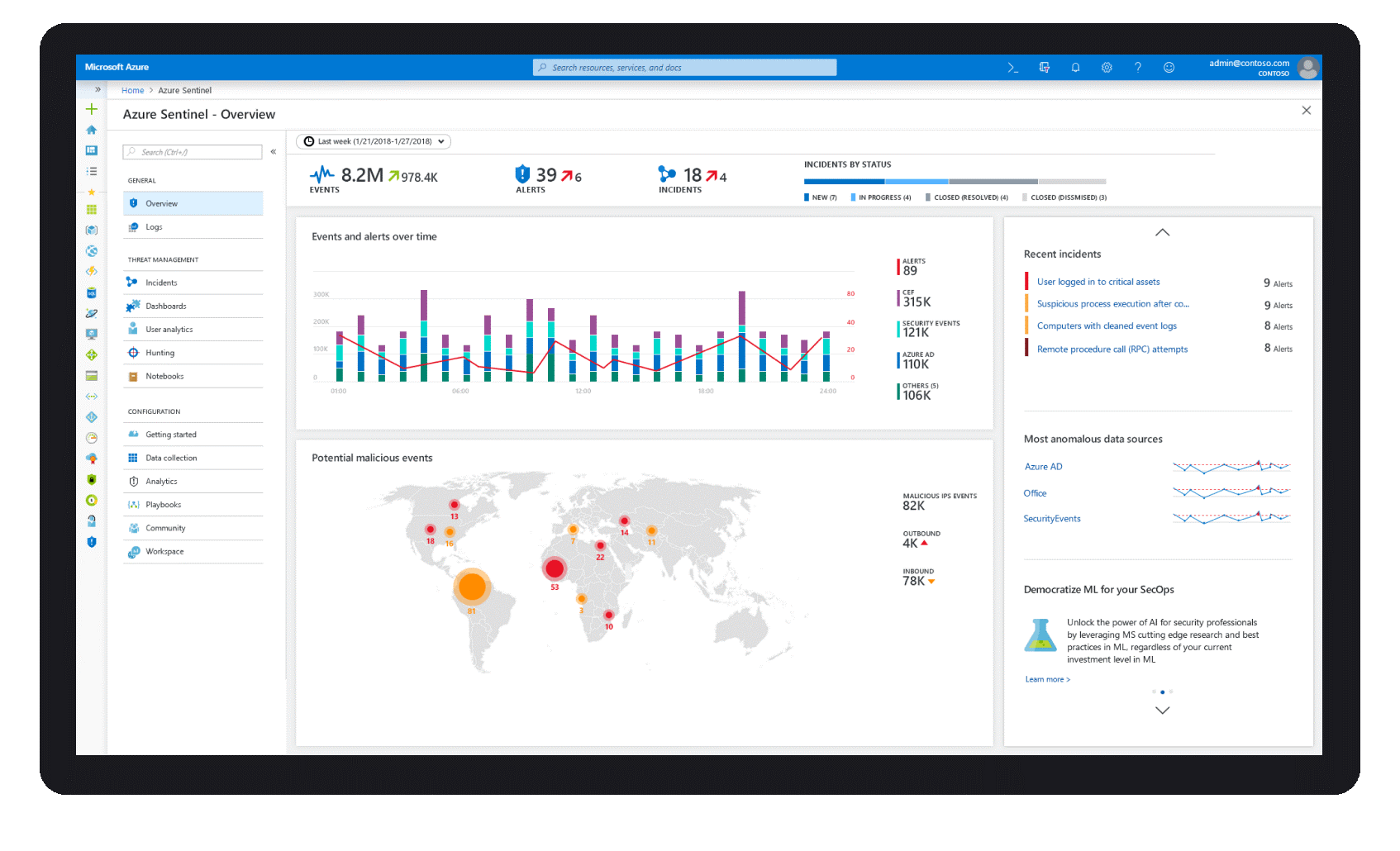 Figure 2: Azure Sentinel makes it easy to collect security data across your entire hybrid organization from devices, to users, to apps, to servers on any cloud.
Provide growth opportunities and training. The threat landscape changes rapidly requiring security professionals to continuously upgrade their skills. Human beings also need new challenges to stay engaged. Provide opportunities for everyone to use creative problem-solving skills. Encourage individuals to learn from each other, such as through an apprenticeship program. Offer regular training for people at all levels of your organization. The Microsoft SOC focuses its training programs on three key areas:
- Technical tools/capabilities.
- Our organization (mission and assets being protected).
- Attackers (motivations, tools, techniques, habits, etc.).
Take care of employees’ mental health. Stress is driving too many people to leave cybersecurity. In fact, stress has motivated 66 percent of IT professionals to look for a new job. Fifty-one percent would be willing to take a pay cut for less stress. Late nights and high-pressure incident response take a toll on employees. In these circumstances, it’s important to respect time off. People should be able to enjoy their days off without worrying about work. A collaborative culture that is forgiving of mistakes can also reduce the pressure. Ask your team how they are doing and really listen when they tell you. Their answers may trigger a great idea for alleviating stress.
Create an inclusive culture
People go where they are invited, but they stay where they are welcome. As you bring new people into your security organization, foster an environment where everybody feels accepted. All ideas should be listened to and considered. People who express ideas that challenge old methods can lead to breakthroughs and creativity. Here are a few ideas for making sure everyone feels included:
- Solicit input from everybody, so you don’t just hear from those that are comfortable speaking up.
- Provide mentorship and sponsorship programs for women and other underrepresented groups to help prepare them for advancement
- Expand your definition of diversity to include neuro atypical, nonbinary, LGBTQ, religious affiliation, and education level in addition to race and gender.
- Make a conscious effort to evaluate performance, not communication or presentation style.
- Hold leadership and vendors accountable for diversity metrics.
As we look past the COVID-19 pandemic, we can expect that cybersecurity challenges will continue to evolve. AI, machine learning, and quantum computing will shape our response, but technology will not be enough. We need creative people to build our products, design our security programs, and respond to threats. We need teams that are diverse as the problems we face.
To learn more about Microsoft Security solutions visit our website. Bookmark the Security blog to keep up with our expert coverage on security matters. Also, follow us at @MSFTSecurity for the latest news and updates on cybersecurity.