

Game Intelligence
We’re excited to share that Game Intelligence has officially joined the larger People-Centric AI research area at Microsoft Research Cambridge. This move strengthens our commitment to advancing human-centered AI and opens up new opportunities for collaboration across machine learning, HCI, design, and social science. Together, we’ll continue pushing the boundaries of interactive and generative experiences that empower players and creators alike.
With over three billion players in the world, AI is poised to transform the landscape of gaming experiences and the games industry itself. Microsoft’s vision for gaming is a world where players are empowered to play the games they want, with the people they want, whenever they want, where-ever they are, and on any device. In close collaboration with the Xbox Gaming division, we drive towards this transformation through world-leading machine learning research.
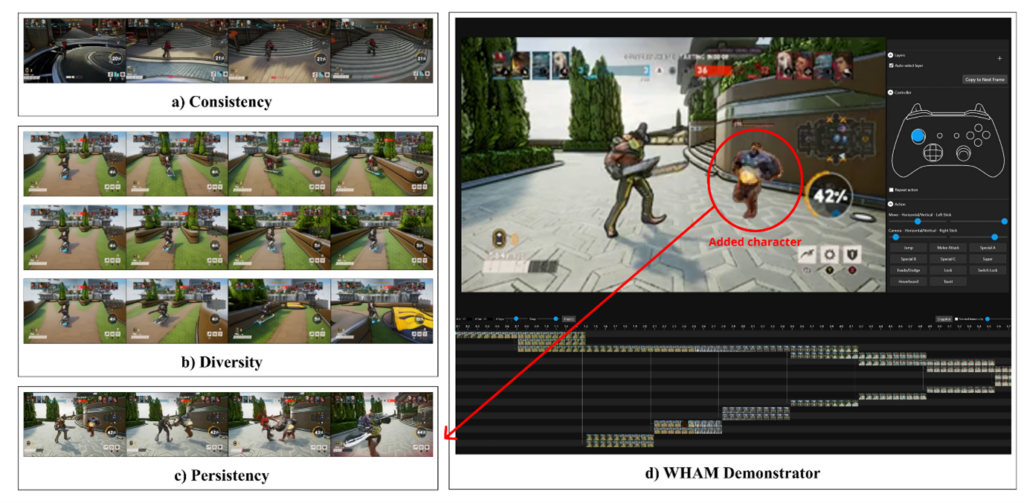
Our most recent research on World and Human Action Models (WHAMs) was published in Nature (opens in new tab) (Read more here (opens in new tab)). With this work we explored how advanced generative models can support human creative ideation, addressing the limitations and challenges of integrating these technologies into the creative process. By examining concept prototypes and conducting user studies, we showcase what these practices might look like in real-world applications. WHAM is developed in partnership with the Tai X team at Microsoft Research and with the game studio Ninja Theory (opens in new tab).

News and awards
-

Introducing Muse: Our first generative AI model designed for gameplay ideation
February 19, 2025 | Katja Hofmann
-

Collaborators: Gaming AI with Haiyan Zhang
For over a decade, Xbox has been leveraging AI to elevate gaming. Haiyan Zhang, GM of Gaming AI, explores the collaborations behind the work and the potential for generative AI to support better experiences for both players and game creators.
-

Using generative AI to imitate human behavior
Diffusion models have been used to generate photorealistic images and short videos, compose music, and synthesize speech. In a new paper, Microsoft Researchers explore how they can be used to imitate human behavior in interactive environments.