

Microsoft SharePoint is where business knowledge lives. As AI-driven capabilities, assistants, and agents have exploded onto the scene, new possibilities for managing that knowledge and presenting it to our employees are emerging.
At Microsoft Digital, the company’s IT organization, we’ve been using the latest AI-enabled features in SharePoint to unlock more flexible, branded, and enjoyable experiences for employees while making SharePoint page creators’ jobs easier.
The modern vision for AI-enabled enterprise knowledge sharing
Since the widespread emergence and adoption of generative AI, new ways of approaching everyday work are springing up across the Microsoft 365 ecosystem. SharePoint is no exception, and AI-powered features are already enabling innovative enterprise content sharing experiences.
It’s all part of our vision for a modern SharePoint.
“We’re investing in making SharePoint the best place to publish stories and pages, the fastest way to build compelling content,” says Sam Crewdson, a principal program manager within Microsoft Digital. “New AI features are making those goals even more attainable.”
The goal is to deliver simplicity, speed, and savings for site owners and page creators while enhancing engagement and discovery for employees.
“SharePoint is the number one source for authoritative content in the enterprise, which is critical for getting high-trust, attributable and verifiable answers from Copilot and agents,” says Kripal Kavi, a principal GPM for SharePoint and OneDrive. “We are investing in making it easier than ever to create this authoritative content that also looks great for human consumption with AI. Our goal is to take the drudgery and toil out of creating awesome high-value content on SharePoint.”
AI-driven SharePoint features in action
The latest AI-powered enhancements in SharePoint provide opportunities for advanced site management and page creation. They deliver intelligent support for maintaining organizational knowledge, automating workflows, and building engaging pages. The result is that site owners, content managers, and content creators can offer more dynamic experiences while offloading manual effort onto agents and AI features.
Knowledge Agent in SharePoint
Knowledge Agent, currently available in public preview, streamlines content management and boosts Copilot capabilities. These new features appear as a persistent, floating button to keep them top-of-mind and accessible in one place.
Knowledge Agent blends curated organizational knowledge with advanced AI to accomplish three goals:
- Improve AI answers: Knowledge Agent gives AI the context it needs with intelligent tagging, classification, and metadata automation and reasoning. It also helps maintain metadata hygiene and policy alignment through smart suggestions, labeling, and admin controls.
- Drive business processes: The agent suggests fields to autofill based on content and user input, creates AI-generated views grounded in metadata, and enables searches and workflows through natural language queries.
- Keep content fresh: The tool analyzes search behavior to detect gaps in content and unmet user needs, fix broken links across the site, and recommend inactive pages for retirement. It also boosts content creation for the web through natural language prompts, templates, and intelligent suggestions.
Curating content with Knowledge Agent
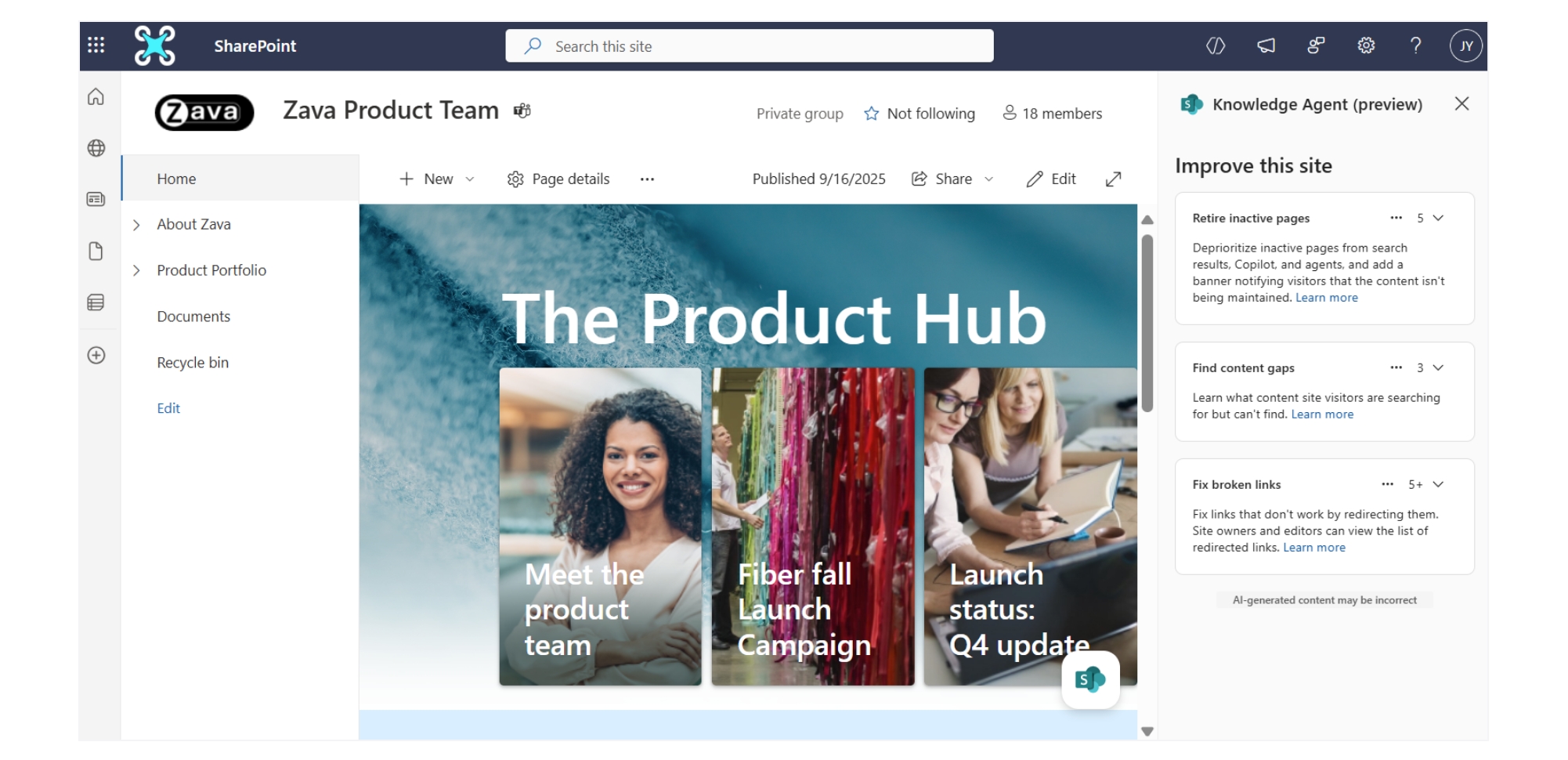
Jon Norris is the senior product manager responsible for the TechWeb Hub, our internal company resource for technical support and the primary vector for people to access our helpdesk organization. For him, the benefits of Knowledge Agent start with taking the manual effort out of existing processes.
He’s built Knowledge Agent into his regular maintenance workflows. For example, he now uses the tool to scan through sites every six months and identify sites and pages in need of retirement or a refresh.
“As site owners at Microsoft, we can now do almost everything we need in terms of content health without a third-party tool,” Norris says. “Of course, we’ve always had workflows in place to ensure the health of our sites, but the agent puts all of those key capabilities in one place while adding AI assistance into the equation.”
Create page from meeting
Anyone who’s tried to coordinate projects after a team meeting understands the grind of taking notes, assembling resources, and sending follow-up communications. The ability to create a SharePoint page from a Microsoft Teams meeting helps people capture next steps and takeaways.
This feature follows a similar process for creating a SharePoint page from a file. When meeting recordings and transcripts are enabled, users can access SharePoint’s “Create a page from AI” feature and select a meeting as their content source. The tool then reviews the transcript and generates a news page based on the meeting.

“Having key takeaways and next steps captured in a central durable place that you can point new and existing team members to is extremely valuable. It serves not just as a record of decisions made, but also as a great tool for onboarding new team members.”
Kripal Kavi, principal GPM, OneDrive and SharePoint
This feature uses any relevant materials from the meeting for context, including links to content shared in the meeting itself. Page owners can also prompt the tool to include material from other sources and augment the page as the team’s needs evolve.
Finally, this feature integrates with SharePoint News, so page creators can publish these resources through any vector that will engage their colleagues, like email, a Teams channel, or a Viva Amplify post.
“Having key takeaways and next steps captured in a central durable place that you can point new and existing team members to is extremely valuable,” Kavi says. “It serves not just as a record of decisions made, but also as a great tool for onboarding new team members.”
Different personas will find different aspects of Knowledge Agent helpful. For example, site managers will primarily be concerned with outdated content, while content managers often feel overburdened by creating AI-ready metadata. And content creators are always looking for inspiration on tight timelines.
Wrapping a layer of agentic support around these back-end SharePoint tasks helps make a variety of scenarios easier to tackle, ultimately with better results for content consumers.
Sections with AI
Sections with AI is a new SharePoint authoring tool that allows users to create full-fidelity SharePoint sections with just a prompt. It looks at the context of your page to offer suggested prompts to surface the content the page creator needs.
From there, they can write their own sections and ground them in relevant files to give the AI more context. When the creator clicks “Generate,” Sections with AI uses those sources, the knowledge and material already within the organization, and content already on the page to create rich sections. Creating content with Sections with AI
Creating content with Sections with AI
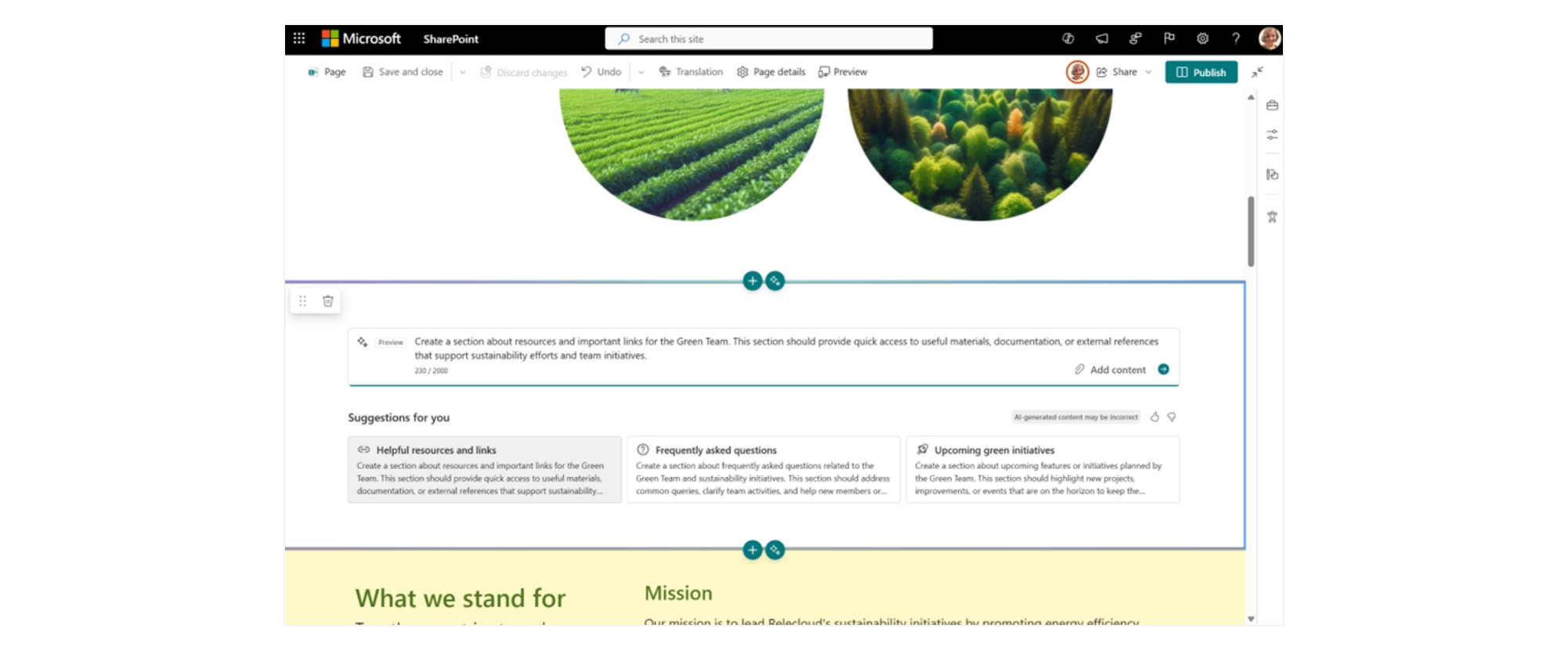
Within Microsoft, Norris has seen program managers and other professionals whose roles aren’t explicitly based around communications using this feature extensively. Their professional expertise isn’t necessarily in creating beautiful sites or effective text, so the AI provides a much-needed boost.
And for communications managers, it’s a way to accelerate and supplement their work.
“Page creation is great, but the majority of users spend their time updating and curating their content,” Norris says. “This feature doesn’t just help with page creation—it makes your existing content better and updating it easier.”
Sections with AI generates recommendations and prompts for the user and takes wider content into account, so it’s grounded and contextually aware. As a result, crafting a site with this tool represents collaborative iteration with an AI helper.

“This is enabling our program managers to spend more time creating the kind of content that that they want to work on and that our users want to consume. It’s having a real impact across the board.”
Jon Norris, senior product manager, Microsoft Digital
It’s a step forward into the agentic future in service of enterprise knowledge management and sharing.
The impact is that it’s taking toil off the plate our program managers who own our SharePoint sites, which is freeing them up to do more of what matters to them.
“This is enabling our program managers to spend more time creating the kind of content that that they want to work on and that our users want to consume,” Norris says. “It’s having a real impact across the board.”
Driving better experiences and greater engagement
SharePoint site owners and page creators are already experiencing the benefits of a more modern, AI-enabled experience. Within Microsoft Digital, they’ve shared that they’re already saving budget and time and creating more engaging sites.
There’s also a bigger picture than individual AI-powered features. Part of SharePoint’s modernization is about making knowledge and content accessible not just through pages themselves, but across the Microsoft 365 ecosystem, especially by publishing them to Microsoft Teams.
“By making SharePoint pages first-class experiences in Teams, site owners no longer have to push users to load a webpage,” Crewdson says. “Instead, they can reach their colleagues without interrupting the flow of work.”
“The initial feedback we are seeing from internal and external customers is super exciting. Our users clearly see the value in how these capabilities help reduce the painful manual work needed today while still maintaining human control of the final output and decision.”
Kripal Kavi, principal GPM, OneDrive and SharePoint
These AI-driven innovations are transforming SharePoint and empowering organizations to manage and share knowledge more efficiently and effectively than ever. At Microsoft Digital, we’ve already experienced their benefits. As AI-powered features in SharePoint continue to evolve, employees and site owners alike can look forward to even more engaging, productive, and streamlined experiences across Microsoft 365.
“The initial feedback we are seeing from internal and external customers is super exciting,” Kavi says. “Our users clearly see the value in how these capabilities help reduce the painful manual work needed today while still maintaining human control of the final output and decision.

Key takeaways
Try out these tips based on our experience at Microsoft Digital to start using SharePoint’s AI-driven features effectively.
- Rethink knowledge management: Discover how AI agents can leverage your organization’s knowledge as context to deliver engaging experiences using sources ranging from legacy content to yesterday’s team meeting.
- Promote peer-to-peer support: Enable your site owners to build a consistent community of practice through tools like Microsoft Viva Engage and Microsoft Teams channels.
- Encourage experimentation: Provide these features to your SharePoint site owners and page creators, and deliver concerted change management efforts so they can build experience and start to see their effects.
- Consider your users: Think about the business personas and scenarios where these features will be most useful, and highlight them in your change management efforts.

Try it out
Want to explore AI-powered features in SharePoint? Get started with a free trial of Microsoft 365.

Related links
- See how we’re supercharging our SharePoint sites at Microsoft with Microsoft 365 Copilot.
- Learn how we’re unlocking knowledge through intelligence: Lessons learned using SharePoint agents at Microsoft.
- Discover ways we’re boosting efficiency with SharePoint agents: How our Microsoft legal team is helping clients find answers faster.
- Explore how we’re reimagining content management at Microsoft with SharePoint.
- Find out how the modern SharePoint experience is making Microsoft’s HR portal more personal.
- Learn how we’re becoming an AI-first frontier firm at Microsoft.
- See how our employees are extending enterprise AI with custom retrieval agents.

We’d like to hear from you!


