
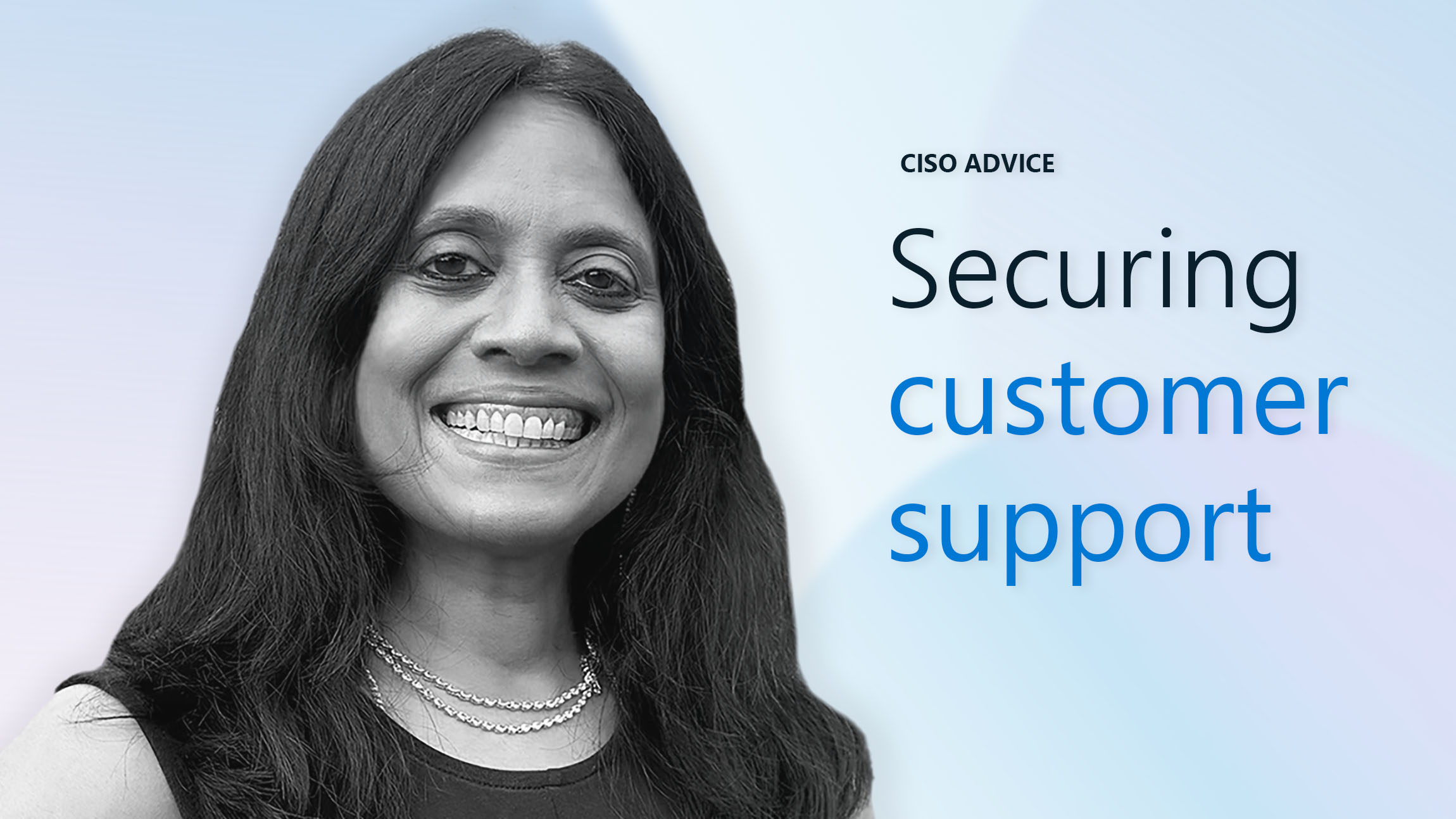
Microsoft business operations teams know all too well that cyberattackers seek to exploit customer support pathways. Tools that can unlock customer accounts or aid in troubleshooting issues in complex environments are a rich target.
“The path attackers really like to use is to compromise support tooling and laterally move to your core tooling,” says Raji Dani, Deputy Chief Information Security Officer (CISO) for Microsoft business operations.

Learn from our experience
The importance of hardening customer support tools against cyberattacks
Dani and her team focus on understanding and mitigating the risks within customer support operations. In this video, she shares principles and practices for every business that relies on online tools in their customer support ecosystem.

Key takeaways
Here are best practices you can apply to your customer support ecosystem:
- Create dedicated and isolated support identities. Use standardized support identities with phish-resistant multifactor authentication based in a separate identity ecosystem.
- Implement least privilege and enforce device protection. Only grant the access needed for a given task and nothing more.
- Ensure tooling does not have high privilege access to customer data. Architect secure tools and manage service-to-service trust and high privileged access.
- Implement strong telemetry. Anomalous patterns in logs and telemetry data are often the first clue a cyberattack is underway.

Try it out
Discover how to start applying Zero Trust practices to protect your customer support ecosystem.

Related links
- Explore more approaches for eliminating high-privilege access to enhance security.
- Review logging and threat detection capabilities.
- Find out more about phishing-resistant multifactor authentication.
- Read how we’re improving security by protecting elevated-privilege accounts at Microsoft.
- Check out how to use role-based access control to manage endpoint access.
