

‘Be the change’ for HIMSS21 Digital and beyond
With a theme of “be the change,” HIMSS21 had something for everyone, whether participants attended in person or online.

Frontier Transformation in healthcare means moving beyond AI pilots to redesign workflows with governance, trust, and scalable impact.

With a theme of “be the change,” HIMSS21 had something for everyone, whether participants attended in person or online.

It’s hard to believe another year of HIMSS is upon us and given the impact of COVID-19 on our society, we’ve all had to rethink how we approach connecting with community and engaging with audiences this past year. So, we are delighted that HIMSS21 will be offered both in-person and digitally—so everyone, everywhere can join together.

Over the past year, the pandemic fundamentally changed several industries and impacted the means of consumption and distribution for goods and services globally.

From the simple intimacy of a bedside conversation between a provider and a patient to the vast complexities of the global healthcare industry, data streams. A provider’s transcribed notes, statistics from clinical trials, genomics data sets, and imaging reports that shines light on the invisible, all of it, and more, flood the system with information.

The past year has brought dramatic change to almost every facet of our lives. We have seen the same disruption play out across every industry, from retail to healthcare to financial services. Customer expectations are fundamentally altered, and it’s hard to imagine things going back to the way they once were.

When communities have access to better data, they can make better decisions. However, progress has not been equal across the globe, and there is a great need to focus on societal issues such as reducing health inequity and improving access to care for underserved populations.
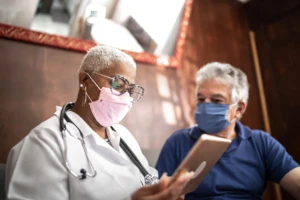
While many organizations define population health slightly differently, its core aim is to provide an opportunity for leaders in healthcare, agencies, education, and business to work together in order to improve the health outcomes in the communities they serve, all while making an impact to reduce the total cost of care.

COVID-19 caused a massive acceleration in the use of virtual health services and has helped expand access to care at a time when the ongoing pandemic has severely restricted patients’ ability to see their doctors. Virtual health technology is enabling healthcare organizations to reimagine how care is delivered and managed for the long term.

A little more than a year ago, on March 11, 2020, the World Health Organization declared COVID-19 to be a pandemic. Since then, COVID-19 has dramatically impacted every person’s life across the globe.

2020 was the year that challenged healthcare professionals to learn, adapt, and grow as they cared for patients through the COVID-19 pandemic. The concepts of quarantine and social distancing became commonplace, as virtual health and remote patient monitoring usage grew exponentially, operational limits stretched, and care collaboration became more important than ever.

The COVID-19 pandemic has negatively impacted our health, economy, and psychosocial well-being. Public health mitigation measures such as wearing masks, social distancing, avoiding large gatherings, and washing hands have demonstrated benefit in curbing the spread of infection, but have been implemented inconsistently and unevenly throughout the world, which has limited their effectiveness.

Today marks the start of RSNA 2020, the annual meeting of the Radiological Society of North America. I participated in my first RSNA 35 years ago and I am super excited—as I am every year—to reconnect with my radiology colleagues and friends and learn about the latest medical and scientific advances in our field.